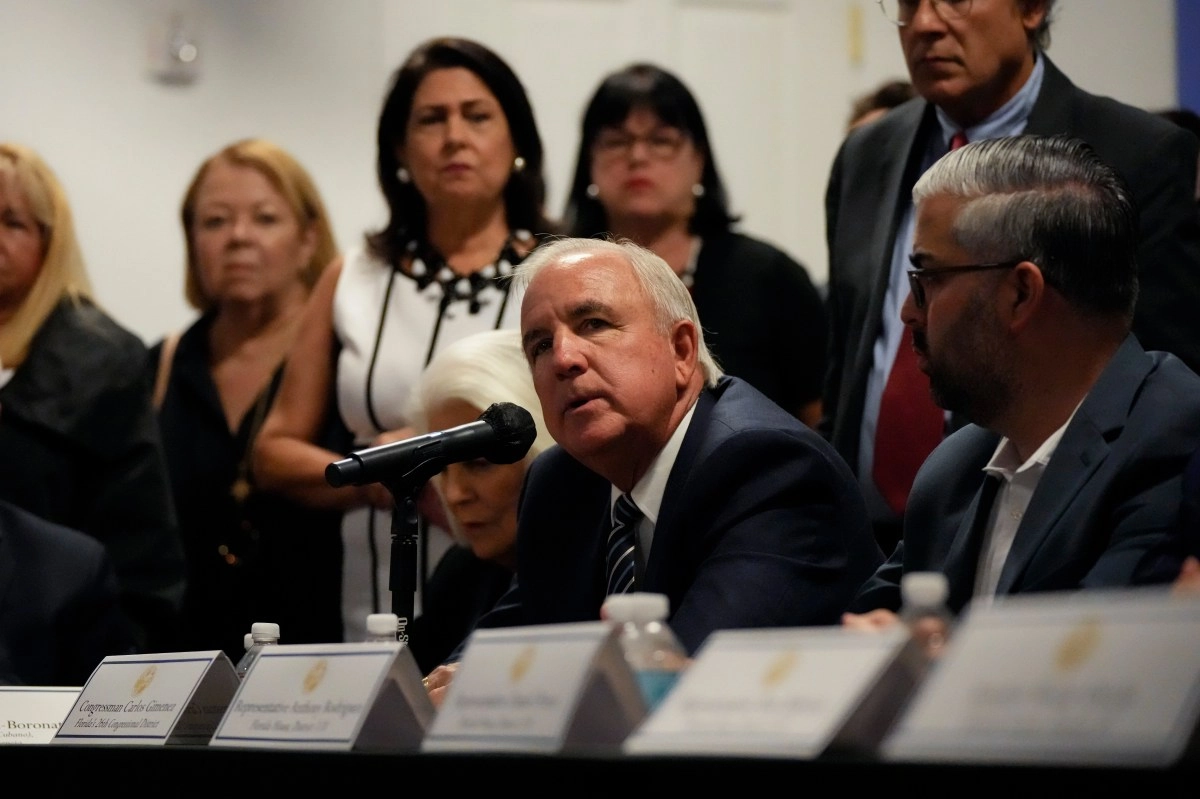

Mexico's decision to maintain sending humanitarian aid to Cuba opened a new front of political tension with Washington. Republican congressman Carlos Giménez, of Cuban origin, accused President Claudia Sheinbaum this Wednesday of “undermining” the pressure strategy of Donald Trump's government against Havana and warned that this position could have repercussions on the relationship between Mexico and the United States.
“From the US Congress, we denounce the corrupt misgovernment of Mexico for continuing to undermine US policy towards the murderous regime in Cuba,” Giménez wrote in Spanish on his X account.
The legislator maintained that Sheinbaum “is perpetuating the longest dictatorship in the region” and questioned whether Mexico would adopt that position while both countries face a stage of trade negotiations.
“Their terrible actions are not that of an ally when trying to renegotiate the T-MEC,” said Giménez, before warning: “They are not good neighbors and they will have to face the consequences.”
The congressman's statements came after Sheinbaum announced that Mexico is preparing a new shipment of humanitarian aid to Cuba, in the midst of the serious economic and energy crisis that the island is going through.
The Mexican position is not new. In February and March, Sheinbaum's government had already sent shipments of food and supplies through Mexican Navy ships. The Ministry of Foreign Affairs reported on March 27 that a fourth shipment, of more than 96 tons, carried mainly beans and rice to Cuba, bringing the accumulated shipments to 3,125 tons of humanitarian aid.
The Mexican government has insisted that its assistance is aimed at the Cuban population and that it is a humanitarian issue, not political support for the government of Miguel Díaz-Canel.
Sheinbaum herself explained in February that Mexico sought to keep aid to the Cubans separate from the diplomatic dispute over oil supplies. “This is not a matter of governments, but of support to avoid a humanitarian crisis in Cuba,” the president stated then.
Tension increased after Trump toughened his policy toward Havana. In January, the White House declared a national emergency related to Cuba and established a mechanism that allows additional tariffs to be imposed on countries that provide oil to the island. The measure sought to pressure the Cuban government and limit its external fuel sources.
Giménez has become one of the most active Republican congressmen in favor of a policy of maximum pressure against the Cuban government. In January he even asked Washington to suspend flights, remittances and oil shipments to the island, arguing that these measures could increase pressure on the regime to promote a political transition.
The clash with Mexico takes on greater relevance because Trump's policy towards Cuba has gone beyond economic sanctions. The US president has publicly raised the possibility of taking control of the island, while his administration maintains a strategy aimed at pressuring the Cuban government to undertake political and economic changes.
Hence, the confrontation raised by Giménez occurs, therefore, at a time when Cuba becomes a new point of friction within a Mexico-United States relationship that is already facing a complex trade renegotiation. And although the congressman speaks of possible “consequences,” his statements do not in themselves represent an official decision by the Trump administration on the relationship with Mexico.