

“The US will not use nuclear weapons in the war against Iran; nobody should ever be allowed to use them”...
For Trump, the military campaign has achieved 75% of its strategic objectives and Tehran's defensive capabilities have been virtually neutralized
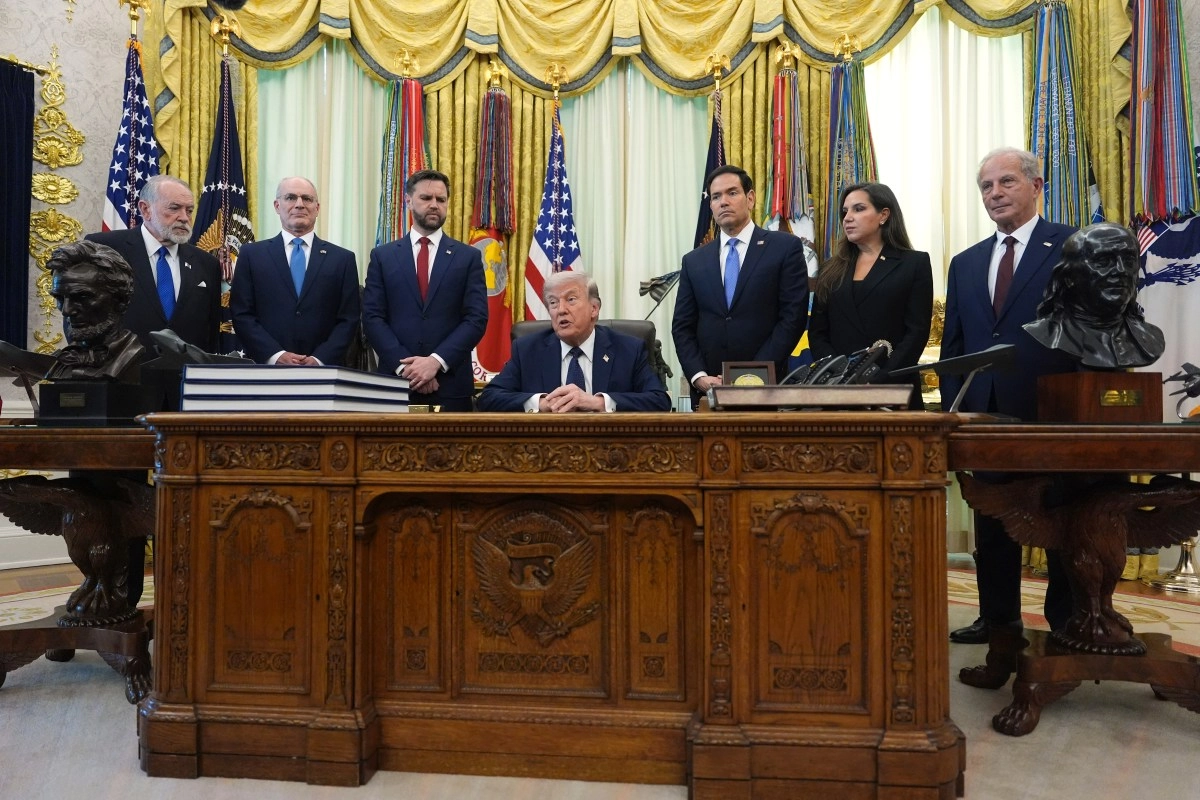

President Donald Trump assured that his administration does not contemplate the use of nuclear weapons in the conflict with Iran, while defending the conventional military strategy implemented so far.
During statements to the press at the White House, the president rejected He categorically ruled out that possibility when questioned about a potential nuclear scenario. "Why would I use a nuclear weapon? We have completely decimated them in a very conventional way," he stated. "No, I would not use it. Nobody should be allowed to use a nuclear weapon," he added. The statements come amid a conflict that has escalated since late February, when Washington launched military operations against Iranian targets, arguing that it was necessary to curb Tehran's nuclear development. Defense of military strategy and pressure for an agreement: Trump insisted that US forces have significantly weakened Iranian military capabilities without resorting to nuclear weapons. According to the president, Iran's navy, air force, and air defense systems have been virtually neutralized. Even so, he acknowledged that during the recent two-week ceasefire, Iran may have partially strengthened its military capabilities. However, I have asserted that any recovery could be quickly reversed. “Perhaps they have strengthened a little, but we would eliminate them in a day,” he maintained. The president also made it clear that he does not feel immediate pressure to reach a peace agreement, despite the prolonged tensions and their economic effects. "I could close a deal right now, but I don't want to. I want it to be a lasting agreement," he noted. Negotiations between the two sides remain stalled, with no set date to resume formal talks. Meanwhile, the ceasefire has been extended indefinitely by a unilateral decision from Washington.
Tensions persist despite ceasefire
The conflict continues to generate friction at strategic points, particularly in the Strait of Hormuz, where Iran maintains restrictions on maritime traffic,while the United States has responded by limiting the passage of vessels linked to Iranian ports.
Trump defended the economic cost of the confrontation, arguing that the main objective is to prevent Iran from developing nuclear weapons. “What the Americans get is an Iran without the capacity to destroy one of our cities or destabilize the entire region,” he stated.
The president also reiterated that Tehran must not possess nuclear weapons under any circumstances, a stance that has been central to his foreign policy in the Middle East.
Despite his firm rhetoric, the president has combined warnings with signs of openness to negotiation.
He indicated that his administration maintains contact with Iranian representatives, although he described the Iranian government as “looked in chaos.” Analysts in Washington believe that the recent statements aim to send a double message: maintaining military pressure while leaving the door open to a diplomatic solution. However, the lack of concrete progress in the negotiations maintains uncertainty about the duration and outcome of the conflict.