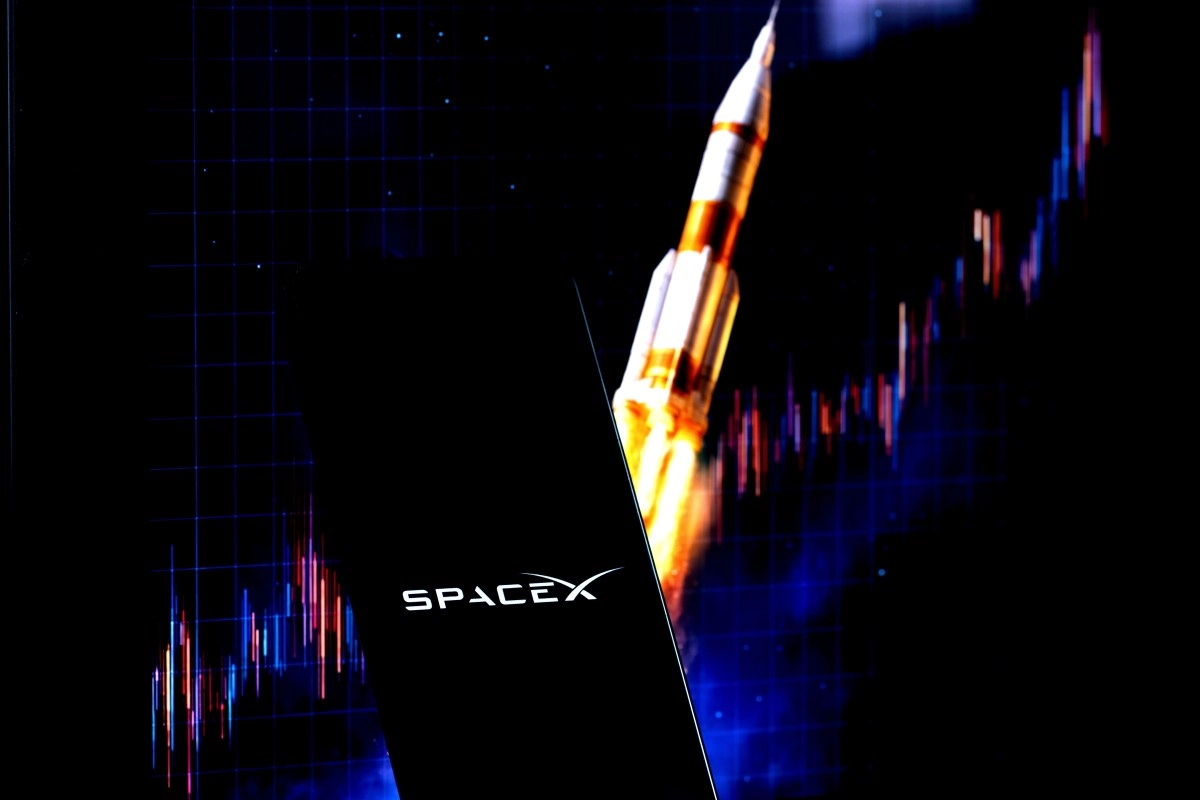

SpaceX had a historic debut on Wall Street, after the aerospace company founded by Elon Musk registered a strong rise in its first day as a public company, driven by investor enthusiasm after starring in the largest initial public offering (IPO) in history.
The shares began trading on the Nasdaq under the symbol SPCX and opened at a price of $150 per share, closing the session at $160.95, which represented an advance of 19% compared to the offer price of $135 set a day earlier. During the day they reached a maximum of $176.52 dollars, equivalent to a gain of close to 31%.
“As is the case with most IPOs, the price skyrocketed,” Jay Ritter, an expert on initial public offerings and professor at the University of Florida's Warrington College of Business, told CBS News. “This is not a miracle operation, but given the size of the transaction, if the share price holds up, the initial return will be higher than any other IPO in history.”
This historic rebound was largely due to interest in the company, which was reflected in the volume of operations. During the day, more than 500 million shares changed hands during the first day of trading, a figure comparable to some of the largest stock market debuts in the technology sector.
The IPO allowed SpaceX to raise $75 billion, far surpassing the previous record set by Saudi Aramco in 2019. After the close of trading, the company reached a valuation close to $2.1 trillion, placing it among the most valuable companies listed on the financial markets.
The plans that drive SpaceX
The company seeks to use the resources obtained to accelerate some of its most ambitious projects. These include the expansion of its satellite network, the development of artificial intelligence infrastructure in space and its long-term goal of establishing a human presence on Mars.
“Whoever is looking at this, SpaceX wants to be able to take it to the Moon, take it to Mars and, ultimately, beyond,” said Elon Musk, founder and CEO of SpaceX, during an event at Starbase in Texas.
On Friday, Musk and Gwynne Shotwell, president and chief operating officer of SpaceX, participated in opening ceremonies tied to the company's stock market debut.
Founded in 2002, SpaceX began as a manufacturer of reusable rockets and currently provides launch services for satellite operators, government agencies and commercial customers. In addition, it controls Starlink, its satellite internet business, considered one of the company's strongest areas.
Musk also noted before the IPO that SpaceX has been generating positive cash flow since around 2015 and that the company is now entering a new stage of growth. Its goals include deploying more than 100,000 communications satellites and developing data centers powered by artificial intelligence in orbit.
Challenges behind the historical valuation
Despite the market's enthusiasm, several analysts believe that the company still faces significant challenges to justify such a high valuation. SpaceX has not yet reported net profits and, according to documents filed for its IPO, has accumulated losses of more than $41 billion since its founding.
“I understand the arguments for a lower valuation for this company,” said Matthew Kennedy, senior market strategist at Renaissance Capital. “It's also true that some stocks are expensive and stay that way.”
Experts also anticipate that stocks could experience volatility in the coming weeks, a common situation following large initial public offerings.
“The issue with SpaceX is not so much the immediate post-IPO listing, but rather how the price will hold in the long term,” said Samuel Kerr, global head of ECM at Mergermarket.
Meanwhile, Tesla shares rose 1.8% to $406.43 on Friday. The electric vehicle maker's market capitalization now stands at around $1.5 trillion.
Time will tell what will happen with SpaceX and with all the investment achieved; In another sense, we will see if that represents gains or losses for those who decided to put their money in the company.
You may also be interested in: