
The idea raised by Dr. Oswaldo Zavala usually generates a reaction of disbelief or rejection when one hears: “Drug cartels do not exist.”
For residents of Latin American countries or the United States, who constantly receive news about drug trafficking organizations and their leaders, such a statement seems inconceivable.
For decades, such organizations have been accused of moving tons of drugs, profiting from substances that cause addiction and death. And the violence generated by a business that has cost the lives of tens of thousands of people.
The big bosses have been classified as de facto rulers of territories, which has made them the protagonists of songs and television series.
But Zavala, a Mexican researcher, author and professor at the City University of New York, maintains that it is not about denying the problems around drug trafficking, but about thinking beyond the deep-rooted idea of cartels. And he points to Washington and its agencies as promoters of a “narrative.”
“We talk about the phenomenon of drug trafficking using the language that has been determined by the institutions that have militarized countries like Mexico,” Zavala tells BBC Mundo.
“When we talk about cartels, the only thing we really achieve is to legitimize the same militarization and military violence that we are suffering in Latin America,” he adds.
Zavala is a critic of the military strategy to combat drug trafficking, which he blames for being partly responsible for the violence in Mexico.
"When someone says 'cartels don't exist,' people even get offended. 'How are you going to say that?' It's another sign by which you realize that the discourse is so deeply rooted hegemonized," he says.
In conversation with BBC Mundo, Zavala explains his point of view on the ideas and language around drug traffickers and which he portrays in his book “The cartels do not exist” (2026).
If cartels don't exist, what does exist? Because there are people who experience violence very closely and who perhaps would wonder what is there then.
I am not saying that there is no drug trafficking, that the traffickers are not really there or that they do not matter. None of this is what I'm really saying.
What I am saying is that when we talk about the phenomenon of drug trafficking, using the language that has been determined by the institutions that have militarized the country, the only thing we really achieve is to legitimize the same militarization and military violence that we are suffering in Mexico.
That language is in itself the mechanism to legitimize violence, to feel so unprotected by these all-powerful drug traffickers that we need the army to come.
Really, when one resizes the size of what we call drug trafficking, one really begins to understand that it is actually an issue to think about issues of addictions, of drug use.
It should not be seen in Mexico as a national security problem, which has been part of the US agenda since the 1980s, but rather it should instigate that debate among us.
What we have to do is rethink our anti-drug policy and our security policy, without the army being activated all the time, without the army patrolling with little oversight, without the army occupying places in civil society.
We have to consider what are the real reasons for the social unrest that Mexico is experiencing.
Some of what you maintain is that the bosses are not as all-powerful as they appear, but in reality they have and exercise significant power at a regional, national and local level.
There are many things and dynamics of violence that are very complex. But many times what we see in some of the most violent environments, especially in Jalisco, in Tamaulipas, in Guerrero, this idea of a cartel occupying the State appears.
But what we see with great concern, and it is something that is not just me, is a process of paramilitarization that we are not really understanding.
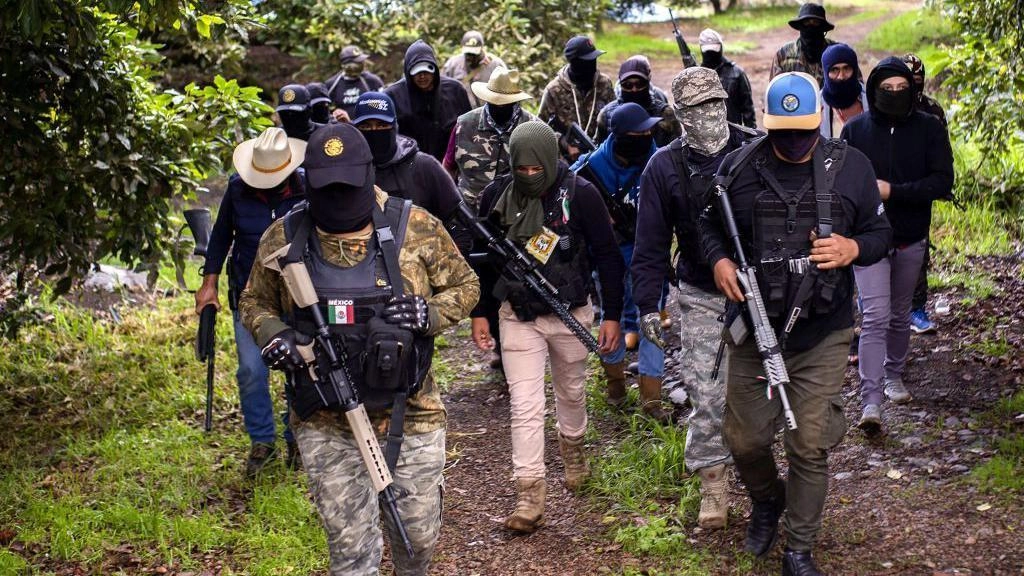
What we are not seeing is how these paramilitary groups operate, which we often see exercising certain propaganda on social networks, appearing with military equipment, armored trucks, etc., making spectacular use of violence.
We saw it in a worrying way after the death of Nemesio Oseguera “El Mencho”, with the 250 riots throughout the country.
Precisely this violence appears before us as a spectacle. After supposedly 250 groups of people go out to break things, set cars or businesses on fire, etc., protesting the death of “El Mencho”, the only thing left for the astonished citizens is to ask for more militarization.
And that is very worrying to me, because from there it is assumed that the violence that the country is experiencing is strictly being carried out by traffickers, which we do not know.
We assume that the solution to this violence is the army, which we know is not real. On the contrary, it is one of the main problems.
So I believe that we must go beyond the fear, the provocation, the scandalous visual appearance of those armed traffickers who flood social networks and try to truly understand these processes of violence.
And don't the drug traffickers themselves end up assuming themselves to be all-powerful?
They assume it because the idea of a drug trafficker, of a cartel, is so internalized in all of us that the criminals themselves would like to attest to it.
In my book “The cartels do not exist” I remember, for example, the ironic and quite sad and pathetic moment in which “El Chapo” meets Kate del Castillo [2015], the actress who starred at the time in the famous soap opera “La Reina del Sur”.
And he has the hope that she will make a film that makes the myth of “El Chapo” Guzmán a reality on the film set.
That moment is very eloquent and the way in which anti-drug policy operates is very sad, because that meeting actually takes place precisely on a strictly symbolic level, in which “El Chapo” wants to meet “The Queen of the South” and “The Queen of the South” wants to meet “El Chapo”, which is also another myth, created by official institutions.
So, neither of them can see the humanity of the other, both are lost in this universe of symbols, of criminalization, of organized crime that are created by the institutions that are going to end in an offensive not only against “El Chapo, but also against Kate del Castillo, who was later accused by the Mexican government of having collaborated with the trafficker.
So it is very interesting, because what it shows us again is that the entire society is mediated by a hegemonized understanding of drug trafficking and that it is very difficult to get out of that mediation, even though we have many tools, a lot of evidence, to understand the violent effects of anti-drug policy. We are still trapped in their echo chamber, in their fantasies.
The original concept of a cartel, which was this confederation of mafias that come to an agreement, is also not what exists today in your opinion?
It is a concept that comes from the economic field and that the DEA took up at the end of the 70s, because that was the imaginary that circulated especially for Americans when they heard the word cartel.
They imagined these Arab oil-producing countries manipulating the price of a barrel and exerting geopolitical tension in which the United States was at a disadvantage.
So, when you say “there are drug cartels in Latin America,” you imagine dark, criminal people who are collaborating to send a toxic product, like cocaine and marijuana at the time, and now fentanyl and synthetic drugs. People who operate almost in a continental conspiracy to harm American society.
The word cartel was deliberately conceived as a propaganda method to scare people, to create a perfect enemy in Latin America.
But the word cartel was not invented by the traffickers. The last to find out that they were in a cartel were the traffickers themselves.
Now more recently you do have young delinquents who, perhaps because that mythology is so in the air, also participate in it in the same way that you and I consume it.
So there are kids who, unfortunately, in this precarious criminal situation, would like to imagine themselves as part of a cartel. And that is perhaps the most dramatic and saddest part of all this: that our most vulnerable, most unprotected youth resorts to a myth to feel empowered for a moment in their lives.
It is also the myth that ends up destroying them. In the name of a cartel, poor racialized youth have been disproportionately murdered in Mexico.
The cultural products of the 80s, 90s or earlier did not talk as much about cartels, or not as with social networks and series platforms today.
Part of what we call narcoculture, sometimes in such a loose way, in reality I believe it refers to the cultural processes that develop alongside, or at the same time, these dominant discourses around drug trafficking.
So, if we go back in time and look at the 70s and 80s, movies and popular music appear, the famous narcocorridos, with quite precarious, quite humble traffickers.
In one of the famous narcocorridos [“Contrabando y Traicion”, by Los Tigres del Norte] he says that “the car's tires are full of weeds”, etc.
They were not large shipments and were small stories that rather functioned to alert citizens in a fairly conservative way that drug trafficking was a truly dangerous profession and that it was not worth it because you were going to end up in prison or worse: dead,
And what is interesting is that this was said in that decade because in the official discourse in Mexico, drug trafficking did not appear as a threat to national security either.
And because in the United States it was not until the late 80s that people began to talk about drug trafficking in that way with President Ronald Reagan.
Although President Richard Nixon is the one who established the DEA and began the fight against drug trafficking in a more determined way at the national level in the United States, Reagan at the end of the 80s began to designate traffickers as threats to national security, and that is where the imaginary of the all-powerful drug trafficker began.
Then a few years later, in 1997, we already have the great bullfight of the Tigres del Norte, “Jefe de Jefes”.
They already imagine traffickers as real threats to national security and that radical change that goes from the poor traffickers of the 70s, who are killed by the sheriff, to the 90s, where you have those traffickers who are even capable of buying the presidency of the country.
And it is not because the traffickers have increased in power.
What you see is a change in the discourse, in the way of talking about them. And the way in which the power of drug trafficking is now presented to us from official institutions, first in the United States and later in Mexico.
And hegemonic discourses are established in such a dominant way that people spontaneously repeat them.
If you go to Mexico right now and ask anyone what they think about drug trafficking, they tell you that they are very powerful, they are in control of the country, which is the same as the State. What's more, the State is the drug trafficker. The same thing that they tell you is going to be said in Spain by a man who is asked the same question about Mexico.
What is extraordinary is that this idea that drug trafficking is extremely powerful and that it captures the State has already been accepted, it has been internalized to such a degree that people accept it without further need for verification.
And that's why people who write scripts for television, who make music, etc., have it completely under their skin and reproduce it.
What do you think is behind sustaining what you call narrative?
There are many things, such as the benefits that the war on drugs brings as a policy. And the first, of course, is that it is an intervention mechanism.
The US government uses anti-drug policy and the imaginary of anti-drug policy, convincing citizens that drug traffickers are very powerful, to change governments in their favor.
A government that does not align with Washington is a government that is penetrated by drug trafficking; A government that does align is a just government, it is a correct government.
Aligning often means delivering strategic resources to the United States, letting the United States intervene in an excessive way, without leaving gains for the country in return.
The looting, the plundering of natural resources and of course the profit that militarization implies.
It is not only the frequently talked about arms smuggling from the United States to Mexico, but the transfer of equipment, training and weapons from the US government to armed forces, including state and municipal forces, in Mexico.
And all of this has an expense and it is really the transfer of public to private money many times, because all types of weapons from private companies are used, but what it also implies is the almost total militarization of the country.