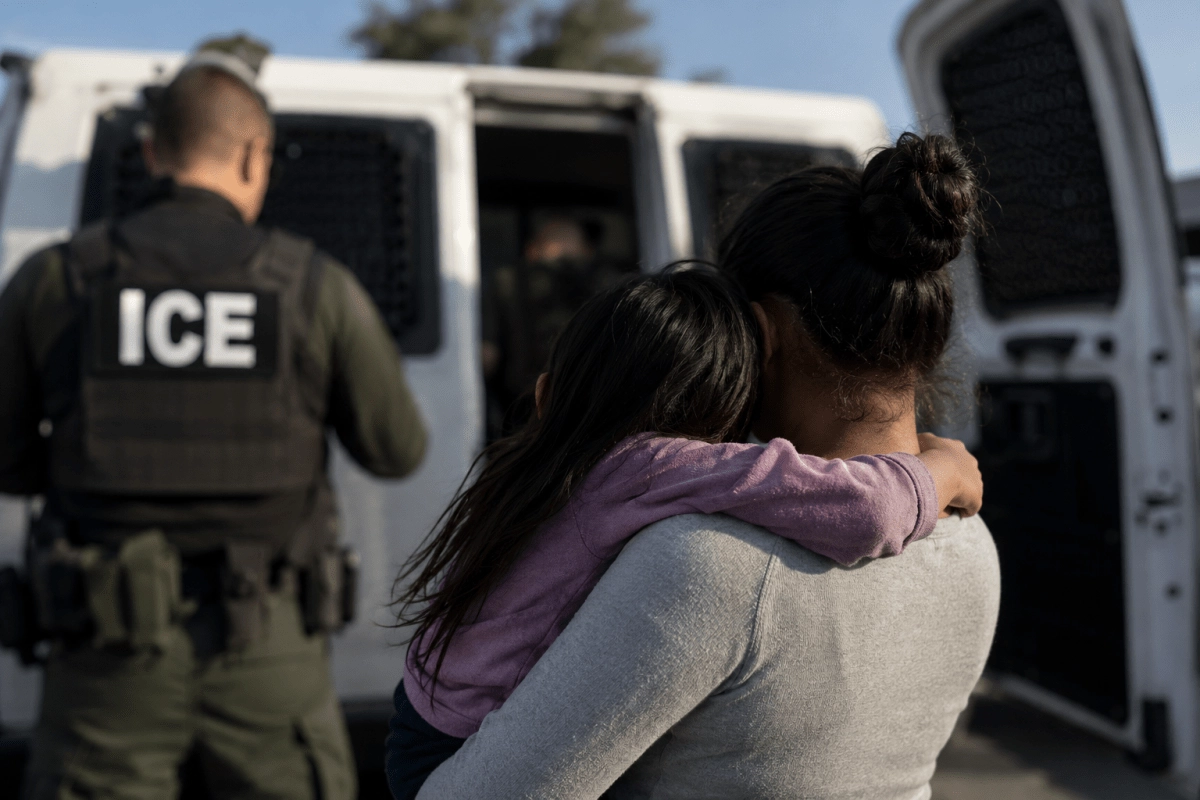

The system created in the United States to reunite migrant children with their families came under strong question after an investigation that revealed the use of sensitive information for immigration operations.
According to an exclusive report by Reuters, the Office of Refugee Resettlement (ORR) has shared more than 460,000 investigative records since January 2025 with ICE, the agency in charge of enforcing immigration laws within the country.
These data included information on unaccompanied minors, their sponsors—in many cases fathers, mothers or other relatives—and also other adults living in the same household.
According to internal documents cited by Reuters, that information was linked to more than 12,000 arrests made by ICE.
You can see: New immigration plan, a proposal by Gabe Vásquez that defends immigrants and the border
The program that sought to reunite children with their families
The ORR depends on the Department of Health and Human Services (HHS) and is tasked with receiving and housing migrant minors who arrive alone in the United States, until they can be released to a sponsor. Typically, that sponsor is a father, mother, older brother, uncle, grandparent or other adult who assumes responsibility for the child while the child's immigration process progresses.
To approve delivery, the agency requests personal documents, contact information, household history and even fingerprints or DNA tests in certain cases. The formal objective of this control is to prevent minors from ending up in the hands of traffickers, abusers or people who do not have a legitimate relationship with them.
For years, that information was considered part of a child protection process. The Reuters investigation maintains that, under the current policy, these same data also began to be used as input for immigration control actions.
You can see: New asylum rule seeks to “pressure people to give up their cases and accept deportation,” warns AILA
What the Reuters investigation discovered
Reuters reported that, since January 2025, the ORR began sending more than 460,000 tips, leads or records to ICE for investigation. These are not necessarily 460,000 different people or 460,000 arrests, but rather entries of information linked to minors, sponsors or other household members.
From that data stream, ICE made more than 12,000 arrests, according to internal figures reviewed by the agency.
The investigation adds a key nuance: the arrests were not limited to people with serious criminal records or suspicions of child trafficking. They also reached relatives who, in many cases, had appeared before the government precisely to try to reunite with a child.
This finding opened a sensitive debate: whether the system that was supposed to facilitate family reunification can become, at the same time, a way to locate and detain those who try to take care of the minor.
You can see: What to do with your children if ICE arrests you: key steps for immigrant families
The case of a mother who recovered her daughter and was later arrested
One of the episodes reported by Reuters is that of a Mexican mother who handed over documents, fingerprints and a DNA test to recover her six-year-old daughter. Days after completing the reunification, both the mother and the girl were detained and transferred to a family center in Texas, according to the investigation.
The case illustrates the fear that, according to lawyers and immigrant advocates, began to spread among many families: coming forward to sponsor a minor could facilitate reunion, but also expose adults to detention or deportation.
Reuters also described other cases of families who, after providing their data to the official process, were targeted by immigration authorities.
The government defends the exchange of information
According to Reuters, the government maintains that the data exchange seeks to protect minors and locate situations of possible risk, such as deliveries to unverified sponsors or to people with a record.
From that perspective, sharing information with ICE would be a tool to detect fraud, human trafficking or cases in which a minor ends up in an unsafe environment.
However, former officials and organizations that work with migrant children warn that the practical consequence could be different: that eligible family members stop showing up for fear of being arrested, and that children stay longer in federal shelters.
You can see: Only 3% of those recently detained by ICE had a history of violent crimes, report
Children spend more time in custody
This possible effect already appears in other relevant data cited by Reuters. The average time that minors remain in ORR custody would have increased dramatically.
According to the research, the average length of stay increased from around 30 days in fiscal year 2024 to 194 days in June 2026.
Although the tightening of controls would not be the only factor behind this increase, the figure suggests that the sponsorship and delivery system became much slower. For lawyers and defenders, this can translate into more separation time, more uncertainty and greater emotional difficulties for children who have already gone through extremely vulnerable situations.
Why this issue worries migrant families
The news hits a particularly delicate point for the immigrant community: the fear that going to the government to protect a child or family member will end up leading to detention.
In the case of unaccompanied minors, the sponsor is often the only way for the child to leave the shelter and live with someone they trust. If potential sponsors fear arrest, the system can be blocked at its most basic core.
Furthermore, the exchange of information raises a broader discussion about the use of personal data provided in humanitarian contexts. For many advocates, it's one thing to investigate trafficking or abuse networks; another, very different, is to use information provided for family reunification as a basis for broader immigration operations.
What the agency in charge of minors said
According to Reuters, the ORR maintained that it is not directly involved in arrests of children and that immigration enforcement decisions correspond to the Department of Homeland Security.
That point is important: the health and resettlement agency does not carry out detentions itself. The question arises from the transfer of information to ICE and the consequences that this exchange may have for sponsors and families.
The Reuters investigation is likely to intensify pressure on the federal administration and on agencies involved in the care of migrant minors.
For now, what is evident is that the border between child protection and immigration enforcement has become much more blurred.