

This is how Russia attracts foreign soldiers to fight against Ukraine
Russia is increasingly recruiting men from poor countries to send them to the front in the war taking place in Ukraine. Why are there people who accept it?
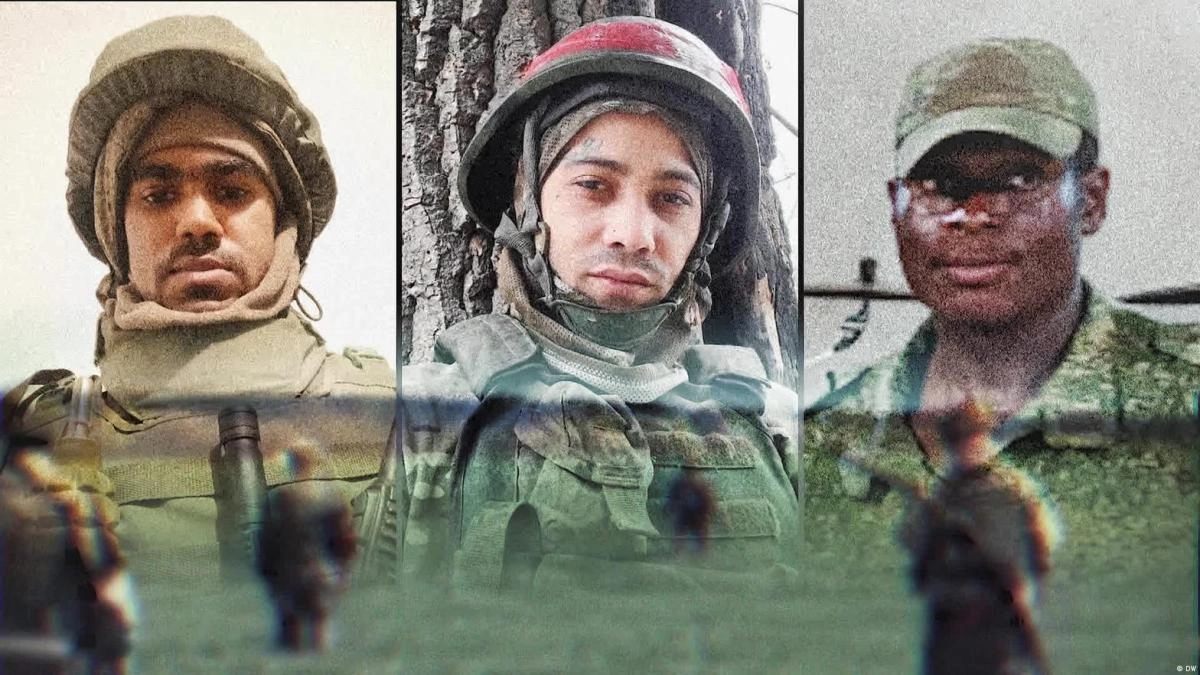

At 72, Charles Mutoka is mourning his son, Oscar Khagola Mutoka, a former soldier who traveled to Russia in 2025 in search of work.
His father said he tried several times to dissuade him, with no luck. Oscar didn't tell anyone exactly where he was going, but a week after leaving, he sent a photograph of himself in a combat uniform. He never contacted me again.
His family learned of his death some time later, and despite calling the Kenyan authorities, they were never able to recover his body. Others were luckier.
In May 2026, the family prepared a makeshift burial site, to at least have a place to pray. "The worst thing is that I can't even imagine it. Is he buried or was his body thrown into some forest in Russia?" asks Charles Mutoka.
Oscar is just one of nearly 27,000 foreigners recruited by Russia for its war in Ukraine, according to Ukrainian Intelligence. A joint study carried out by the International Federation for Human Rights (FIDH), the organization Truth Hounds and the International Human Rights Office of Kazakhstan provides evidence that Russia has established a global network for the recruitment of foreigners.
"This recruitment targets vulnerable people around the world. The methods used to attract these people range from bribery to deception and coercion," Ilya Nusov, one of the authors of the study, told DW.
“I don't want to die of hunger in Cuba”
For many people living in the most impoverished regions of the planet, the salary offered by the Russian armed forces is a great incentive, as it means an opportunity to escape poverty. Precisely for this reason Yoan Mendoza decided to accept the offer, like other Cubans. The Russians promised him a salary of $1,990 a month, a huge sum by Cuban standards, where the average salary is $19.9 a month.
DW learned about Mendoza's story through his brother Michael, who lives in the United States. Yoan had tried to emigrate to that country, but it was impossible due to financial and bureaucratic obstacles.
Then the Russian offer appeared. "Yoan called me and told me that he had found a way out. He told me about a project in Russia," said Michael, who told DW that he had tried in vain to change his brother's mind.
In September 2023, the Reuters agency filmed young Cubans who wanted to go to Russia. Among them was Yoan, 23 years old at the time. He told reporters that he knew perfectly well where he was going and that he did not want to stay and starve in Cuba. He also showed a document that was purported to be an employment contract with the Russian armed forces, which would also grant him citizenship.
Michael says his brother was sent to the front in Ukraine and then tried to escape. “He begged, said he had made a mistake and asked us to get him out of there quickly,” he says. Afterwards there was no more contact. Yoan's name later appeared on lists of foreigners killed in combat published by Ukraine.
“They used us as human shields”
Although Mendoza and Oscar Mutoka probably knew they were going to war, many other foreigners are deceived with promises of jobs in construction, security, logistics or agriculture.
This is what happened to Arman Mondol, from Bangladesh. He wanted to work abroad to lift his family out of poverty. His father, a farmer, sold some property and took out a loan to pay a recruiter. Mondol was told he would work as a packer in a warehouse. On a tourist visa, he traveled via Saudi Arabia to Russia. Once there, they forced him to sign a contract in Russian, a language he naturally did not understand.
Mondol said he and other foreigners had been mistreated in the army. "When we were on a mission, they always sent us ahead while they stayed behind us. They used us as human shields," he told DW.
During one of those missions, his vehicle ran over a mine. He was one of the two survivors and was taken to a hospital, from where he managed to escape. The Bangladesh embassy in Moscow helped him return home, but the war continues to haunt him.
"I still have those images in my head: people dying, their faces disfigured. How they were torn apart by mines. How there was one drone attack after another. How they lost their limbs. It was horrible," says Mondol, who still has shrapnel in his leg and limps noticeably. Back home, he has not found a job.
Mercenaries or victims?
Foreigners fighting for Russia in Ukraine are often called mercenaries. However, Ilya Nusov explains that, strictly speaking, this is not what they are, according to international law, since many times these people adopt Russian citizenship before joining their armed forces.
Others, however, had no intention of fighting. If they were recruited under false promises or coercion, they could be considered victims of human trafficking. This violates the United Nations Convention against Transnational Organized Crime and the Palermo Protocol, which prohibits human trafficking and has been ratified by almost the entire world, including Russia.
Russia has insisted that all foreigners participating in the war do so voluntarily. In March, Russian Foreign Minister Sergei Lavrov said during a press conference with his Kenyan counterpart that “no one is being hired, so no one is being recruited to participate in the special military operation,” which is what Russia calls its aggression against Ukraine. “The volunteers arrive in full compliance with Russian legislation,” he added.
Foreigners' involvement in the war is receiving increasing attention, with their families protesting from Nepal to Peru. Some politicians, including Indian Prime Minister Narendra Modi, have even raised the issue in meetings with Russian leader Vladimir Putin. According to media reports, Russia restricted the recruitment of citizens of several “friendly” countries in February 2026. A list of such countries has not been published.