
The arrival of the train to Macondo begins as a party. The town that lived isolated for years is finally connected to the rest of the country and sees inventions, visitors and new possibilities descend from the wagons. In the second part of “One Hundred Years of Solitude,” however, that image also contains the fall that will come later: through the same route will arrive the banana company and a form of progress capable of transforming life until it becomes unrecognizable.
Netflix released the second part on August 5, 2026 with seven episodes. The special that will conclude the adaptation will premiere on August 26. The first part, made up of eight chapters, had arrived in December 2024. With the final chapter, the production filmed in Colombia will complete the Buendías' journey from the founding of Macondo to the fulfillment of their destiny.
The project has a unique weight because it is the most emblematic work of Colombian literature and a novel that Gabriel García Márquez resisted for decades from delivering to audiovisual format. He was concerned that the image would establish the characters and spaces that each reader could imagine. In 1987, however, he even said that he could imagine it as a long-running television series for years. After his death, his sons Rodrigo and Gonzalo accepted the adaptation and joined as executive producers.
The question about whether it was necessary to adapt it is inevitable and also recently accompanied “Pedro Páramo,” the film that Rodrigo Prieto directed based on the novel by Juan Rulfo. In both cases, the question is useful when it forces us to measure what the screen adds and what is lost when converting a literary voice into bodies, landscapes and sounds. This second part gives its best answers in Macondo's physical transformation and stumbles when fidelity to the words assumes that the tone will sustain itself.
Laura Mora directs episodes 1, 2, 5 and 6 of this installment, in addition to the grand finale; Carlos Moreno was in charge of chapters 3, 4 and 7. In an interview with La Opinión, both described a production that had to complete half a century of history, incorporate a new generation of characters and resolve some of the most recognizable images of the novel: the rise of Remedios la Bella, the arrival of the train, the massacre of the workers and the flood.
Progress brings politics to the center of Macondo
The story returns to the Buendías after the armistice signed by Colonel Aureliano. While the conservatives prepare an attack against him, a succession of events takes Fernanda del Carpio to Macondo. Her marriage to Aureliano Segundo incorporates her into a house ruled for decades by Úrsula Iguarán. At the same time, José Arcadio Segundo manages to bring the railroad to the town and, without knowing it, opens the door to the banana company.
Mora, who had directed three episodes of the first part, assumed the creative direction in this installment and was in charge of five chapters. He returned to the writers' room, participated in the rewriting and sought to make each episode work as a film with its own personality. His challenge, he explained, was to make the staging more complex at the same pace as the novel and “return the political character to the work.” That decision is perceived in a more confident narrative of the crowds, the war, and the physical deterioration of the town.
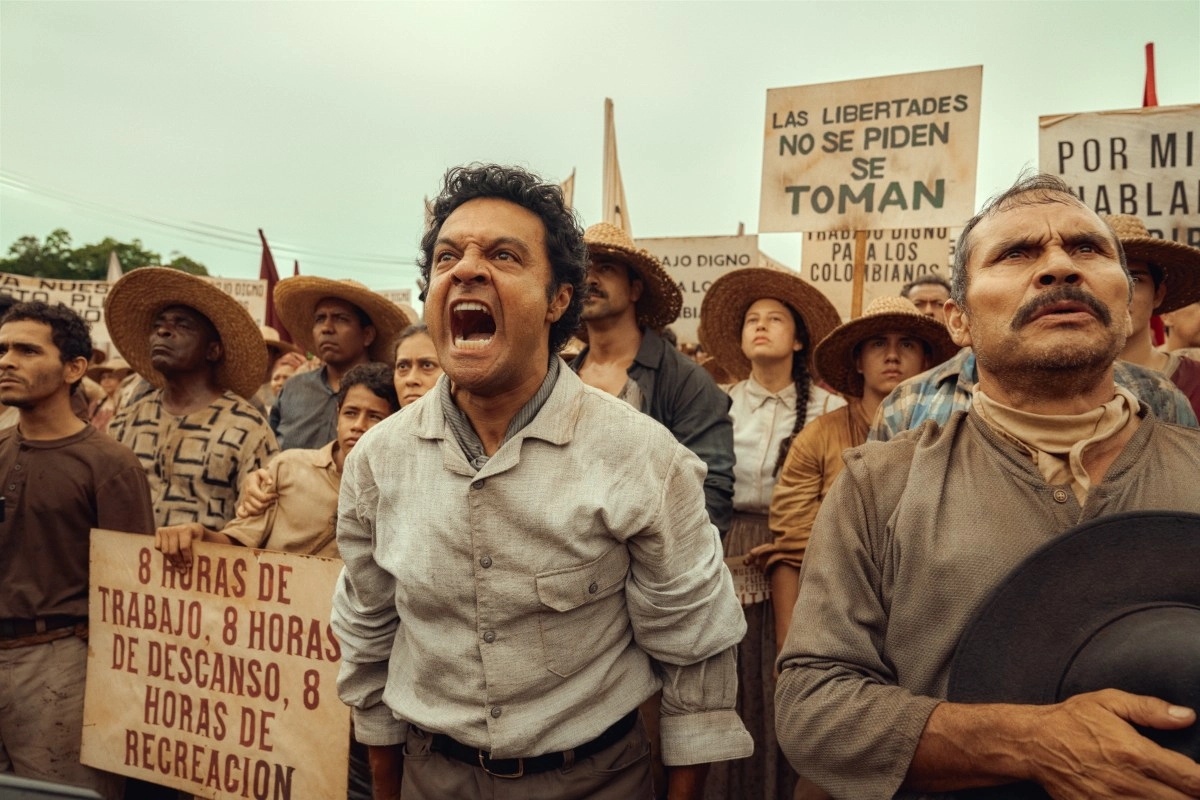
On screen, the second part seems more successful in production. Macondo appears as a period recreation that ages and accumulates the passage of time. The first installment dedicated long passages to romance and family drama, often at the expense of the book's excess and humor. Now the train, the strike, the massacre and the years of rain articulate a clearer chain between the characters' decisions and the economic forces that transform the community.
Moreno summarizes the change through a paradox: “Through the same door that progress enters, social injustice enters, capitalism enters.” The railway fulfills José Arcadio Buendía's dream of connecting Macondo with the world. It also introduces imperialist dynamics and a company that modifies labor relations, displaces local authorities and manages to impose its own version of reality after violence against workers.
The banana company has a precise historical reference. In 1928, workers from the United Fruit Company in the Magdalena banana area organized a strike whose call was signed by delegates from 15 unions and supported by thousands of workers. On December 6, the Colombian Army opened fire on a concentration in Ciénaga.
The premiere coincided with a political transition in Colombia. The second part arrived on August 5 and two days later the right-wing Abelardo de la Espriella assumed the presidency, after a narrow electoral victory and at the end of Gustavo Petro's government. While it is true that the calendar does not turn the series into an electoral commentary nor does it allow its characters to be equated with current figures, it does make its conflicts over partisanship, authority, foreign capital and the dispute over memory especially resonant.
The bet also has a material dimension. Netflix estimated that, as of December 2024, the project had contributed more than COP 225 billion to the Colombian economy through direct spending and its supply chain. The figure comes from the company, not from an independent audit, and is not equivalent to the budget of this second installment. Even with this caution, he places the adaptation at the intersection between literary heritage, global investment and Colombian industrial policy.
How prodigies were built in front of the camera
The rise of Remedios the Beautiful and the flood were largely constructed in front of the camera. Mora summarized the technical principle as using technology “more to erase than to create.” In the deluge, digital effects extended the rain and eliminated visible mechanisms, but the actors, the sets and much of the water were physically present during filming.
The decision adds weight and texture to the images. Moreno, who stated that he considered the resources of a production of this magnitude “sacred,” spoke of returning them through efficiency, beauty and effectiveness. Mora added that tools without an idea behind them become “fireworks.” The scale of this delivery usually responds to a narrative purpose: to make visible how the town expands, deteriorates and loses control of its own history.
Magical realism and the problem of solemnity
For Moreno, magical realism is above all a foreign label. During the interview he said that the filmmakers sought to free Macondo from a fantastical and “almost childish” reading to approach irony, contradiction and humor. The intention is pertinent: turning each omen or apparition into an exotic postcard would reduce the work to a collection of wonders separated from the life that produces them.
Moreno added that García Márquez never spoke of his literature in those terms. The statement does not hold up literally. The writer rejected pigeonholing and called his work “pure and simple realism,” but he also used the expression “magical realism” to describe a feature of Latin American culture. That the term was born outside the region does not make it false; The risk appears when it is used as a brand and flattens what in the Caribbean was everyday matter.
The label retains usefulness to describe a narrative pact. It loses precision when it turns the work into ornamental fantasy. Myths, religious beliefs, exaggerations, memories and oral stories are part of what a community recognizes as reality. The strength of the novel is that an ascension, a plague of insomnia or a shower of flowers do not require us to suspend daily life to be accepted. They occur within her and are narrated with the same security as a meal, a war or a family dispute.
García Márquez insisted that his inventions had a basis in reality and that the Caribbean experience could resemble the wildest imagination. That conviction is also a technique: the voice maintains poise when the narrated event defies ordinary laws. Humor is often born from that lack of underlining. On screen, music, lighting, and pacing can announce that a miracle has arrived before it happens; When they do so, they separate from the world that which the novel presents as a natural extension of it.
The rise of Remedios la Bella offers the clearest contrast. In the book, several women are folding sheets when she begins to rise. Úrsula understands what happened and Fernanda ends up worried about recovering the clothes. The beauty of the scene coexists with a domestic annoyance and with the humor of a family that does not need to discuss the laws of levitation. The series reproduces the prodigy with care, but the gravity of the image underlines its exceptionality and weakens part of that naturalness.
Something similar happens with the flood. The four years of rain mark the decline of Macondo and erase the traces of the banana company. In the novel they also produce leaks, boredom, clothes that never dry, and characters forced to find routines within the disaster. The adaptation more clearly privileges purgatory and decline. It's a legitimate decision, although it reveals how much the tone can change even when the actions and words of the original are preserved.
The material work does not resolve the relationship with the novel by itself. Technique decides how a miracle is built; Whether the viewer receives it as an ordinary Macondo fact or as an exception depends on the tone. This second part gains in cohesion and political and visual ambition compared to the first. It also confirms that narrating entire passages of the book out loud is not enough to preserve the irreverence with which García Márquez placed tragedy and absurdity within everyday life itself.