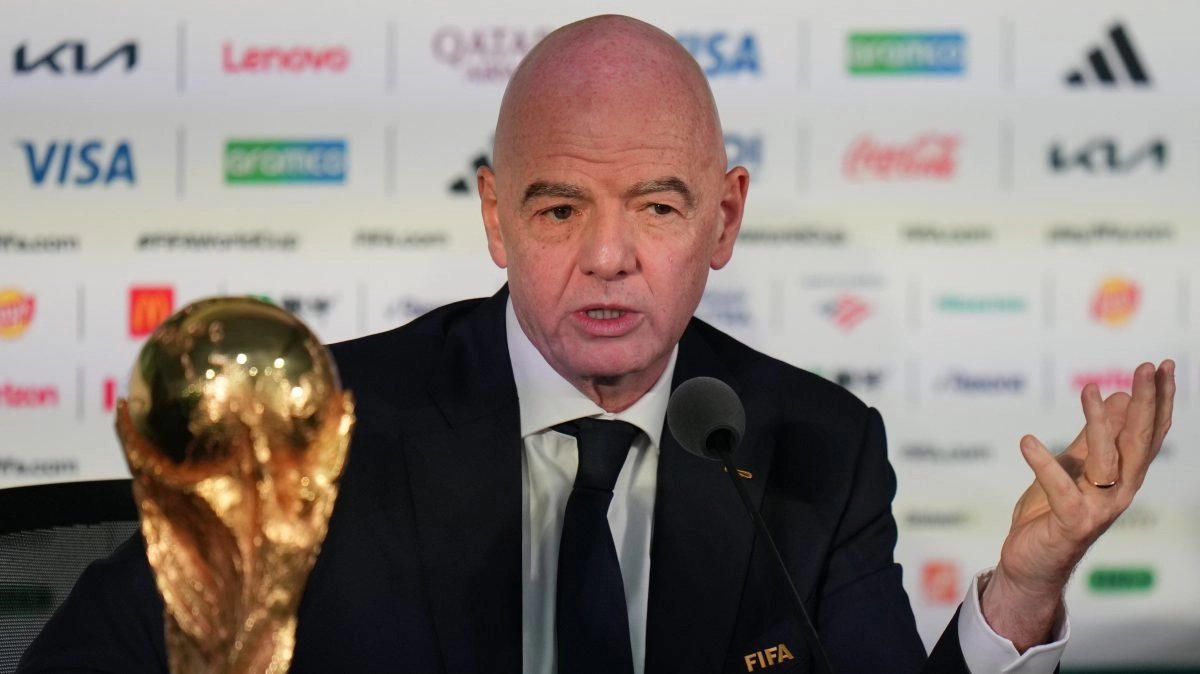

The resignation this Friday of Carlos Cordeiro, advisor to FIFA president Gianni Infantino, in protest against his plan to sell participations in the World Cup is the latest blow caused by the controversial project, amid widespread criticism and calls for reform of the governing body of world football.
The shadow of a boycott hangs over FIFA competitions, after UEFA announced that its national federations will not participate in them if the organization insists on its idea. A complaint that other confederations have also joined, such as those of North America, Central America and the Caribbean and Asia.
This plan for FIFA competitions threatens this year's events such as the U-20 and U-17 women's World Cups in Poland and Morocco, and the men's U-17 World Cup in Qatar or the qualification for the women's absolute championship in Brazil 2027.
A key advisor to Infantino resigns
Carlos Cordeiro, FIFA advisor on the White House World Cup panel and close collaborator of Gianni Infantino, announced his resignation this Friday as a result of his disagreement with the organization's new and controversial proposal, something he considers "detrimental" to football.
"I want to make it clear that I have had nothing to do with this proposal and that I am unequivocally opposed to it. It is a bad agreement for the member federations of FIFA, a bad agreement for football and a bad agreement for the long-term future of this sport," explained the manager in a statement released on social networks.
The highest organization of world football has received numerous criticisms in recent days for the lack of transparency of the project, which was joined this Friday by the British Prime Minister, Andy Burnham, who described Infantino as “the wrong person” at the head of the organization.
FIFA defends itself
FIFA had to step up to the wave of criticism to defend that its FIFA Forward Enterprise (FFE) project does not intend to sell football or give up control of its governance.
The entity acknowledged in a statement that it respects the comments and concerns expressed publicly and assured that the creation of FFE will only advance if it has the support of the majority of the associations.
"No one is selling football. This is not something FIFA would ever consider," the organization explained.
Furthermore, in the words of FIFA, the initiative seeks only to optimize the commercial management of its tournaments to generate greater income, guaranteeing that the money raised will be redistributed among the 211 member associations.
And he fired a direct shot at European football by pointing out that “no entity can claim to represent the 211 member associations around the world.”
Last Tuesday, FIFA's intentions were revealed to open the door to private capital to finance its major tournaments, including the World Cup, through the FIFA Forward Enterprise (FFE) project, as well as expand financing for football development to more than $10 billion for its 211 associations.
So far, three of the six continental confederations have publicly expressed their rejection of an initiative that contemplates the creation of a commercial subsidiary, valued at about $20 billion, of which it could open up to 20% of its capital to private investors.