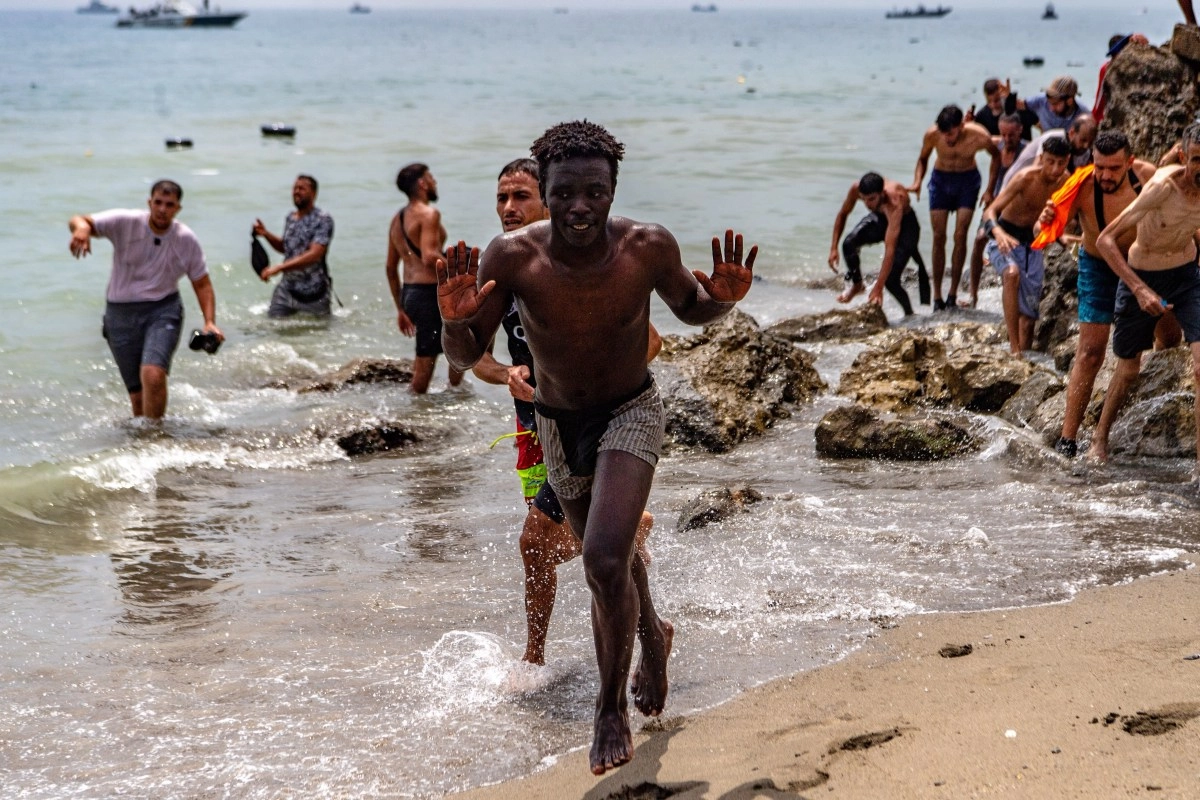

Ceuta is going through a new migration crisis after around 1,500 people arrived in just one week, many of them after jumping into the sea from Morocco and swimming to Spanish territory.
The situation led the president of the autonomous city, Juan Jesús Vivas, to ask this Thursday the Government of Spain to declare a national emergency and coordinate an urgent response to the collapse of reception resources.
Local authorities estimate that in recent days about 300 people have been entering per day. Among the new arrivals are adults, adolescents and numerous minors who traveled without family members.
Ceuta is located in North Africa, but is part of Spain. It shares a land and maritime border with Morocco and, due to this condition, it is one of the most guarded entry points into Spanish territory and the European Union.
Hundreds of people came swimming from Morocco
Most crossings occurred by sea. Groups of young people left Moroccan beaches and tried to swim around the breakwaters that separate Morocco from Ceuta.
Some arrived with wetsuits, fins or floats. Others jumped into the water without sufficient protection and in dangerous conditions due to currents, fatigue and distance.
More than 1,000 people had already managed to enter during the previous week, mainly Moroccan and Algerian citizens. The authorities also recorded hundreds of attempts that were intercepted by Moroccan security forces.
The increase continued until it overwhelmed both the Temporary Immigrant Stay Center and the services for unaccompanied minors.
Centers for minors are overflowing
Ceuta had 472 migrant minors under its guardianship as of July 28, after receiving more than 250 in just two weeks.
The ordinary capacity of its protection system was exceeded by “1,600%,” according to the local government. Some later estimates put occupancy well above that level, while arrivals continued.
The Temporary Immigrant Stay Center also reached its limit. Part of the adults remained sleeping outside the premises due to the lack of beds.
Vivas assured that Ceuta does not have sufficient resources to handle an arrival of this magnitude alone and requested the coordinated intervention of the ministries of the Interior, Defense, Inclusion and Territorial Policy.
Spain mobilized the Army and reinforced the border
The Spanish Government announced the deployment of Army troops to support surveillance and logistics tasks in Ceuta.
It also reinforced the presence of the Civil Guard and temporarily closed Melilla's land border with Morocco after another mass entry attempt.
The President of the Government, Pedro Sánchez, and the Minister of the Interior, Fernando Grande-Marlaska, planned to travel to the area to evaluate the crisis and meet with local authorities. Spain and Morocco also agreed to strengthen border cooperation.
The central government, however, has for now refused to formally declare a national emergency, maintaining that this figure is not contemplated for a migration crisis within civil protection legislation.
At least 18 people would have died
The emergency also has a human cost. Spanish authorities reported at least 18 recent deaths linked to attempts to reach Ceuta by sea, although the figures vary depending on the period counted by each agency and a half.
During the last weekend of July, four bodies were recovered on the coast of Ceuta and other people were reported missing. In all of 2026, local media counted at least 27 bodies recovered until July 26.
The currents can drag those attempting the crossing to other areas of the Mediterranean. This week, bodies were also found off the coast of Malaga that could correspond to migrants trying to reach Ceuta.
Why so many people try to enter Ceuta
Ceuta is not the place from which migrants flee. It is the destination they are trying to reach. Many are young Moroccans or Algerians seeking better job and economic opportunities in Europe. Others come from African countries affected by war, persecution, poverty or political instability.
Upon arriving in Ceuta, they formally enter Spanish territory, although this does not mean that they automatically obtain residency, asylum or authorization to travel to the rest of Europe.
Your situation must be evaluated by the immigration authorities. Unaccompanied minors remain under the guardianship of the city, while adults can be transferred to shelters, initiate an application for international protection or face a return procedure.
A ruling changed returns by sea
The crisis also comes after a ruling by the Spanish Supreme Court that limited so-called immediate or “hot” returns for those who are intercepted after entering swimming.
The court considered that this special procedure was intended mainly for people who cross the fences or physically violate the border containment elements, and could not be automatically applied to those who arrive by sea.
Some Ceuta leaders maintain that this decision could have encouraged new attempts. Migration specialists warn, however, that there is not enough evidence to attribute the entire mass arrival to the ruling and also point out political, economic and diplomatic factors between Spain and Morocco.
The fear of a repeat of the 2021 crisis
The situation is reminiscent of what happened in May 2021, when more than 8,000 people entered Ceuta in two days while control on the Moroccan side was relaxed.
On that occasion, many migrants also arrived by swimming and hundreds were minors. The images of exhausted people, soldiers deployed on the beaches and families looking for their children caused a diplomatic crisis between Spain and Morocco.
Spanish authorities fear that the current flow will continue and once again completely overwhelm local reception systems.
For now, the immediate challenge is to find accommodation for the new arrivals, protect minors and prevent new deaths on a stretch of sea that seems short, but can become a deadly route.