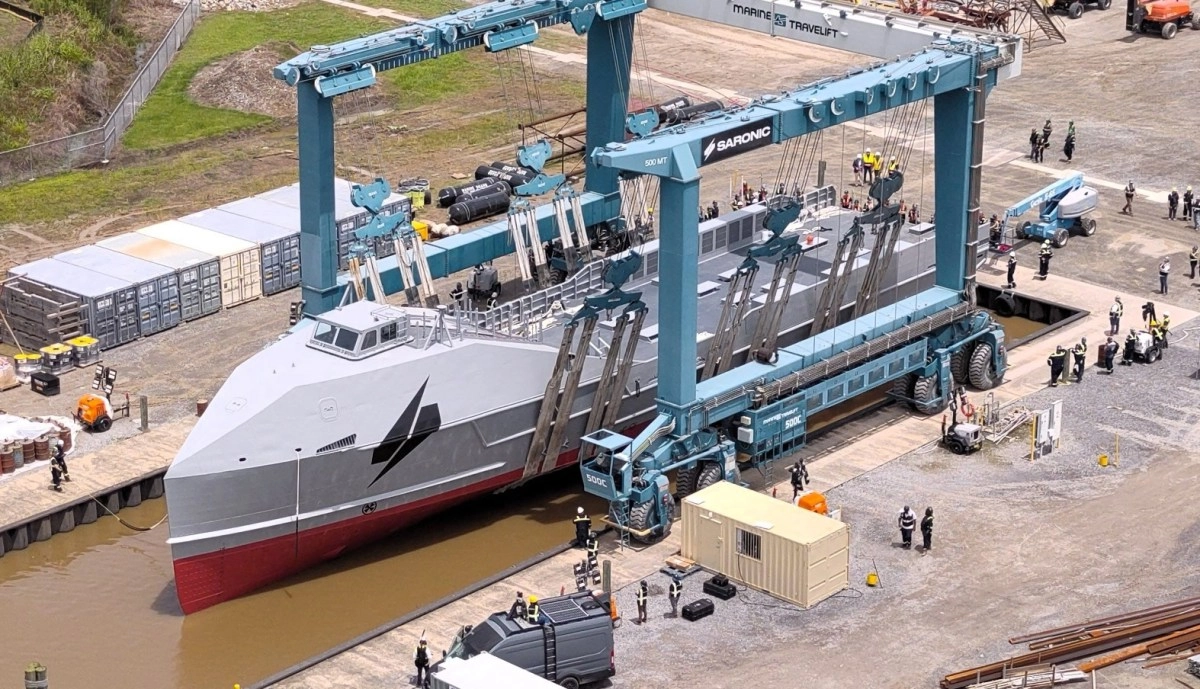

The United States is preparing to test in 2027 an unmanned surface ship capable, at least in theory, of launching hypersonic missiles from the open sea. This is the Marauder, an autonomous vessel that breaks the mold of current naval drones and aspires to become the first platform of its kind armed with this type of extreme weapons.
A 55-meter naval drone designed for hypersonic missiles
The project revolves around the Marauder, an autonomous vessel of about 55 meters in length developed by the American company Saronic. We are not looking at a small boat but rather a medium-sized hull that is closer to the silhouette of a light patrol boat than that of the naval drones that we usually see in headlines.
Saronic has designed the Marauder as a MUSV or Medium Unmanned Surface Vessel, a category designed to operate in the open sea for long periods without a crew on board. The idea is that it can navigate autonomously, with its own sensors and control software, but also integrate into Navy command networks to receive orders, share data and act as another node within the “swarm” of surface platforms.
The truly groundbreaking thing is the payload that is intended to be mounted on this platform. The Castelion company plans to integrate its Blackbeard hypersonic system into the Marauder, an experimental weapon that seeks to bring extreme speed and strategic range to the field of naval drones. According to both companies, we would be facing the first attempt to integrate a hypersonic weapon into an autonomous surface ship, something that makes it a unique vessel in its category within the US arsenal.
In practice, this means that an unmanned ship could reach sensitive areas, remain silent, receive coordinates and launch a missile capable of flying at hypersonic speeds, with very little room for reaction for the adversary. All this while reducing the risk to human crews and opening the door to much more aggressive operating concepts in areas where today a manned vessel would be too vulnerable.
What will the 2027 test be like and what role does the Navy play?
The big event is marked on the calendar for 2027, the year in which Saronic and Castelion plan to carry out a demonstration at sea of the Blackbeard system launched from the Marauder. We are not talking about a simple laboratory simulation but rather a real shot from a surface drone sailing in open waters.
The United States Navy is not a passive spectator in this story. The service has already selected Saronic within its “MUSV marketplace” initiative, a program with which it wants to evaluate different unmanned surface platforms and see which ones fit best into its long-term plans. According to published information, the Marauder will undergo sea trials this summer and, if it passes the evaluation, the company could receive additional financing and enter the list of candidates for future production contracts.
This test campaign is key because it will determine the extent to which an autonomous vessel of this size can operate reliably in real-world scenarios, from navigation and endurance to sensor integration and weapons systems. The Navy has already been experimenting with launching hypersonic missiles from traditional platforms, including stealth destroyers like the USS Zumwalt, but bringing that concept to a naval drone multiplies the technological and tactical variables.
Although the Marauder is presented as theoretically capable of firing hypersonic missiles from the US arsenal, the project is being handled as a technological demonstration. That is to say, the fact that it can launch Blackbeard does not imply that tomorrow we will see entire squadrons of these ships patrolling with loaded hypersonic missiles, but it opens a very specific door within the fleet's modernization strategy.
Why this ship marks a before and after in naval warfare
Beyond the specifications, what is powerful about the Marauder is the concept. A 55-meter surface drone that sails without a crew and aims to launch hypersonic missiles puts naval warfare on a new square on the board. It is no longer just a matter of replacing routine tasks with robots but rather moving strategic attack capabilities to autonomous platforms that can take on more risk and operate in a more distributed way.
These types of projects fit with the US Navy's trend to proliferate hypersonic missiles throughout the fleet, from large destroyers to submarines and, now, unmanned ships. Hypersonic conventional strike missiles, such as those integrated into the Conventional Prompt Strike program, are designed to travel at speeds of at least Mach 5 and reach targets thousands of kilometers away in a very short time. Integrating that philosophy into an autonomous platform means exploring a new combination of weapon and vehicle that has not been tested until now.
The result is a vessel that does not fit into the classic molds of “warship” or “light drone” and, for this reason, is described as a unique design of its kind within the American naval ecosystem. It does not replace large destroyers or attack submarines, but it adds another piece to the logic of distributed fleets, with more nodes, more autonomy and more attack options from unexpected directions.
From a technological point of view, the Marauder also serves as a floating laboratory for artificial intelligence systems, autonomous navigation and data fusion, elements that will be essential in the next generation of ships, manned or not. And from a geopolitical perspective, it sends a very clear message to powers like China and Russia about the United States' intention to push the combination of AI, unmanned platforms and hypersonic missiles far beyond what has been seen so far.
For all this, the ship that the Navy plans to test in 2027 is not just another drone with more sensors. It is a bid to bring the most advanced weapons in the US arsenal to an autonomous, one-of-a-kind platform, with the potential to redefine how naval power is understood in the next decade.