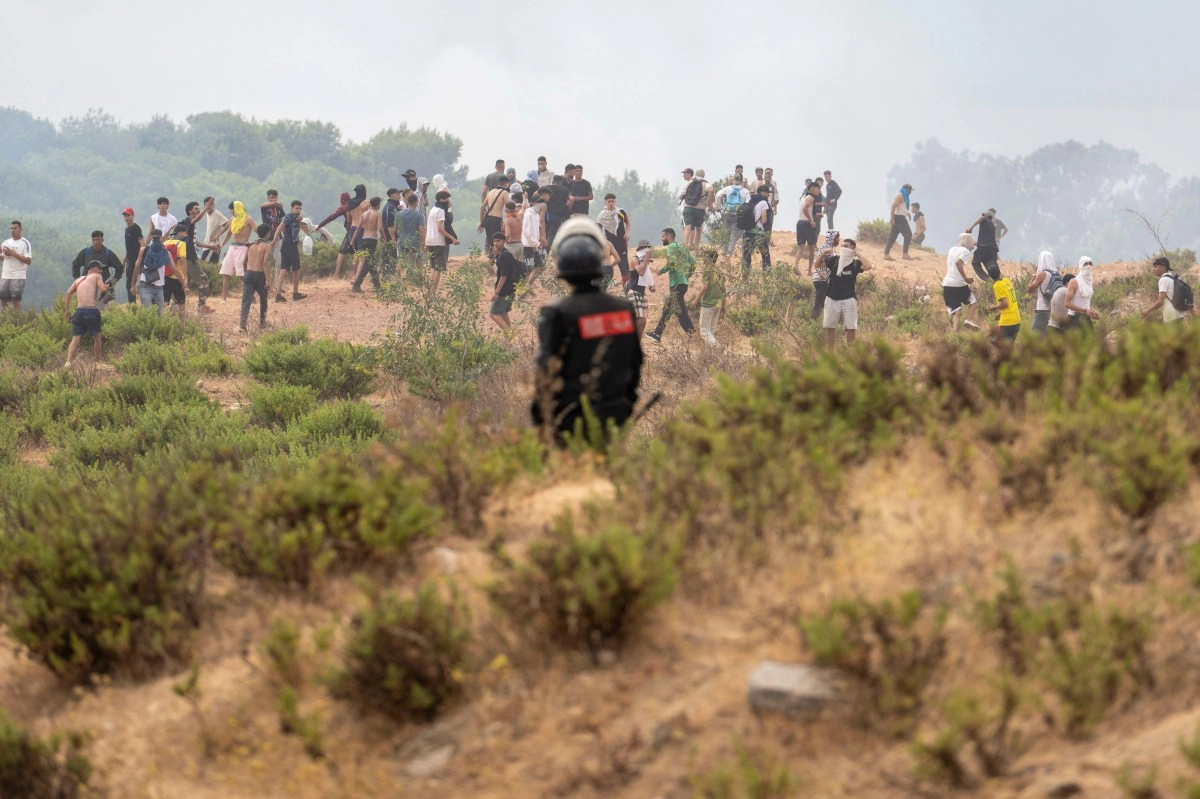

The arrival of tens of thousands of people from Morocco to Ceuta once again put one of the most sensitive borders in Europe under pressure and opened an inevitable question in the United States: could something similar happen in Texas, Arizona or California?
The most prudent response is that an identical episode is unlikely, but a sudden concentration of thousands of migrants at a specific point on the US border could occur.
Ceuta is a small city, separated from Morocco by a very concentrated border, with beaches and breakwaters. The border between Mexico and the United States, on the other hand, extends for almost 2,000 miles and has numerous ports of entry, Border Patrol sectors and federal resources that allow the response to be distributed.
However, the Spanish crisis showed how a combination of economic difficulties, rumors on social networks and a possible relaxation of controls in the neighboring country can mobilize a crowd in a very short time. Reuters reported that Instagram posts and misleading accounts of a Spanish ruling helped convince young Moroccans that they could enter and stay in Ceuta.
An episode like Ceuta would be difficult, but not impossible to imitate
In the United States, the most likely scenario would not be a crowd occupying an entire border city in a few hours. It would be a localized saturation in places like El Paso, Eagle Pass, Del Río, San Diego or Calexico.
A sudden arrival could temporarily overflow:
The United States has already gone through episodes of this type, although on a smaller scale. At different stages, thousands of people gathered in Del Río, Eagle Pass and El Paso, forcing crossings to be closed, temporary camps to be set up and federal personnel to be transferred.
The difference is that American infrastructure allows resources to be deployed from other sectors. Ceuta, on the other hand, has a much more limited territorial and reception capacity.
Mexico is decisive to avoid a sudden crisis
Experts agree that the security of the US border does not depend solely on walls, agents or technology placed on the northern side. It also depends on what Mexico does within its own territory.
A report from the Migration Policy Institute prepared by Ariel G. Ruiz Soto, Doris Meissner and Andrew Selee concluded that Mexico has been fundamental in reducing irregular migration to the United States. The researchers summarized that relationship directly: “Both governments fundamentally need each other.”
The institute noted that Mexican measures were central to reducing crossings from 2024 and that, for some months, Mexico recorded more encounters with migrants within its territory than the Border Patrol itself on the southwest border.
The Congressional Research Service also attributed part of the recent decline to the intensification of Mexican controls. Between February and July 2025, encounters on the US border fell 93.3% compared to the same period the previous year, while Claudia Sheinbaum's government deployed more National Guard troops and reinforced detentions and returns.
That data reduces the possibility of an immediate crisis, but also reveals a vulnerability: if Mexico were to abruptly reduce its controls, thousands of people could approach the US border in a short period.
The rumors have already mobilized hundreds of migrants to Texas
The United States has a history that bears similarities to what happened in Ceuta. In April 2023, a video spread on social media falsely claimed that certain migrants could show up at the border and legally enter the country before Title 42 ended.
The next day, hundreds of people arrived at the Paso del Norte international bridge between Ciudad Juárez and El Paso, convinced they would be allowed to cross. The information was false.
The episode demonstrates that social networks do not by themselves create the causes of migration, but they can determine when and where a population that is already waiting for an opportunity is concentrated.
The Border Patrol warned again in August 2025 that human smuggling organizations were spreading false news about changes to asylum rules to lure clients onto dangerous routes. “These criminal networks are putting lives at risk by spreading lies to exploit people for profit,” warned Walter N. Slosar, then acting head of the El Paso sector.
A vulnerable population remains stranded in Mexico
Another factor that could favor a sudden concentration is the presence of migrants trapped in Mexican cities, unable to legally enter the United States or easily return to their countries.
A May 2026 report from the Strauss Center at the University of Texas at Austin described waits of up to two years for some refugee processes in Mexico, difficulties accessing formal jobs, unstable housing, and frequent exposure to violence and extortion.
In February, the same center estimated that around 5,260 migrants were still living in Mexican border cities. Many others had returned to their countries, had moved to the interior of Mexico or had attempted clandestine routes after the closure of mechanisms to request asylum from the border.
That population does not automatically represent a threat of mass crossing, but may be especially vulnerable to rumors announcing a supposed opening, a new amnesty or a limited opportunity to enter.
What could trigger a mass rally
For an episode similar to that in Ceuta to occur, several factors would have to coincide:
None of these factors allow us to affirm that there is a crowd preparing to cross today. The risk is structural, not a warning about an imminent event.
The US border has already registered historic levels
In fiscal year 2023, CBP accounted for approximately 2.5 million encounters at the southwest border. In 2024, the figure dropped to 2.1 million, still well above pre-pandemic levels.
It is important to clarify that an “encounter” does not necessarily equate to a different person. The same person can be counted more than once if they try to cross on different occasions.
These figures show that the United States has experience processing large annual flows. The difficult thing would be to attend to an arrival concentrated in a few hours and in a single sector, especially when children, injured people or separated families are involved.
Texas would be among the most exposed areas
Texas brings together several sensitive points due to the length of its border, the presence of the Rio Grande River and the proximity between American and Mexican cities.
El Paso and Ciudad Juárez form a cross-border metropolitan region. Eagle Pass is in front of Piedras Negras, while Del Río is located next to Ciudad Acuña. In these places, a rumor-driven mobilization could quickly gather hundreds or thousands of people.
A localized crisis could lead to temporary bridge closures, delays in international trade, and overcrowding of detention centers. Experts warn that there could be accidents in the river and strong pressure on municipal governments and humanitarian organizations.
Even so, the United States would have the capacity to mobilize agents, transportation, medical personnel and resources from other parts of the country.
Arriving in a group does not create the right to stay
Another element that traffickers often take advantage of is the false idea that crossing with a crowd prevents deportation.
US law continues to allow detention, expedited removal or the opening of immigration proceedings for those who enter without authorization. Asylum seekers must pass legal assessments and demonstrate fear of persecution or serious harm in accordance with current rules.
A crowd may make control difficult for a few hours, but it does not automatically change the legal status of its members.
The main lesson that Ceuta leaves
The Ceuta crisis does not demonstrate that a similar entry is about to occur in the United States. It does confirm that borders can overflow when thousands of people simultaneously receive the message that there is an opportunity to cross.
The main American defense is not only on the border line. It also depends on cooperation with Mexico, surveillance of trafficking networks and the ability to deny rumors.
Furthermore, according to experts, the existence of clear and understandable immigration procedures is also key.