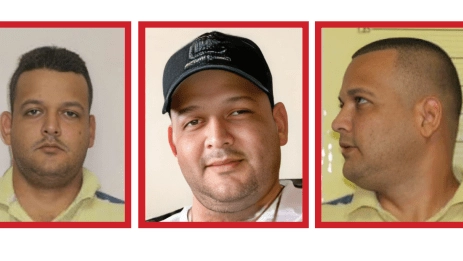

After years on his trail, Costa Rican authorities managed to capture Alejandro Arias Monge, alias “Diablo,” considered the most wanted drug trafficker in the Central American country.
Arias' arrest occurred in the early hours of July 24, in a “complex operation” marked by an intense shootout that lasted for around an hour and left eight agents injured and an alleged member of his criminal organization dead.
Arias was arrested along with Jonathan Pérez Méndez, alias “Tan”, who is considered his lieutenant, on a farm located in the town of Sarapiquí, province of Heredia, near the border with Nicaragua, Michael Soto, director of the Judicial Investigation Agency (OIJ), informed the media.
The fall of “Diablo” was celebrated by the United States Embassy in San José, which recalled that Washington had offered a reward of US$500,000 for information leading to the arrest of whom it identified as the “leader of a violent transnational criminal organization.”
But who is Arias and what is he accused of? We tell you.
From bananas to drugs
Arias was born on September 19, 1984 in Santa Rosa de Ticabán, in the province of Limón, off the coast of the Caribbean Sea.
Before entering into illicit activities, “Diablo” began his working life working in banana companies, but by 2010 he began to be linked to assaults on people and robberies of homes.
As time went by, he expanded his criminal activities to thefts of cargo trucks, as well as agrochemicals in pineapple, banana, and livestock farms, according to television station Teletica.
By 2015, the subject was already on the authorities' radar, as he was identified as a suspect in the murder of a man, Ademar Jiménez Gómez, whose bullet-riddled body was found burned on a farm in the middle of some banana trees.
A year later the authorities managed to arrest him and he remained in preventive detention for a year due to another death.
After regaining his freedom, he began a violent dispute with another local boss: Michael Alfredo Moreno Borbón, alias “Pechuga”, who had previously been his ally.
The confrontation over control of micro-trafficking in the province of Limón and the routes used to send drugs to Nicaragua and, from there, to the United States has left around 150 dead in the last decade, according to the organization Insight Crime.
Some of the victims attributed to “Diablo” and his henchmen were decapitated and burned alive.
Due to drug trafficking, Costa Rica has lost its status as the safest country in Central America and has experienced an increase in homicides in recent years.
In 2025 alone, 873 people lost their lives violently in the country. Judicial authorities have attributed more than 60% of these deaths to fights between drug trafficking groups, including the “Diablo” group.
Throughout these years, Arias has used social networks to show off the automatic weapons and the money he owned.
Money as a weapon
Throughout his criminal career, the man detained today used money as a weapon.
In 2020, audio clips attributed to “Diablo” and other members of his organization were released, in which 2.5 million colones (US$5,500) were offered for the death of police officers. The figure rose to 5 million for each murdered OIJ investigator (US$11,000).
“The Patron (that is also known as “Diablo”) sent word that for every paco (police) killed in Guápiles, Cariari, Puerto Viejo de Sarapiquí, he would be paid 5 million,” was heard in one of the recordings, as reported at the time by the Costa Rican newspaper La Nación.
“There is a lot of talk, of course, but all that talk is destined for the jupa (head) of the researchers who wanted to play as artists, doing us justice,” the audio continues.
“For anyone who wants to play as a hero, there is plenty of talk,” he concluded.
The offer paid off, because in February 2025 Geiner Zamora, a high-ranking officer of the OIJ in the province of Guápiles, was murdered by hitmen while he was in a restaurant. A crime that according to the authorities, Arias would have ordered, the media outlet CRHoy reported.
“Diablo” also used money to corrupt some law enforcement officers.
After his capture, the capo revealed to the prosecutors who interviewed him that over the years he had the collaboration of police agents to commit his crimes, in exchange for large sums of money.
This would explain why in recent years several attempts to apprehend him have failed. One of the closest occurred in January 2023, when more than 50 judicial agents were a few meters away from capturing him during a family activity.
In 2024 alone, OIJ agents carried out at least ten additional operations without success, Teletica reported.
Hours after this confession, five agents were arrested and charged, reported the Deputy Prosecutor's Office against Drug Trafficking and Related Crimes.
The combination of his brutality and bribes to some officials would also be the reason why the “Diablo” organization managed to expand to at least seven regions of Costa Rica, including the Northern Zone, San Ramón, Turrialba and Guanacaste.
The fear he generated within the criminal world caused other criminals to use his name to extort merchants in provinces such as Limón and Heredia.
“The Devil's Advocate”
Arias' decision to appoint Cristian Rodríguez Arce as his defense lawyer has only reinforced suspicions about his alleged infiltration of the State. Rodríguez was a criminal prosecutor between 2002 and 2020.
Rodríguez, who has been dubbed by the local press as the “Devil's Advocate,” also represents a sister of Arias in another case.
The decision to keep the boss detained preventively did not surprise his defender, who anticipated it.
“There is a very clear danger of flight,” he told local media before the court made the announcement.
“It is absurd to argue that there is no risk of flight when, in fact, there is,” he admitted.
“Diablo” was held in the maximum security prison of La Reforma, about 23 kilometers from the capital, San José.
And although the lawyer ruled out the possibility that his client faces an extradition request from the United States, since he is only accused of crimes committed in Costa Rica, the evidence points in another direction.
"According to the DEA, Arias has conspired with numerous drug traffickers and drug trafficking organizations to transport shipments of hundreds of kilograms of cocaine from Colombia. The cocaine is smuggled through Costa Rica, Honduras and Guatemala to Mexico, with its final destination in the United States," reads the State Department website.
For his part, the attorney general of Costa Rica, Carlo Díaz, stated that if Washington formally requests the delivery of “Diablo” it will be evaluated “from that moment on.”
Download the new BBC World Service app. Choose BBC News World and receive news alerts, documentaries and analysis, all in one place. Important: The new app is not available in the United Kingdom or the United States.