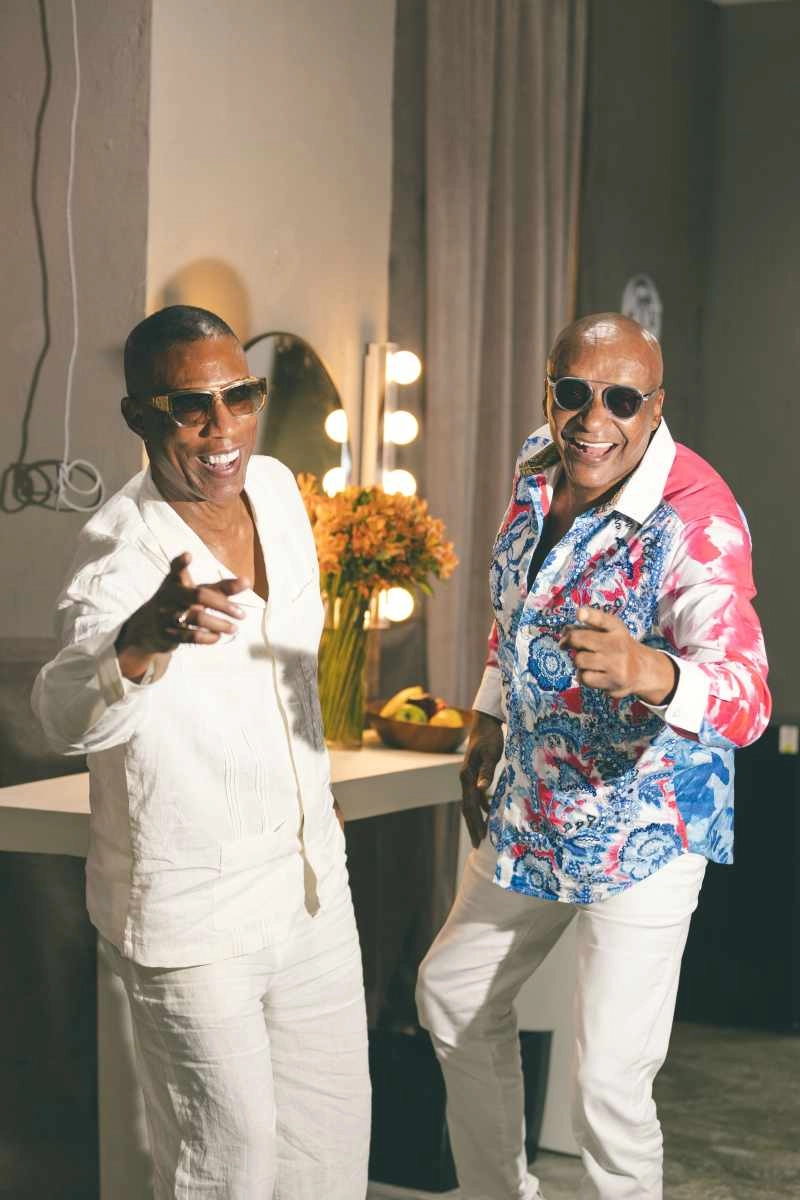

Nino Caicedo and his band, the Orquesta Guayacán, celebrated 40 years of partying, and they celebrated with an album that reflects what the salsa they love is like, that is unlike any other and that celebrates a street sound that does not exist anywhere else in the world.
“Deliberately, we wanted to reflect on the neighborhood and for the sound of the neighborhood to be projected there,” he said. “And that everything, everything that is experienced in that sauce, a sauce that is making resistance, will be captured in this '40th Anniversary—Caleño neighborhood salsa'.”
For Nino, this album is a summary of the four decades of life of the Colombian orchestra, and contrary to what had happened in previous productions, where he had been the sole composer of the songs, on this occasion he invited his close friend Alexis Lozano, leader and founder of the combo, to write half of the songs.
And, originally, Alexis was in charge of writing the band's songs, but that changed when Nino joined the combo. Since they joined, Alexis became the arranger and Nino the orchestra's main composer.
“But on this fortieth anniversary we wanted to divide the composition work,” said Nino, who ended up writing five of the nine cuts that the album contains; Alexis composed the rest. They are currently promoting “Amé a mi vida”, a romantic song that Nino wrote and that has shades of the classic “A mi vida”, but with the seal of Guayacán.
Two greats of Caribbean music joined the celebration; one was Luis “Perico” Ortíz, trumpeter, composer and producer who worked as an arranger for half of the songs on the album. Although new generations may not know him, he was the one who arranged the successful album “Siembra” by Rubén Blades.
“We are friends with him, but we had not used his talent as an arranger,” Nino said.
The other genius was Manolito Simonet, a renowned Cuban pianist and composer who arranged the other half of the Guayacán album. Simonet founded the El Trabuco orchestra in 1993, in which he mixes Cuban rhythms with jazz.
“Why this ‘choosing’ songs and looking for other arrangements?” said Nino. “Because it is the 40 years of life of the orchestra, because we wanted to make an album uniting three hearts.”
One is the heart, the feeling and the musical knowledge of Puerto Rico, embodied in Luis “Perico,” said the artist. Another is the heart and knowledge of Manolito, and finally, the heart of Colombia, which the Guayacán Orchestra embodies.
“We have been presenting the album on the tour we just finished in Europe,” Nino said. “We have presented it in Mexico and Colombia and they really, really, really liked the Cali neighborhood sound that we imbued into this production of ours,” he said.
This month, the orchestra has scheduled performances in West Palm Beach and Sarasota, Florida, and in Chicago.
The uniqueness of this album is its style, which according to this maestro, is a neighborhood sound that has not been lost and that Guayacán has been in charge of perpetuating since it was founded. The Cali rhythm, he described, has to do with the percussions that are present in the rhythms of the orchestra.
“Caleña salsa is a hallmark that when you listen to an orchestra from Cali like Guayacán, you realize that it doesn't sound like any Puerto Rican artist,” he said. “It sounds different and it doesn't sound like a Cuban artist either, it sounds different.”
It is like a fruit, he compared, that, although the flavor is explained to you in a thousand details, you can only understand it when you eat it and taste it.
"I can talk to you about tropical fruits like borojo, for example, like chontaduro; I can explain to you, but until you eat them, until you go to Cali and pick borojo or try chontaduro, you will not understand in depth what I'm telling you," he said.