

Who were the leaders of the Revolutionary Guard and the nuclear scientists whose funerals Iran holds after the attacks o
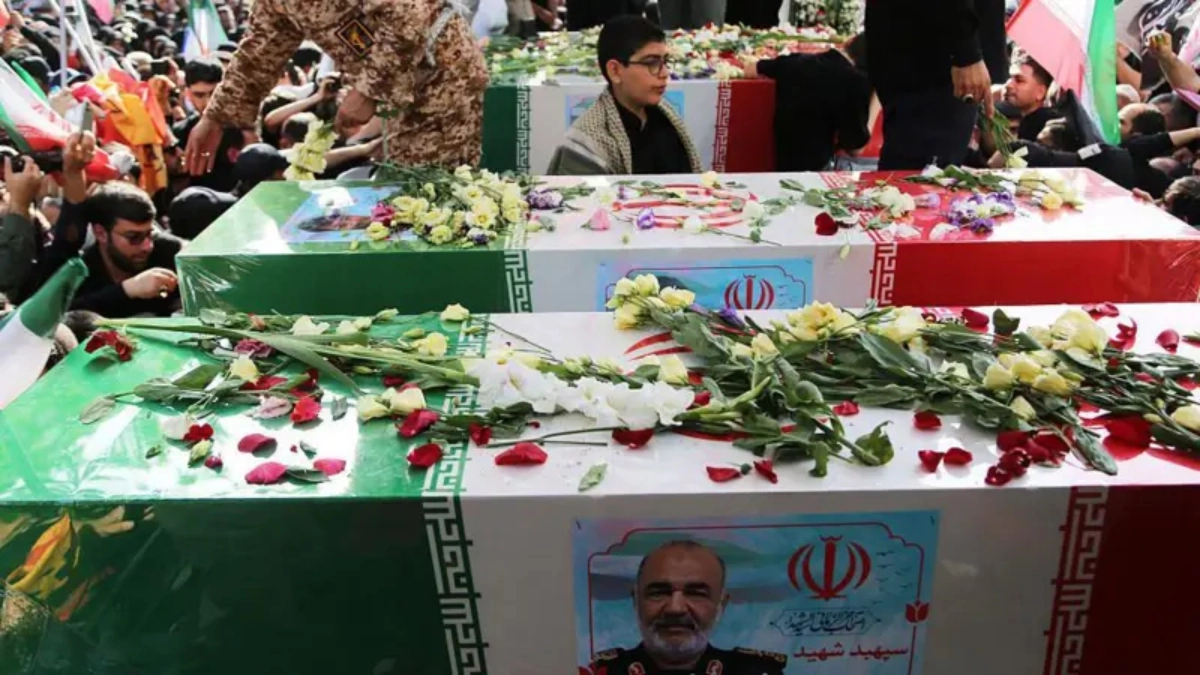
Iran held a state funeral for some of the most prominent figures killed during the 12-day Israeli offensive

The Israeli airstrike against Iran, which began in the early hours of Friday, June 13, hit dozens of targets, including nuclear facilities, military barracks, and private residences.
During the offensive, several senior military commanders were killed.
The Israeli strikes, codenamed Operation Rising Lion, also targeted other influential figures linked to Iran's nuclear programs, including six prominent scientists, Iran's Tasnim news agency reported after the attacks.
Some relatives of these figures were also killed, as well as dozens of civilians, including children.
On Saturday, the Middle Eastern country held a massive public funeral for those killed in the Israeli bombing.
Coffins draped in the Iranian flag, bearing portraits of the slain commanders, were flanked by a crowd near Tehran's Enghelab Square.
The conflict ended with a ceasefire earlier this week after the United States became directly involved by bombing key nuclear facilities in Iran.
Huge crowds of mourners dressed in black chanted slogans, waved Iranian flags, and held portraits of the deceased.
Before the event, A media campaign urged citizen participation, and authorities offered free bus and subway rides. Government offices remained closed for the day. Among the remains is Mohammad Bagheri, Iran's highest-ranking military officer, who was chief of staff of the Iranian armed forces. Bagheri will be buried next to his wife and daughter, who were killed in an Israeli strike. In total, Iranian authorities reported the deaths of 627 people in Iran. Israeli officials reported the deaths of 28 people in Israel following the Iranian missile attacks.
Saturday’s funeral also includes Hossein Salami, commander-in-chief of the Islamic Revolutionary Guard Corps, as well as several nuclear scientists including Mohammad Mehdi Tehranchi, director of Tehran’s Azad University.
Mohammad Bagheri
Bagheri was the highest-ranking military officer in Iran, serving as chief of staff of the Iranian Armed Forces, which includes both the Islamic Revolutionary Guard Corps and the Iranian army.
Bagheri joined the IRGC in 1980, at age 20, and with his brother, helped establish its intelligence unit during the Iran-Iraq War.
He was considered less hardline than other commanders. He recently came under fire for a speech he gave in April outside the ancient ruins of Persepolis, in which he called for peace and urged the avoidance of war. Abdolrahim Mousavi has been appointed the new chief of staff of the armed forces, Iran's state news agency Irna reported. He does not come from the ranks of the IRGC, as he is a general in the army.
Hossein Salami
Hossein Salami was the commander-in-chief of the IRGC.
Salami joined the IRGC in 1980 during the Iran-Iraq War and rose to deputy commander in 2009, before being promoted to commander in 2019.
Known for his oratory skills, he took a tough stance towards Israel, stating last month that Tehran would “open the gates of hell” if it was attacked by Israel or the US.
Mohammad Pakpour has been appointed the new commander of the IRGC, Iranian state media reports.
Gholamali Rashid
Gholamali Rashid was the head of the IRGC’s Khatam-al Anbiya Headquarters, which coordinates the Iranian joint military operations.
Rashid fought in the 1980s war against Iraq and was previously deputy chief of staff of the Iranian armed forces.
Following his passing, Ali Shadmani has been named the new leader of the emergency command, according to Iranian state media.
Amir Ali Hajizadeh
The commander of the IRGC Aerospace Force, Hajizadeh was a prominent figure in charge of the country's missile program.
The Israel Defense Forces (IDF) claimed that Hajizadeh had met in an underground command center along with most of the IRGC air force commanders to prepare an attack against Israel.
The IDF claimed that the group was later killed in an attack on the building.
They added that Hajizadeh commanded the missile attacks by Iran against Israel in October and April of last year.
Hajizadeh was viewed less favorably by the Iranian public after taking responsibility for the downing of a Ukrainian passenger plane that took off from Tehran in 2020, killing all 176 people on board.
Nuclear Scientists
Fereydoon Abbasi, a nuclear scientist, led the Atomic Energy Organization of Iran from 2011 to 2013.
He subsequently served as a member of Parliament from 2020 to 2024.
He promoted hardline positions regarding Iran's nuclear activities.
In May, he spoke on the Iranian television channel SNN.ir about the possibility of building a nuclear weapon and stated that he would be willing to carry out orders if he received them.
Iranian state media also reported the deaths of other nuclear scientists.
This article was originally published on June 13 and updated on June 28 for the state funeral.
Click here to read more stories from BBC News Mundo.
Subscribe here to our new newsletter to receive a selection of our best content of the week every Friday.
You can also follow us on YouTube, Instagram, TikTok, X, Facebook and on our new WhatsApp channel.
And remember that you can receive notifications in our app. Download the latest version and activate them.