Spain and the United States are resorting to a similar border strategy: placing floating barriers in the water to prevent migrants from swimming to their territories.
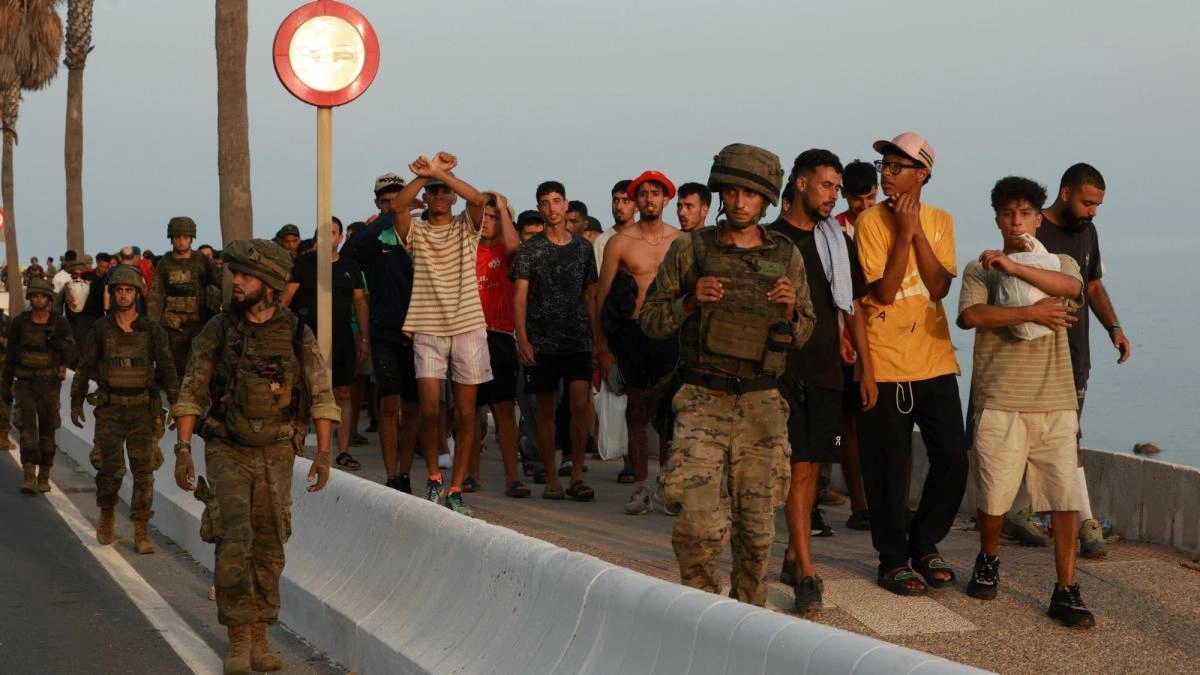
The comparison gained strength this Saturday, August 1, when Spain began to deploy a 500-meter structure next to the Tarajal breakwater, on the maritime border between Ceuta and Morocco. The decision was made after a mass arrival during which some 50,000 people crossed or attempted to cross the border and at least 67 died.
Thousands of miles away, the United States government is developing a much more extensive project on the Rio Grande, also called the Rio Bravo. Donald Trump's administration plans to place more than 500 miles of large connected buoys along the Texas-Mexico border.
Although the structures are not identical, both are based on the same logic: turning water into an extension of land barriers.
How the barrier installed in Ceuta works
The Spanish structure was placed in front of one of the main points used by those trying to enter Ceuta by swimming or going around the breakwater that separates the Spanish territory from Morocco.
The system combines a pneumatic barrier with a line of anchored buoys provided by the Spanish Navy. The floating part protrudes between 30 and 70 centimeters above the water and extends up to one meter below the surface. Between the two lines there is a channel so that Civil Guard boats can patrol the area.
Its objective is not to close the entire coast of Ceuta, but to make it difficult to pass around the Tarajal breakwater, where numerous entry attempts were concentrated during the border crisis.
The installation also responds to a recent ruling by the Spanish Supreme Court. The ruling limited the immediate returns of those who are intercepted at sea before overcoming a physical barrier. By placing an aquatic containment element, the government intends to extend the legal concept of material border to the sea.
You can see: Can a massive arrival like the one in Ceuta be repeated in the US? What the experts say
The American project began in Texas
The most direct antecedent is near Eagle Pass, Texas. In July 2023, Greg Abbott's state government placed approximately 1,000 feet — about 305 meters — of spherical buoys connected and anchored to the bottom of the Rio Grande.
Texas presented the barrier as part of Operation Lone Star and assured that it would serve to deter crossings outside the ports of entry. The Joe Biden administration's Justice Department sued the state, alleging that it had installed an obstruction in a navigable river without the required federal authorization. He also pointed out risks to navigation, public safety and relations with Mexico.
In 2024, a federal appeals court allowed the structure to remain while litigation continued. The judges considered that the federal government had not demonstrated, in that preliminary stage of the process, that the affected section met the necessary conditions to justify the order to remove the buoys.
Trump made the buoys a federal project
What began as a Texas initiative was later adopted by the federal government. On January 7, 2026, Homeland Security Secretary Kristi Noem announced the placement of more than 500 miles of floating barriers in the Rio Grande. At that time, approximately 130 miles were already contracted and installation of the first segments began.
The plan includes around 536 miles between the Gulf of Mexico and different points in southern Texas. The first section built near Brownsville is about 17 miles and is part of a project that exceeds $1 billion in contracts.
The federal buoys are different from those initially installed by Abbott. They are cylindrical structures that can be 12 to 15 feet long and approximately four to five feet in diameter. They are connected in chains and are attached to the bottom of the river.
The Department of Homeland Security presents them as part of a “smart wall” that combines physical obstacles, cameras, lighting, patrol paths and detection technology.
A difference in scale between Spain and the United States
The main difference is in the magnitude. The Ceuta barrier is 500 meters long and protects a very specific point on the coast. The U.S. project could cover hundreds of miles of river running through cities, farmland, wilderness refuges and border communities.
The environments are also different. In Ceuta, the structure is subject to maritime currents and waves. In Texas, buoys must withstand changes in flow, sediment, and flash floods of the Rio Grande.
Specialists consulted about the US project warned that such an extensive chain could modify the flow of water, accumulate materials, aggravate flooding or alter the course of the river, which could also cause disputes with Mexico. Customs and Border Protection said the barriers were designed to withstand a flood of a magnitude that statistically occurs once every hundred years.
More than 100 buoys came loose during a flood
Those risks were no longer just hypothetical in July 2026. More than 100 federal buoys broke loose during a rising Rio Grande and began moving downstream near Eagle Pass. Authorities temporarily closed two international bridges while they evaluated whether the structures could hit the facilities or impede traffic. No injuries or structural damage were reported.
The incident occurred just two weeks before Spain installed its own maritime barrier and showed one of the difficulties of using floating structures on natural borders: they must stop people, but at the same time resist water forces that can be unpredictable.
You can see: Trump's “smart wall” advances with AI, sensors and billions to protect the border
Humanitarian criticism is similar
Spanish and US authorities maintain that these barriers discourage dangerous crossings and make the work of human trafficking networks difficult.
However, humanitarian and environmental organizations question whether the structures really prevent migration. They warn that they can push people towards longer, farther and more dangerous routes, rather than eliminating crossing attempts.
In the case of Texas, the Department of Justice noted since 2023 that the buoys raised humanitarian and security concerns. Mexico also protested the installation and questioned whether parts of the structure were in the waters of its territory.
In Ceuta, criticism focuses on the possibility that migrants will try to go around the new barrier and go further into the sea. The structure also does not eliminate a person's right to request international protection, although it may make it difficult for them to reach a place where they can formalize their request.