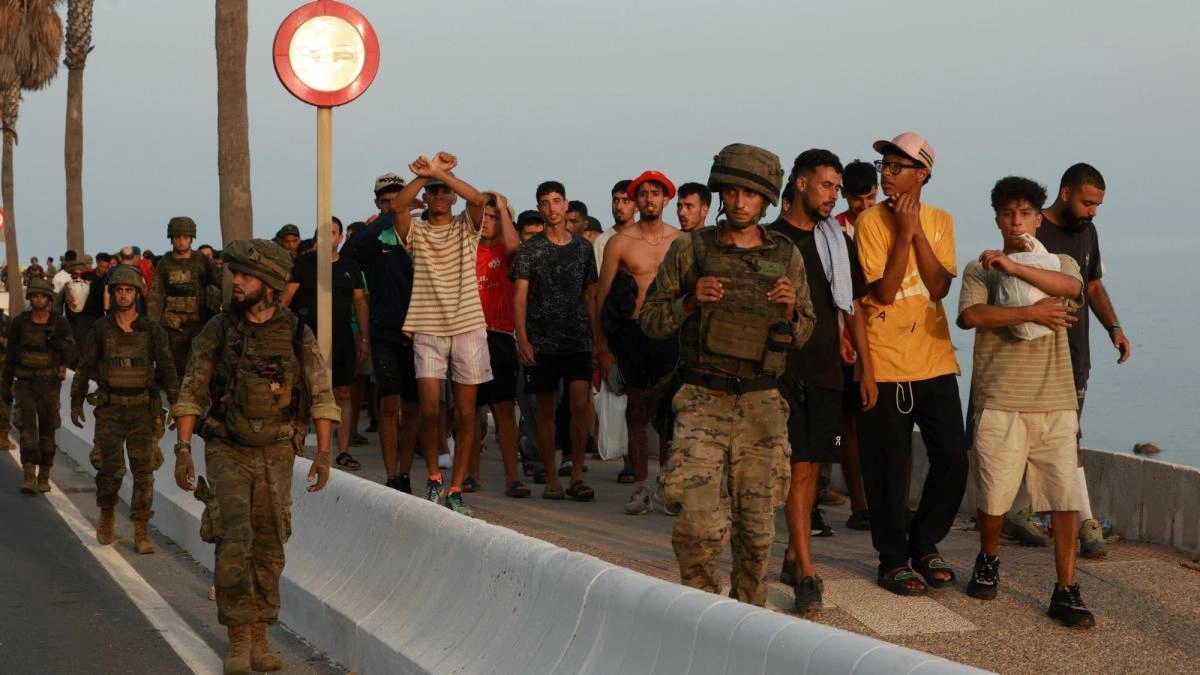

Most of the tens of thousands of migrants who swam into the Spanish enclave of Ceuta on Thursday have already returned to Morocco, escorted to the border by Spanish soldiers and police.
But the extraordinary mass exodus leaves at least 67 dead, whose bodies were recovered from the sea, among abandoned floats and fins.
This week's events shook Europe politically, once again highlighting existing divisions over the sensitive issue of migration.
And they leave unanswered questions about what triggered the sudden influx: whether social media posts promising an easy path to Europe simply went viral or whether it was something more deliberate.
Politics in the crisis
Whatever the cause, the president of the Spanish government is upset with the response.
Pedro Sánchez harshly criticized some members of the European Union for “attacking” Spain in this crisis, and taking advantage of it to play politics instead of showing their support.
He was referring to Italy, above all.
Fratelli d’Italia, the right-wing party of Prime Minister Giorgia Meloni, was quick to publish images of migrants running through the streets of Ceuta with the caption: “this is the Sánchez model that the Italian left likes so much.”
Meloni subsequently announced the suspension of the Schengen agreement between Italy and Spain, which allows the free movement of people, citing a security threat.
Madrid was furious.
Not only does he consider that the crisis has been contained, but that Ceuta is not in the Schengen zone, so Moroccan migrants would not be able to go to continental Europe without going through controls.
Meloni knows it.
But he faces an election next year and his coalition is losing ground to a new and virulently anti-immigrant party. This was an opportunity to be firm and win back votes, and he took it without hesitation.
A Spain that is too permissive?
However, Italy is not the only country that considers Spain to be too permissive with immigration.
A petition by Meloni for an urgent meeting of interior ministers to be held next Tuesday was signed by almost two dozen EU heads of state, who call for the elimination of all policies that could be “pull factors” for migrants to Europe.
They were referring, above all, to the controversial decision that Spain made to allow hundreds of thousands of undocumented immigrants to apply for residence and work permits to “regularize” their status.
But those who flocked to the beaches of Ceuta this week did not do so to take advantage of this measure, which, in fact, has already ended.
Sánchez himself points to another possible explanation: a recent ruling by the Supreme Court of Spain that established that those who enter the country by sea cannot be returned immediately.
The prime minister says people smugglers twisted information to promise an easy path to Europe.
The role of social networks
However, the crowd heading to Ceuta did not need to pay human traffickers, since the majority were Moroccans and the route is well known.
The message was actually spread over the Internet.
The migrants showed journalists posts on social networks where people were seen shouting “Spain is open” and jumping into the sea.
We ourselves verified multiple accounts in which young people are seen wearing wetsuits and fins, or recording themselves while swimming towards Ceuta, and then images taken from inside the enclave.
Some of these accounts have only been active for a few weeks. Several accumulate tens of thousands of “likes.”
All his promises were false.
The crowd that managed to reach the shore in Ceuta with joy found nothing. With no food or shelter, and no way to reach mainland Europe, most quickly returned.
So what was this all about?
Have migrants been “instrumentalized,” as happened a few years ago in Belarus, for example? And if so, who did it?
For now, we only see those who are taking advantage of it.
The global right is “hyperventilating with happiness,” as journalist Andrea Rizzi wrote in the Spanish newspaper El País.
US President Donald Trump, angry with Spain for opposing his war against Iran, spoke of a “catastrophe” and an “invasion.” Like Meloni, he faces an upcoming election.
Russia has also gloated: it loves chaos and division in Europe. Anything to weaken Ukraine's allies.
As for Morocco, he blames “criminal organizations.” But their border guards must have seen the crowds gathering.
The last time something similar happened, although on a smaller scale, Spain and Morocco were at odds over Western Sahara, a former colony.
There are new tensions at the moment.
Sánchez does not blame Morocco at all for what happened, and describes Rabat as a “good ally.”
But his critics call him appeasement and say he should be “baring his teeth.”
The results left by the crisis
For now, Spain is busy protecting Ceuta from any further incidents.
The border fence is being extended out to sea, placing long rows of orange buoys at the dock, which will then be patrolled by ships to deter migrants in the future.
Next week, EU interior ministers will debate reinforcing external borders, with populist sectors of the right emboldened.
Travelers from Spain heading to Italy will face random police document checks for a few weeks.
In the end, there were no big changes.
Except for the dozens of young people who took to the sea chasing a vision they had seen on the internet and who are now being sent back to Morocco in coffins.
This article was originally written in English and we used an artificial intelligence tool to translate it. A BBC journalist reviewed the text before publication. Learn more about how we use AI.
Download the new BBC World Service app. Choose BBC News Mundo and receive news alerts, documentaries and analysis, all in one place. Important: The new app is not available in the United Kingdom or the United States.