Thousands of migrants crossed in recent days from Morocco to the Spanish enclave of Ceuta, in North Africa, unleashing strong reactions in both Spain and the European Union and further raising diplomatic tensions between Madrid and Rabat.
According to estimates by the Spanish authorities, nearly 50,000 people managed to access Ceuta either by land or sea. This Friday it was reported that more than 48,000 had already returned to Morocco.
Shocking videos and images showing thousands of people swimming towards the Spanish city went viral on Thursday.
The authorities of Ceuta confirmed this Sunday that at least 72 people drowned while trying to reach the territory, under Spanish control for more than five centuries.
The Civil Guard continued working to recover the bodies of the victims.
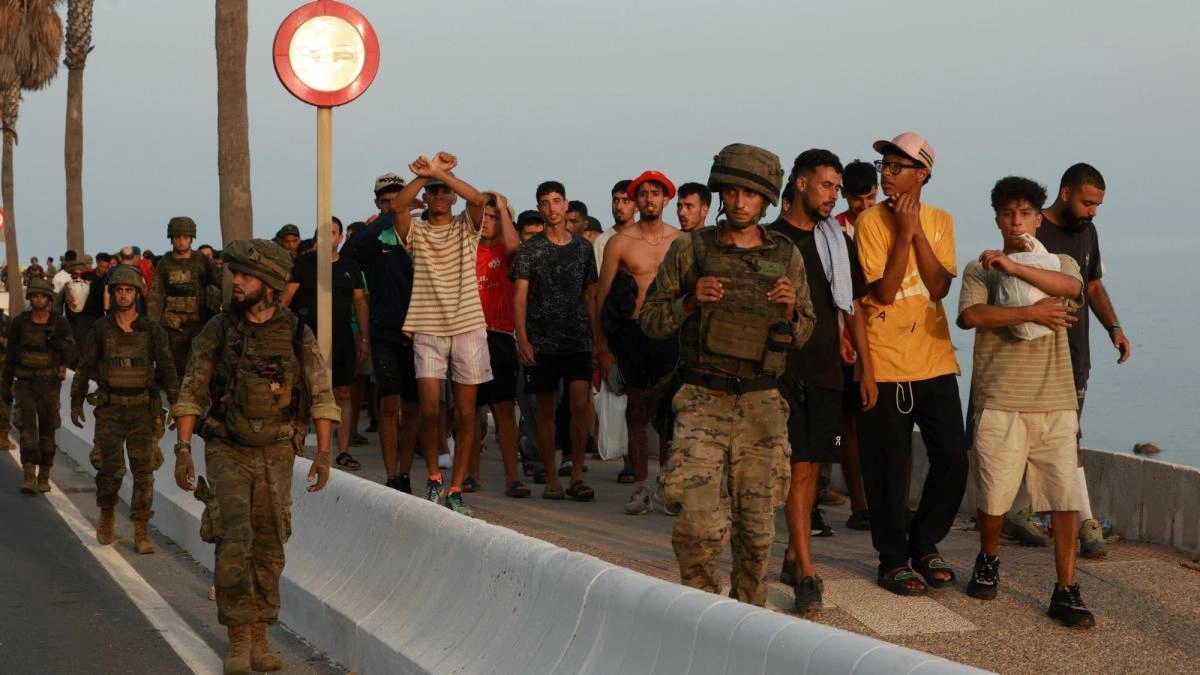
Following the massive arrival of migrants, mostly young men, although there were also women and children, local authorities requested help from the central government in Madrid, which deployed its armed forces to reinforce security in Ceuta and its sister city of Melilla, another Spanish enclave in Africa.
1. What happened at the border?
Ceuta and Melilla are two autonomous cities that have belonged to Spain for more than five centuries. Since Morocco gained its independence in 1956, Rabat has claimed them as part of its territory.
International law does not consider them colonies and the United Nations (UN) does not include them in its list of territories pending decolonization, which in practice supports their status as part of Spain.
Both enclaves constitute the only land borders of the European Union with Africa and are protected by double fencing systems, in addition to a high police and military presence.
After the entry this week of nearly 50,000 migrants from Morocco, the Spanish government deployed Army troops to Ceuta to reinforce security.
Videos recorded on Thursday showed an avalanche of people running along Tarajal beach, in Ceuta, and its surroundings.
Ceuta, along with Melilla, has been one of the main entry points to Europe for many African migrants seeking better economic opportunities for years.
The city, whose population is around 83,600 inhabitants, was overwhelmed in recent days with the arrival of tens of thousands of migrants and on Thursday chaos reigned in its streets.
"No one goes out into the street. They are afraid," a security guard at a hospital very close to the border told the Spanish newspaper ABC.
“This now is stronger and more aggressive than what we had experienced before,” he added.
After the arrival of Army troops and police reinforcements, the situation stabilized this Friday. By the afternoon, more than 48,000 people had voluntarily returned to Morocco, according to Spanish authorities.
2. How have Spain and other European countries reacted?
Following the deployment of military troops and additional naval support, the president of the Spanish government, Pedro Sánchez, traveled to Ceuta on Friday.
From Spanish territory, he described what happened on Thursday as an “attack, a violation of the territorial integrity of Spain.”
Likewise, he blamed the mafias for “deceiving many young people” and announced the deployment of buoys to create a containment barrier.
He added that his government would study reinforcing the border with Morocco and that Moroccan authorities were collaborating in the return of those who had entered illegally.
For his part, the president of the Autonomous City of Ceuta, Juan Jesús Vivas, warned on Thursday about the seriousness of the migration crisis and assured that the situation had reached a level of “absolute humanitarian and social emergency.”
Vivas requested the central government in Madrid to declare a “national emergency” due to the spike in arrivals from Africa. However, the Spanish Executive maintained that it could not activate this figure because, according to state civil protection regulations, migratory flows are not considered a risk within the National Civil Protection System nor are there specific plans for its management.
During his visit to Ceuta, Sánchez assured that his government would use “all the resources of the State” to guarantee the security of the autonomous city.
His response to the crisis generated criticism from the opposition and some European governments.
The leader of the Popular Party (PP), Alberto Núñez Feijóo, accused him of acting “weakly.”
On Thursday, Feijóo had called for a “massive media deployment” and accused the Sánchez government of having given a “version belied by reality.”
"The situation that Ceuta is suffering is an unprecedented avalanche. It started on Monday and continues to worsen. The government version of a quick solution is being contradicted by reality," Feijóo added in a statement.
For his part, the leader of the far-right Vox party, Santiago Abascal, described the migration crisis as an “invasion.”
Italian Prime Minister Giorgia Meloni described the images from Ceuta as “shocking” and wrote on social media that such “uncontrolled immigration” posed a threat to the security of Europe.
During the afternoon of Friday, Italy suspended the Schengen zone agreement regarding the free movement of people with Spain. Since both countries do not share a land border, the measure would in practice apply only to flights, which apparently simply translates into additional controls for passengers.
The Spanish Foreign Minister described Meloni's statements as “inappropriate” for “a partner and friendly country from which we expect European solidarity and not partisan demagoguery.” Likewise, he summoned the Italian ambassador in Madrid on Friday.
Meanwhile, the president of the European Commission, Ursula von der Leyen, stated that the images coming from Ceuta were “unacceptable” and should “stop immediately.”
Finnish Interior Minister Mari Rantanen backed Meloni and declared that Spain had failed to protect its border, while German Chancellor Friedrich Merz demanded Morocco “immediately repatriate illegal immigrants.”
For his part, French President Emmanuel Macron offered help to the Spanish government, while ordering border controls between France and Spain to be strengthened.
3. Why is it happening now?
In Spain, some have attributed the recent spike in crossings to a ruling by the Supreme Court that, three weeks ago, ruled that migrants intercepted at sea when trying to reach Ceuta or Melilla cannot be immediately returned to Morocco.
The Ministry of the Interior accused human trafficking networks of being “instrumentalizing” that judicial resolution to “encourage the flow of undocumented immigrants” to Ceuta.
In addition, he announced an agreement with Morocco to strengthen coordination between both countries and expedite the return of those who have entered irregularly "as soon as possible."
What is not clear is where the Moroccan border guards were when the flood of migrants towards Ceuta began or why they were not dispersed or detained before crossing into Spanish territory.
Ceuta has been a point of friction in major diplomatic crises between Madrid and Rabat in recent years.
In May 2021, the Moroccan government withdrew its border controls and allowed around 8,000 people from Morocco and sub-Saharan African countries to enter the Spanish city in just two days.
The move was widely interpreted as Moroccan retaliation for Spain's decision to allow an independence leader from the disputed territory of Western Sahara to receive medical treatment in a Spanish hospital.
Tensions only eased after the president of the Spanish government modified his country's historic position on Western Sahara and met the following year with the king of Morocco, Mohamed VI.
For Paul Melly, a research associate in the Africa Program at the London-based think tank Chatham House, the big question now is why Morocco again this week allowed “its usually efficient border forces to adopt such a permissive attitude toward migrants.”
"This refers to the delicate sensitivities surrounding Morocco's relations with both Europe and its neighbor Algeria; a context in which Spain plays a special role," says the expert.
"And more than 50 years have passed since Madrid ceded control of what had been its territory in the Spanish Sahara under pressure from the then king of Morocco, Hassan II; Algeria, for its part, chose to support the Sahrawi independence movement Polisario Front, hosting its supporters in refugee camps in the desert and housing its political leaders."
According to Melly, today, both Maghreb governments remain immersed in a bitter diplomatic cold war over said territory, while European governments tried, for decades, to avoid taking sides.
“However, on occasions they have fallen from the diplomatic tightrope, provoking the wrath of Algiers or Rabat.”
The expert points out that Morocco has already demonstrated its willingness to use migratory pressure as a retaliatory tactic against Spain - as in the 2021 episode - and this week's migratory wave in Ceuta occurs 10 days after Pedro Sánchez visited Algeria.
“This trip had been, in turn, a Spanish diplomatic effort to mend relations with Algeria and calm its discomfort caused by the 2022 decision of the Madrid government to abandon neutrality and support Morocco's plan to grant autonomy to Western Sahara, but denying it independence,” Melly points out.
4. What did Morocco say?
The Moroccan ambassador to Spain, Karima Benyaich, stated on Thursday that the situation was not what her country wanted and asked Moroccan citizens who crossed into the Spanish autonomous city to return to their country.
“The government of Morocco asks and wants these fellow citizens who have crossed the border to return to our country,” he said during an event held in Madrid on the occasion of the 27th anniversary of the enthronement of King Mohamed VI.
"It is not something that pleases us; we always want orderly and safe immigration for everyone," he added.
The diplomat explained that the ministers of both countries remained “in continuous contact” to try to manage the situation and find a solution.
Download the new BBC World Service app. Choose BBC News Mundo and receive news alerts, documentaries and analysis, all in one place. Important: The new app is not available in the United Kingdom or the United States.