
The closure of the Strait of Hormuz represents a “latent ecological crisis” and an “enormous international threat to biosecurity,” an international team of marine biologists warned in a report published in the journal “Biological Invasions.”
Scientists point out that the fact that ships remain stranded for months has given invasive species unprecedented time to latch onto them.
Once these ships resume sailing to destinations around the world, biologists say a “large-scale marine bioinvasion superspreader event” could be triggered.
According to the report, an estimated 1,500 ships have been stranded in the Persian Gulf (the Gulf) since February, with hundreds more in the Gulf of Oman.
The “worst case scenario” possible
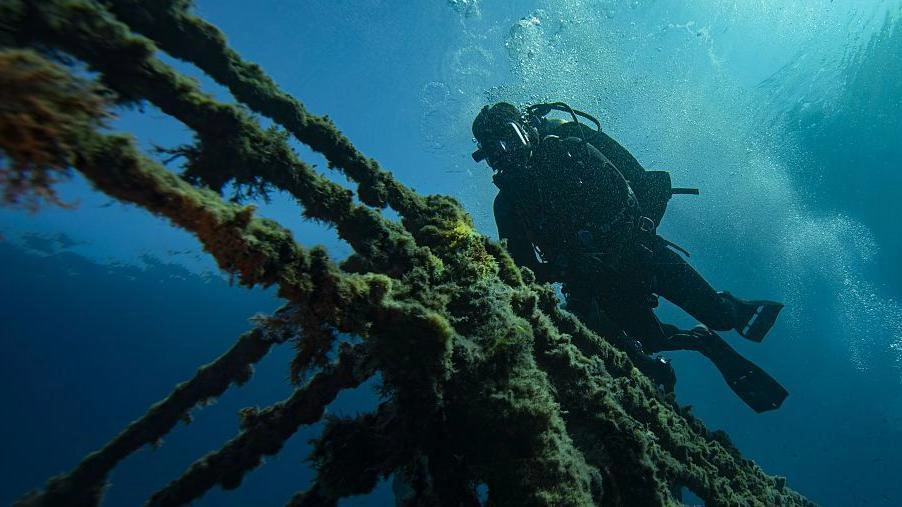
Many marine microbes, algae and invertebrates quickly attach to and proliferate on ships when these vessels remain stationary for long periods. This phenomenon is known as “biofouling.”
“There is a whole set of organisms – typically invertebrates and algae – that we call sessile or sedentary, since they spend their lives attached to a surface,” explains marine ecologist Mario Tamburri, lead author of the study and professor at the University of Maryland in the United States.
Tamburri published this warning together with scientists from the United States, Argentina, Portugal, Saudi Arabia, New Zealand, Finland, South Africa, Canada and Israel.
Tamburri explains that, whenever a new structure is introduced into the sea, it initially begins to be colonized by bacteria and other microbes that form a microbial film.
"Subsequently, this biological film is colonized by spores of macroalgae - such as kelp forests - or by invertebrate larvae - such as barnacles, worms and similar organisms. These communities grow and expand, since they require hard surfaces to develop."
The Persian Gulf has very little hard surface seabed. Its bottom is mainly composed of mud, silt and sand.
Therefore, as soon as these organisms find a solid surface - such as boats - to which they adhere, they do so, explains Tamburri.
Given its central position in global shipping routes, the Gulf is both a place where ships transport these fouling organisms from other parts of the world and a place where vessels can accumulate them while lying dormant.
Following the closure of the Strait of Hormuz, a large number of large vessels have remained idle for a very long period.
Researchers say this is an “unprecedented” situation in modern history. For example, the blockage of the Suez Canal in Egypt lasted six days in 2021, while the collapse of a bridge in the port of Baltimore in the United States interrupted the activity of a few ships for about 11 weeks in 2024, notes the scientist.
Scientists note that ships in the Gulf region typically remain in port for one to three days before setting sail. They add that invasive species can quickly accumulate on ships after periods of more than 10 days.
In 2023, the International Maritime Organization recommended that ships that have been idle for long periods take measures to combat biofouling before returning to sea.
Many ships in the Gulf have been idle for months now.
“If the worst possible scenario had to be designed regarding ship biofouling and the spread of invasive species, nothing better than this could have been devised,” says Tamburri.
Additionally, many marine invertebrates and algae reproduce in response to seasonal changes.
When the Strait of Hormuz was closed in late February, the waters were just beginning to warm ahead of the summer months.
“This increase in temperature usually induces organisms to reproduce, lay eggs, grow and look for new places to live or surfaces on which to develop… if this closure had occurred in the middle of winter, the risks would have been lower,” explains Tamburri.
The report notes that Amphibalanus improvisus, a highly adaptable estuarine barnacle that has spread around the world through shipping and is found in the Gulf, can release up to 36 larvae per adult per day at a temperature of 30°C.
Millions of larvae may have been released during this period of inactivity in the Persian Gulf.
"It is simply the magnitude, scale and scope that is worrying. And the radius of action of the ships in this area, since they sail everywhere," explains Tamburri.
“Enormous” damage
If these organisms are transported to new habitats, they can cause “enormous” economic and ecological damage, says Tamburri.
They can displace native organisms and cause local extinctions, affect fishing and aquaculture, and even clog the cooling systems of power plants, he adds. “Once invasive species become established, especially in marine systems, they are very difficult to remove.”
The report's authors note that these invasive organisms can also carry harmful parasites and pathogens, and that the warm waters of the Gulf region could favor the proliferation of heat-resistant strains.
If introduced into other areas, these strains could prove more resistant than native species to a future increase in temperatures.
Furthermore, the accumulation of fouling organisms is harmful to the boats themselves.
As these organisms grow, they increase the weight of the boat and the resistance to moving forward in the water, which reduces its speed.
“Boats end up consuming more fuel to maintain speed,” explains Tamburri.
“The simple layer of microbial biofilm that grows on the hull can result in 2% to 5% more fuel consumption.”
“If there is strong biological fouling, with the presence of barnacles and mussels, fuel consumption could increase by up to 25%.”
Antifouling paint containing toxic biocides has been developed to repel this unwanted buildup of marine organisms.
“These paints work well when boats sail frequently… but they are not really effective when boats remain inactive for long periods,” explains Tamburri, since they end up “overtaken by the accumulation of biological fouling.”
After taking into account factors such as maritime traffic, duration of voyages and environmental conditions, the researchers identified several ports that could be especially vulnerable to the arrival of these species.
These include Jeddah (Saudi Arabia), Bombay (India), Colombo (Sri Lanka), Singapore, Alexandria (Egypt), Piraeus (Greece), Algeciras (Spain) and Rotterdam (Netherlands). Ports with similar environmental conditions – such as warm, saline waters – could be “extremely susceptible,” says Tamburri.
International cooperation
Scientists say that in an ideal scenario, idle ships should be cleaned before leaving the Gulf.
However, clearing the large number of huge and heavily embedded vessels is a challenge.
Experts highlight the importance of collecting and eliminating organisms to prevent them from dispersing in the water, as well as not releasing the antifouling paint, which contains toxins and microplastics.
It is possible to clean ships and capture organisms using technologies such as robotics. However, most underwater cleanup services in the Gulf do not capture the waste, as this is a relatively recent practice, Tamburri notes.
There is also a capacity problem due to the huge number of vessels with heavy fouling accumulation, he adds.
Given the magnitude of the problem, the urgency of resuming shipping and evacuating stranded crews, as well as various logistical constraints, scientists consider it unlikely that properly cleaning ships before their departure is a practical solution.
They say international cooperation will be essential and that ports expecting to receive ships from the area should be prepared to clean them upon arrival to mitigate the risk of the spread of invasive species.
“We are pretty sure that reopening the Strait of Hormuz will lead to the introduction of non-native organisms,” Tamburri says.
"Some invasive species can remain in the background: they are there, but they go unnoticed or do not cause significant impacts. Others, however, do."
The researchers note that the possibility of the problem becoming a global “widespread bioinvasion” event now depends less on what has grown on the ships, and more on the future international response.