
"The Government remains firm in its political stance of respecting the Three Non-Nuclear Principles. On that basis, the mission of our country, the only nation that has suffered atomic bombings, is to lead the efforts of the international community towards a society free of nuclear weapons, guaranteeing that a tragedy of such magnitude will never be repeated," said Prime Minister Sanae Takaichi, from the ceremony commemorating the 81st anniversary of the US dropping of the atomic bomb on Hiroshima.
Takaichi, who minutes before had met with the survivors of the atomic bombs ('hibakusha') to listen "directly" to their testimonies, reaffirmed in a press conference his "strong determination to never repeat the tragedy that occurred" on August 6, 1945 in Hiroshima and three days later in Nagasaki.
A nuclear debate “without taboos” and a “realistic approach”
However, when asked about the review conference of the Treaty on the Prohibition of Nuclear Weapons to be held in November at the UN, she advocated for a “realistic approach” and declared that it is “necessary to evaluate the situation considering international trends and the increasingly complex security landscape” in the region.
Her first appearance at the ceremony as head of government comes as the government prepares to review its key national security documents, raising questions about whether nuclear principles will remain intact, especially after Defense Minister Shinjiro Koizumi called for a “no taboos” nuclear debate.
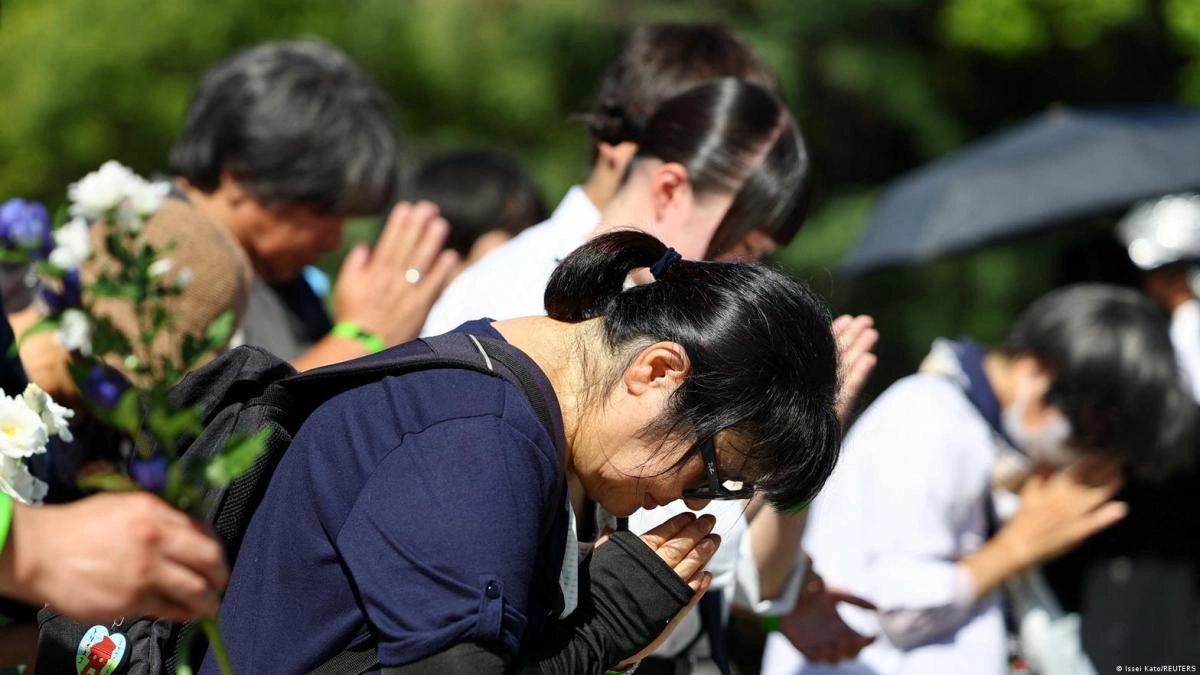
The prime minister met with the 'hibakusha', relatives of the victims and local and foreign representatives at the Hiroshima Peace Memorial Park, where they observed a minute of silence at 8:15 local time (23:15 GMT on Wednesday), when the bomb exploded over the city, leaving an estimated 140,000 dead.
A Government in favor of nuclear deterrence
This year's ceremony is held in a context of growing speculation about whether the Takaichi Government - a supporter of nuclear deterrence - could relax the Three Non-Nuclear Principles adopted by Japan after the war, coinciding with the preparation of new security and defense documents scheduled for the end of the year.
Takaichi has advocated reviewing these principles, raising the possibility of eliminating the third: the one that prohibits the introduction of nuclear weapons into Japanese territory.
Japan is under the United States' "nuclear umbrella" and has repeatedly asked Washington for assurances about its commitment and stronger protection. Because of this, the Government of Japan has rejected the survivors' request to sign the Treaty on the Prohibition of Nuclear Weapons or to attend its meetings as observers.
Warning against “another Hiroshima or Nagasaki”
“Downplaying the inhumanity of nuclear weapons and accepting the use of force to seek one's own prosperity carries the risk of generating cycles of violent retaliation that could ultimately lead to another Hiroshima or Nagasaki,” declared the mayor of Hiroshima, Kazumi Matsui, this Thursday (08/06/2026).
Too many political leaders continue to view nuclear deterrence as a realistic approach and legitimize violence, which “simply further distances the possibility of a world without nuclear weapons,” Matsui said in his peace statement at the ceremony. He also called on every citizen to learn from the lessons of the past and take action.
"The horror of nuclear weapons is just one of the lessons of Hiroshima. Another is the need to build a world in which the threat or use of these weapons is unthinkable," said United Nations Secretary-General António Guterres in a statement.
Without the US ambassador
At this peace ceremony, in which some 50,000 people were expected to attend, including representatives of some 120 countries and regions, including the United States and Iran, the US ambassador to Japan, George Glass, was absent for the first time.
lrass reported that it will not participate in the Nagasaki ceremony either. Washington will be represented this year at both events by the 'number two' of the diplomatic legation, Aaron Snipe.
Without giving any reason for their absence, Glass said in a statement that Hiroshima and Nagasaki “are not only inspiring symbols of peace and hope for the world, but also a reminder that the alliance between the United States and Japan can never rest in its mission to preserve peace and protect freedom throughout the region.”