

Monument in Pyongyang reveals how many North Korean soldiers have died in the war between Russia and Ukraine
An estimated 11,000 North Korean soldiers were sent to fight in Russia's war against Ukraine
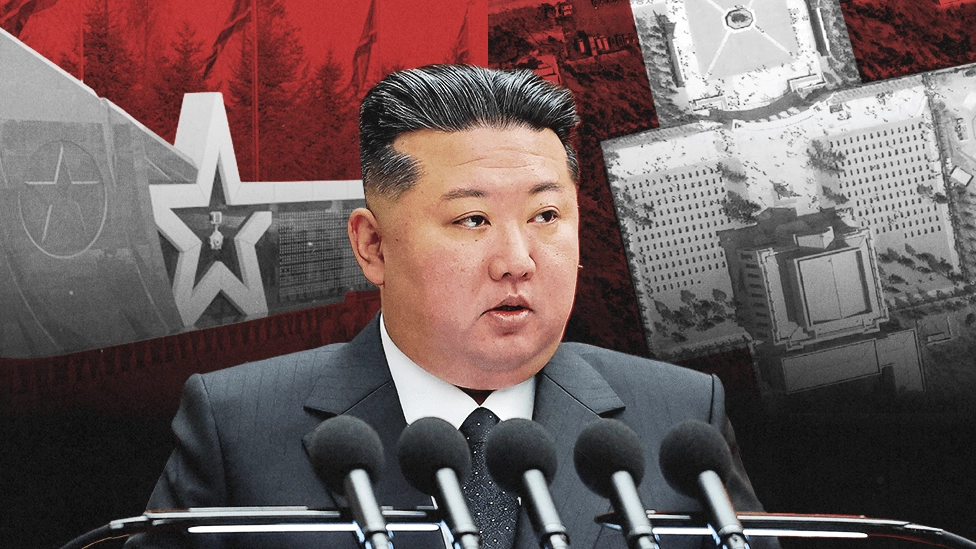

Some 2,300 North Korean soldiers have died fighting alongside Russia in its war against Ukraine, according to a BBC investigation based on satellite images and official photographs of a new memorial in Pyongyang.
South Korea estimates that at least 11,000 North Koreans were sent to Russia to help recapture parts of western Kursk, after Ukraine launched a surprise raid on Kursk in August 2024.
North Korean leader Kim Jong Un publicly paid tribute to soldiers killed in the war, and it is believed that in exchange for sending soldiers, Pyongyang received food, money and technical assistance from Moscow.
The secretive regime has never revealed the death toll in the Kursk operation, which Russia claims to have fully recovered; However, for the first time, the new monument offers visible clues. This is what they reveal.
Names on the walls
In October 2025, North Korean leader Kim Jong Un ordered the construction of a museum in the Hwasong district of Pyongyang to honor soldiers who fell in the Russo-Ukrainian war.
According to a BBC analysis based on satellite images provided by Planet Labs, an American imaging company, work began that same month in a densely forested area.
In December the basic structure of the 52,000 m2 complex could be seen. By March, most of the exterior construction appeared to be completed. The gardens and surrounding facilities were completed last month.
Opened on April 26, the Commemorative Museum of Combat Feats in Overseas Military Operations seeks to convey the “unparalleled bravery” of North Korean soldiers during their deployment to “liberate the Kursk region,” according to Korean state news agency KCNA.
The monument consists of two 30-meter-long memorial walls engraved with names, a building and a cemetery.
A BBC analysis of several images published by KCNA shows that each wall is divided into approximately 14 sections, marked with gray stone lines at the top. The names are engraved in nine of these sections, each with approximately 16 columns, according to a BBC estimate.
Eight names of fallen soldiers are inscribed on a column, as close-up photographs of the east wall show.
With 16 columns and nine sections, this would be equivalent to 1,152 names engraved on each wall, making a total of 2,304 names between both memorial walls.
Songhak Chung, a senior researcher at the Korean Institute for Security Strategy, agrees with the BBC's findings.
"The memorial walls are filled with names of dead soldiers written in tiny characters. Given the surface area and density of the text, it is likely that the number of people registered there reaches several thousand," he says.
The exact figure cannot be determined due to a lack of high-resolution images, but the BBC's estimate is close to the figure provided by South Korea's National Intelligence Service (SNI).
In September 2025, the spy agency reported that about 2,000 North Korean soldiers had been killed and another 2,700 wounded.
However, in February this year, the SNI updated the figure, indicating that some 6,000 of the approximately 11,000 military personnel deployed in Russia had been killed or wounded, although it did not provide a breakdown of the figures. Neither Pyongyang nor Moscow have provided official figures.
A “stratified system”
The monument itself features a “stratified system of commemoration,” according to Korean research firm SI Analytics.
Soldiers who demonstrated “extraordinary valor” are honored with outdoor graves and tombstones, while others are commemorated in urns inside the columbarium.
Kim Jin-mu, a former senior researcher at the government-funded Korea Institute for Defense Analysis, says those buried at the cemetery could include recovered bodies, high-ranking officers or people who received special recognition, including those who acted with selflessness.
According to a satellite image taken in early April and provided by SI Analytics, there are approximately 140 graves on the west side of the cemetery and 138 on the opposite side.
There is also what appears to be a gray building in the center of the cemetery, probably a columbarium that houses funeral urns, according to Chung.
Describing the columbarium, Chung states that “the entire wall appears to be covered with storage compartments in a grid pattern for the remains.”
“The columbarium is a three-story building, and even without counting the offices and exhibition areas, the interior repository alone could hold at least 1,000 sets of remains,” Chung adds.
Justification of war
South Korea's Unification Ministry says it is "difficult to confirm" whether all fallen soldiers were commemorated on the walls.
However, researcher Kim believes that it is very likely that the names of all the North Korean soldiers who died in Kursk are inscribed.
“The monument aims to reward those who sacrificed for the State and maintain public support,” he says. “Omitting names could cause discontent among the families of the deceased and undermine its purpose.”
North Korean state media also reported that a housing complex for Russian war veterans and their families had been built in the same district. Residents began moving in in March.
Cho Han-bum, a senior researcher at the state-run Korean Institute for National Unification, says Pyongyang's decision to build a monument dedicated to fallen soldiers reflects an attempt to justify the deployment in the wake of heavy casualties.
“For North Korea, Russia is the only country with which it can cooperate militarily in its current state of isolation,” he says.
The monument also symbolizes Pyongyang's willingness to continue military cooperation with Russia "regardless of the outcome of the war."
Graphics by Arvin Supriyadi. Additional reporting by Grace Tsoi.