
This Saturday, Spain criticized the response of some European Union countries to the massive arrival of migrants in Ceuta and described it as “selfish, polarizing and illegal.”
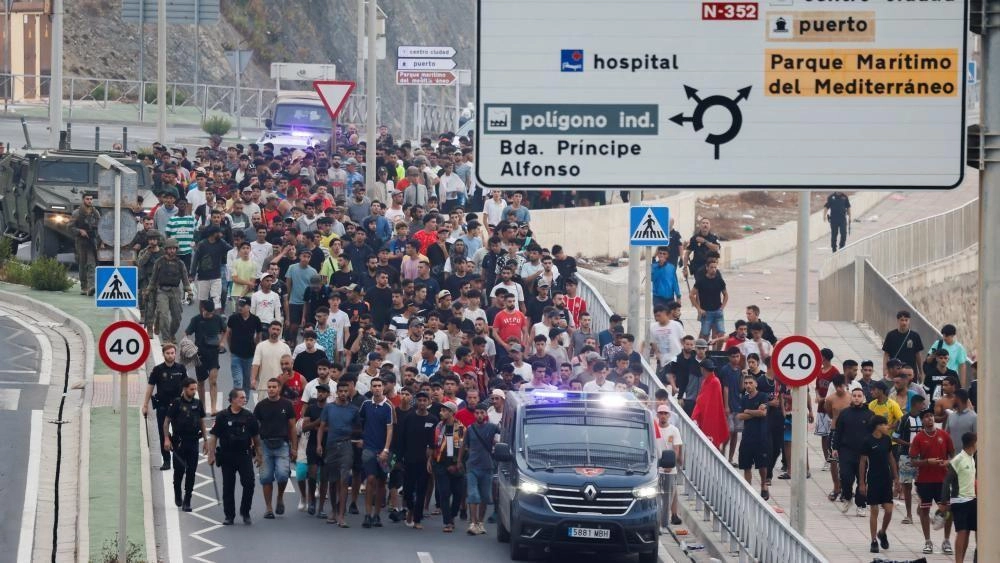
Nearly 50,000 people arrived in the Spanish enclave from Morocco on July 30, according to local authorities.
Spain assures that almost all of them, some 48,000, have returned to Morocco, while the delegate of the Government of Ceuta, Miguel Ángel Pérez Triano, confirmed this Sunday that at least 72 people drowned while trying to reach Ceuta.
The crisis has opened a dispute within the EU after Italy announced the temporary suspension of the Schengen agreement with Spain, which allows the free movement of people between member countries.
The Italian Prime Minister, Giorgia Meloni, described the images from Ceuta as “shocking.”
Finland and Denmark supported the Italian position, while the Czech Prime Minister, Andrej Babiš, called for a temporary suspension of Spain from the Schengen area.
In a letter addressed to the president of the European Commission, Ursula von der Leyen, the president of the Spanish government, Pedro Sánchez, stated that he had “serious concerns” about some European governments.
He claimed that Madrid had fully reestablished border control and prevented any “unauthorized movement towards continental Europe” in less than 48 hours.
Sánchez pointed out that, although the majority of European governments had shown "support and solidarity", others had chosen to attack Spain, motivated, he said, by "prejudices, fake news, ignorance or political interests."
The Spanish leader also recalled that Ceuta is not part of the Schengen area.
“The European Union cannot afford this type of selfish, polarizing and illegal reaction,” Sanchez said in the letter.
He also called for an urgent meeting with EU Interior Ministers to “reaffirm that the security of our external borders is a shared responsibility of all Member States.”
22 of the 27 countries of the European Union also requested an emergency meeting in an open letter, in which they expressed their “serious concern” about the situation in Ceuta.
The letter indicates that the member countries “welcome that Spain and Morocco are cooperating closely to guarantee the rapid return of migrants,” but insists that a video conference of EU Interior Ministers would help reach an agreement on the mobilization of community mechanisms and support for Spain to reestablish “effective control” of the border and prevent new uncontrolled crossings.
Political and diplomatic repercussions
There were scenes of chaos in Ceuta on Thursday, when border controls in the Spanish enclave in North Africa were apparently overwhelmed.
In a press conference held this Saturday, the Minister of the Interior, Fernando Grande-Marlaska, assured that the situation in Ceuta had practically returned to normal.
“Almost all the migrants have already left Ceuta,” the minister declared to journalists, adding that businesses have already reopened. “The situation has taken an almost complete turn.”
Grande-Marlaska also stated that Spain had begun installing an inflatable maritime barrier to prevent new irregular crossings by sea.
Although the situation on the ground has improved, the political and diplomatic repercussions of the crisis are already being felt in Madrid and other European capitals.
On Thursday, Italian Prime Minister Giorgia Meloni stated on social media that the “uncontrolled immigration” registered in Ceuta represented a threat to national security.
Subsequently, Italy announced the suspension for one month of the Schengen agreement with Spain.
The Schengen area is an open border system that encompasses 29 European countries that have abolished controls at their common borders.
Spain responded by summoning the Italian ambassador in Madrid, while its Foreign Minister stated that he expected “European solidarity and not partisan demagoguery.”
For her part, Finnish Interior Minister Mari Rantanen reported that her government had begun preparing to reestablish internal border controls “if necessary.”
Likewise, he urged “all European countries” to support Meloni's initiative.
Danish Prime Minister Mette Frederiksen also called on the EU to “consider all options”, including suspending cooperation within the Schengen area.
France has reinforced controls on its border with Spain and announced that it will increase police presence starting Saturday.
Portuguese Prime Minister Luís Montenegro said his government was considering strengthening border controls.
The president of the European Commission, Ursula von der Leyen, stated that the images from Ceuta were “unacceptable”.
“We cannot allow anyone to enter our Union without respecting our rules,” he wrote on social media.
German Chancellor Friedrich Merz said he “supports Spain's intention not to allow illegal immigrants to enter the European continent” and called on Morocco to “immediately receive illegal immigrants.”
In the US, the State Department stated that the episode was a direct consequence of Spain's immigration policies.
“Not a single person” has reached the continent, according to Madrid
Spain has defended its management of the migratory wave.
Madrid sent troops, more police officers, drones, divers and boats to Ceuta.
It also deployed its armed forces to reinforce security in Melilla, the other Spanish enclave in North Africa, where hundreds of crossing attempts were also recorded.
Sánchez, who visited Ceuta after the influx of migrants, said he would consider reinforcing the border with Morocco and that Moroccan authorities were cooperating.
He attributed the sudden increase in migrant arrivals to human trafficking mafias and described what happened as a “violation of the territorial integrity of Spain.”
According to him, the “mafias that traffic in human beings” made an “interested reading” of a Supreme Court ruling,” which “spread like wildfire.”
European Commissioner Magnus Brunner declared, after a telephone conversation with the Spanish Foreign Minister, José Manuel Albares, that “not a single person” reached continental European territory.
Three weeks ago, the Spanish Supreme Court ruled that migrants detained at sea while trying to reach Ceuta or Melilla cannot be immediately returned to Morocco without due process.
Although the magnitude of this year's arrivals is extraordinary, Ceuta has long been a transit point for those trying to reach Europe.
During the summer months, mass crossing attempts are often organized, often coordinated through social media.
In 2021, nearly 8,000 people entered Ceuta in a matter of days, exacerbating Spain's diplomatic tensions with Morocco.
Morocco, which suffers from high unemployment, witnessed several anti-government protests by Generation Z last year, with young people demanding better opportunities and improvements in public services.
Together with Melilla, Ceuta forms the only land border of the European Union with Africa. Migrants can access the enclave by swimming several kilometers.
Spain has a relatively flexible stance on immigration. In April, the government approved plans to grant legal status to 500,000 undocumented immigrants, allowing them to formally integrate into the labor market.
At that time, the right-wing Italian prime minister already criticized Sánchez, saying that the policy “would affect her neighbors.”
In June, the European Parliament approved stricter immigration rules giving authorities greater powers to return irregular migrants.
Download the new BBC World Service app. Choose BBC News Mundo and receive news alerts, documentaries and analysis, all in one place. Important: The new app is not available in the United Kingdom or the United States.