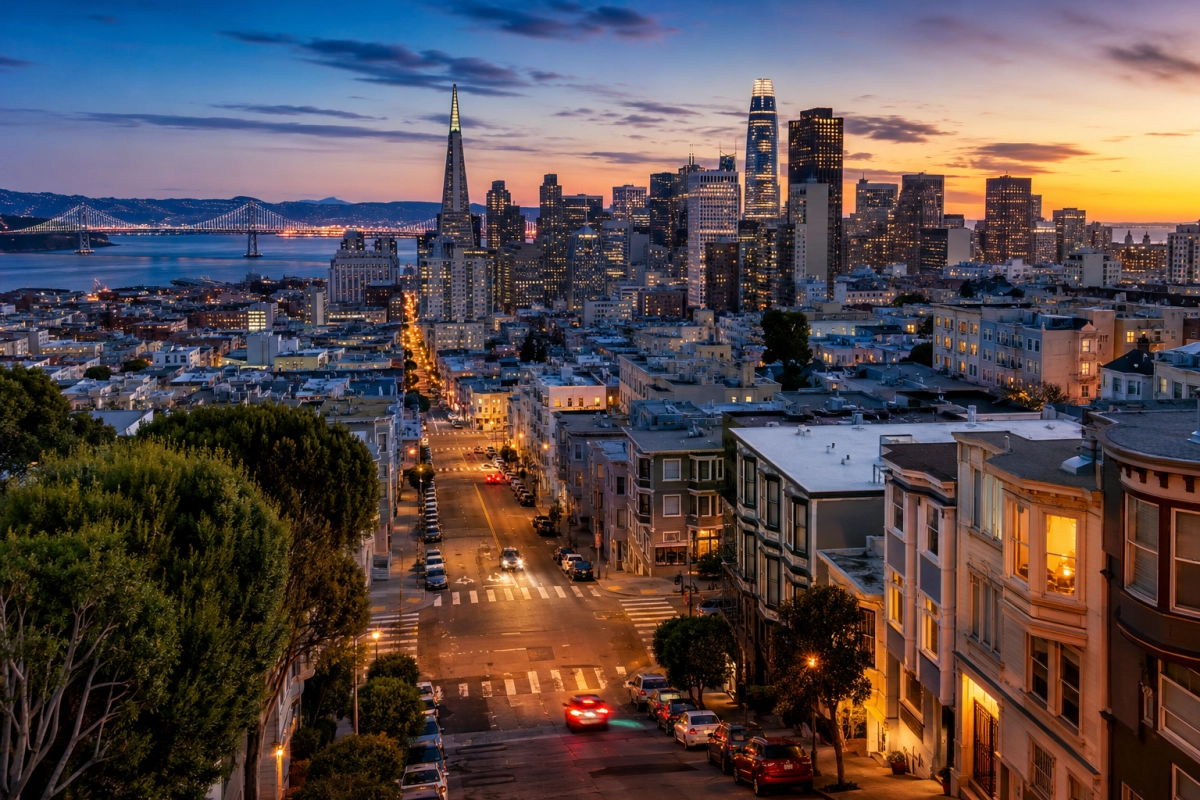

San Francisco is experiencing an overall reduction in reported crime, but the risk is not distributed equally throughout the city. Police records for the first half of 2026 show that robberies and other property crimes continue to be concentrated especially in certain downtown sectors, commercial areas and neighborhoods with large tourist traffic.
The information comes from the official database Police Department Incident Reports: 2018 to Present, published by the San Francisco Police Department?SFPD? through the municipal DataSF portal. The database brings together reports made by agents, digital complaints filed by citizens and records associated with stolen or recovered vehicles. It only incorporates cases reviewed and approved by a police supervisor.
The analysis allows us to observe the events that occurred between January and June 2026 according to their category and the neighborhood assigned by the Police. However, before talking about the neighborhoods “with the most robberies” it is necessary to make a distinction: the word robbery can refer to different crimes.
What the San Francisco Police consider to be robbery
The SFPD separates incidents into several categories:
Therefore, an area may have a lot of thefts, but not necessarily a high number of violent robberies.
SoMa, among the areas with the highest concentration of incidents
South of Market, known as SoMa, appears as one of the main points of attention on the San Francisco crime map.
The neighborhood extends south of Market Street and brings together shopping centers, offices, hotels, museums, event spaces and some of the city's busiest transportation stations. This combination produces a daily circulation much higher than its resident population.
SoMa records include numerous reported thefts from commercial establishments. An especially relevant case is the Fourth and Mission sector, where changes in the number of reports filed by a single business can significantly alter the numbers for the entire neighborhood.
This does not mean that all streets in SoMa are equally dangerous. The neighborhood is extensive and presents very marked differences between sectors. However, the concentration of businesses, tourists, stations and parked vehicles increases opportunities for theft.
Tenderloin continues among the neighborhoods that require more caution
Tenderloin is located in the heart of San Francisco, close to Union Square, Civic Center and numerous hotels. Its location causes some travelers to enter the neighborhood without realizing it when traveling a few blocks.
The area historically has a high concentration of robberies, assaults and other reported incidents. It also faces issues related to the street drug trade, homelessness and mental health crises.
For a visitor, the most important fact is that security can change a lot over very short distances. A hotel advertised as close to Union Square may be located toward the Tenderloin, with a very different setting from the commercial area to the east.
This does not imply that every person who walks through the neighborhood will suffer a crime. It does justify avoiding unnecessary trips during the early hours, not displaying phones or cameras and checking the location of the accommodation precisely.
Mission accounts for a significant portion of reported thefts
The Mission District is one of the most attractive neighborhoods in San Francisco for its restaurants, murals, nightlife and spaces like Dolores Park.
At the same time, for years it has been one of the areas where a significant portion of reported robberies are concentrated. A historical analysis of SFPD data found that Mission, Tenderloin, SoMa, Financial District and Bayview accounted for about half of the robberies reported during the first six months of each year since 2018.
In Mission, the primary risk to a visitor is typically associated with phones, bags, and personal items, especially around BART stations, transit stops, busy streets, and nightlife areas.
The neighborhood should not be discounted as a tourist destination. The recommendation is to visit it with the usual precautions of a busy urban area and avoid walking distracted with your phone in your hand.
Financial District: many incidents and few residents
The Financial District also frequently appears among the areas where robberies and property crimes are concentrated.
However, their rates per 1,000 residents can be misleading. The neighborhood receives workers, shoppers and tourists daily, but has a relatively small residential population.
When a crime affects a person who works or visits the area, the incident is added to the neighborhood total. But that person is not incorporated into the resident population used to calculate the rate.
For this reason, a high rate does not necessarily mean that each visitor has an exceptionally high probability of being a victim. It indicates that there is a significant concentration of incidents in relation to those who live permanently there.
You can see: Alert in San Antonio: car thefts are increasing and the police warn of a pattern
Bayview, another sector with a historical concentration of robberies
Bayview is less touristy than SoMa, Tenderloin or Mission, but it appears in long-term analyzes as one of the neighborhoods that account for a significant portion of reported robberies.
The area is located in the southeast of San Francisco and combines residential, industrial and commercial areas. For most tourists it is not part of the usual routes, although some may cross it when traveling by car or to southern sectors of the city.
Not all Bayview locations present the same level of risk. As happens in other large neighborhoods, incidents are concentrated in certain streets and corridors.
Thefts are not the same as violent robberies
One of the biggest sources of confusion in crime statistics is that in everyday language “robbery” is used for very different situations.
A phone stolen without the victim's knowledge is generally recorded as a larceny theft. If the perpetrator hits or threatens the person to keep the phone, the incident may be classified as robbery.
The difference is important because property crimes are much more frequent than violent acts. Presenting both categories as if they were equivalent can generate a distorted image of the city's safety.
The map drawn from police records distinguishes property crimes — burglary, larceny theft and vehicle theft — from violent crimes, which include assault and robbery.
Crimes fell in San Francisco during the first half
Although some neighborhoods have more incidents, the general outlook for 2026 shows a reduction in reported crime.
During the first six months of the year, both violent crimes and property crimes decreased. The biggest drops were seen in burglary, theft and vehicle theft, according to the analysis of police records published in July.
This means that the identification of areas with more robberies should not be interpreted as evidence of a crime wave throughout San Francisco.
A city can register a general decline and, at the same time, maintain pockets of concentration in certain neighborhoods, stations, businesses or corridors.
Car theft continues to be a risk for tourists
For those visiting San Francisco by car, the most well-known problem is the theft of items left inside parked vehicles.
Although these incidents have decreased compared to their highest levels, the Police recommendation continues to be not to leave visible objects inside the vehicle.
This includes luggage, backpacks, shopping bags, computers, cameras, documentation, and cables or chargers that may suggest devices are stored.
It is also not advisable to park and then move your belongings to the trunk, as someone could observe the maneuver. The safest thing is to put everything away before arriving at the place where you will leave the car.
Tips to reduce the risk of theft
The most effective precautions are simple: