

The coffee shops in India in which the customers pay with garbage
A pioneering initiative, which has been replicated in several Indian cities, seeks to combat plastic pollution and hunger
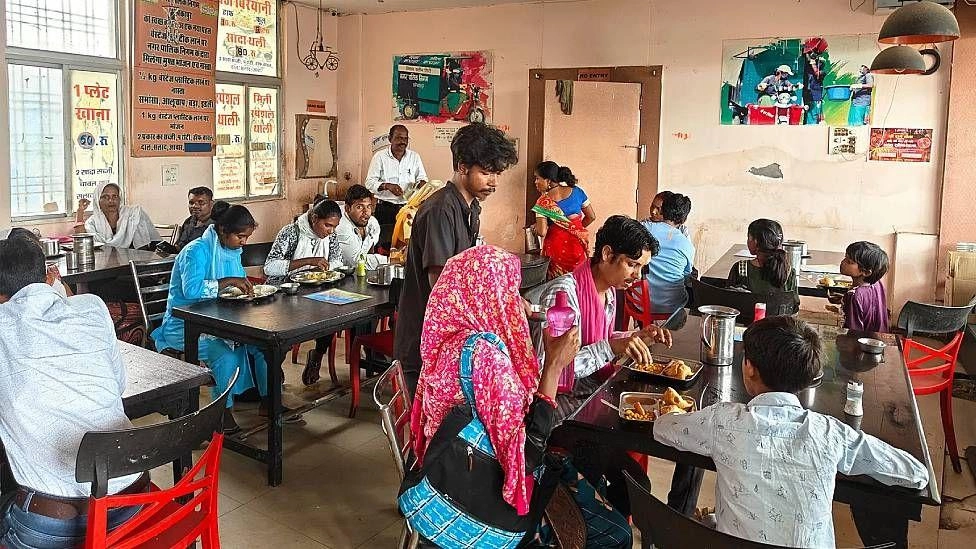

“Garbage cafes” are proliferating throughout India. The BBC visited the town of Ambikapur to find out the true impact these businesses can have on the plastic pollution crisis and on the people.
As I approach India’s first trash cafe on a cloudy, misty winter day in early 2025, the smell of warm samosas, a type of traditional pastry, immediately makes the place feel welcoming.
Inside, people sit on wooden benches with steel plates piled high with steaming food, some chatting, others eating leisurely.
Every day, hungry people arrive at this cafe in Ambikapur, a town in the central Indian state of Chhattisgarh, hoping for a hot meal.
But they don’t pay with money; They hand out packets of plastic waste, such as old bags, food wrappers, and water bottles. Diners can exchange one kilogram of waste for a complete meal that includes rice, two vegetable curries, dal (pulses), roti (a type of bread), salad, and pickles, says Vinod Kumar Patel, who runs the cafe on behalf of the Ambikapur Municipal Corporation (AMC), the public body that manages the city’s infrastructure and services. “For half a kilogram of plastic, they get a breakfast like samosas or vada pav (potato buns served with bread and various condiments).” Ambikapur is looking to use the problem of plastic pollution to combat hunger. The first trash cafe opened in 2019, under the motto “the more waste, the better the taste.” The cafe is funded by the AMC's sanitation budget and was set up near the city's main bus stand.
"The idea is to address two existing problems in Ambikapur: plastic waste and hunger," says Patel. The concept is simple: encourage low-income people, especially the homeless and garbage collectors, to collect plastic waste from the streets and landfills, and provide them with hot meals in return.
“Food for my family”
Rashmi Mondal is a local woman who brings plastic to the cafe. Every morning she sets out early on the streets of Ambikapur in search of discarded plastic, from food wrappers to plastic bottles. For her, collecting this waste is a way of survival.
“I’ve been doing this job for years,” says Mondal, looking at the small pile of plastic she’s collected. Previously, Mondal sold the plastic she collected to local scrap dealers for as little as 10 Indian rupees per kilogram (12 US cents), barely enough to survive. “But now I can get food for my family in exchange for the plastic I collect. This makes all the difference in our lives.”
Sharada Singh Patel, who has worked at the cafe since its founding, says that “if food is available instead of plastic, we not only help fill empty stomachs but also contribute to cleaning up the environment.” On average, Vinod Patel notes, the cafe feeds more than 20 people a day.
The cafe has also had an impact on the amount of plastic waste ending up in landfills, says Ritesh Saini, who coordinates sanitation and waste management in the city for Swachh Bharat Mission Urban, a cleanliness and sanitation initiative launched by the Indian government in 2014.
The cafes have collected nearly 23 tons of plastic in total since 2019, he says, contributing to an overall reduction in plastic ending up in landfills in the city, from 5.4 tons annually in 2019 to two tons annually in 2024.
That’s a small part of Ambikapur’s total plastic waste, which will reach 226 tons in 2024, almost all of which is recycled, according to Saini.
The cafe aims to collect the plastic that escapes the main collection network, he adds, as well as encouraging citizen participation.
This is in addition to a broader effort in the city to reduce and recycle plastic waste, which includes stricter rules on plastic use and better ways to sort and manage waste, he adds.
This push has helped the city earn a reputation as one of the cleanest in India.
Zero-waste city
Ambikapur produces 45 tonnes of solid waste a day, says Saini, and “was previously struggling with a 6.5-hectare landfill site located 3.5 km away.”
But in 2016, the AMC converted it into a park and implemented the decentralized zero-waste system in the city, eliminating the need for such a landfill.
The collected plastic is recycled to make pellets that are used in road construction or sold to recyclers,generating revenue for the local government.
The wet waste is used in compost, and only a small amount of non-recyclable scraps are sent to cement factories for use as fuel, according to a 2020 government report. Thanks to this and similar efforts, Ambikapur has become a “zero waste” city.
The plastic collected from the garbage cafe is sent to specialized local waste collection (SLRM) centers run by the AMC.
Ambikapur currently has 20 of these decentralized centers, which sort the collected waste into more than 60 categories to maximize the recovery of recyclable materials.
The centers employ 480 women, called swachhata didis or “cleaning sisters,” who handle waste segregation and go door-to-door daily to collect household waste. They earn between 8,000 and 10,000 Indian rupees (about US$100) a month.
“Between 30 and 35 people bring plastic here every day,” says Sona Toppo, who runs one of these waste collection centers. “While some people contribute regularly, others participate occasionally.” She adds that people from a variety of walk-of-life sectors bring plastic to the center, from street scavengers to shop workers and laborers.
The “Ambikapur model”
Waste collection center staff are provided with gloves and masks to reduce health risks while handling waste, Saini notes, though waste collectors do not receive this hygiene support.
Minal Pathak, an associate professor at Ahmedabad University in Gujarat, western India, who researches climate change mitigation in urban settings, notes that without basic protective gear, garbage collectors are exposed daily to bacteria, sharp objects, and toxic waste, increasing their risk of disease.
Shashikala Sinha, president of the Swachh Ambikapur Mission City Level Federation, a cooperative that organizes and manages women waste collectors, says that since opening in 2016, the centers have collected and recycled approximately 50,000 tonnes of dry waste such as plastic, paper/cardboard, metals and e-waste.
The idea of ??door-to-door waste collection has worked so well that it has become popularized as the “Ambikapur model” and is now being used across the state of Chhattisgarh, in 48 districts.
Ritu Sain, a government official who pioneered the zero waste model in Ambikapur, noted that the aim was always to solve the problem not only in Ambikapur, but also in other medium-sized towns facing similar constraints.
“Our goal was to create a model that was operationally feasible, environmentally sustainable, and financially viable,” he wrote in a blog post for Princeton University in 2025.
Trash cafes have also sprung up in other parts of India. In Siliguri, West Bengal, a program launched in 2019 to offer free meals in exchange for plastic waste.
That same year, a new program in the town of Mulugu, Telangana, began offering one kilogram of rice for one kilogram of plastic.
In Mysuru, Karnataka, a program launched in 2024 allows residents to exchange 500 grams of plastic at soup kitchens for a free breakfast, or 1 kilogram for a free meal, according to local media. Meanwhile, a campaign in Uttar Pradesh is giving out sanitary pads to women in exchange for plastic waste.
However, these programs haven’t always run smoothly.
The city of Delhi also launched a plastic waste collection initiative through cafes in 2020, involving more than 20 locations.
But operations there have slowly been scaled back, facing challenges including a lack of public awareness, poor waste separation practices, and insufficient support for recycling infrastructure, several cafes in Delhi told the BBC.
Saini suggests that the lower enthusiasm for trash cafes in Delhi could be because there are fewer low-income people there than in Ambikapur.
“We need deeper changes”
Outside India, Cambodia has adopted similar programs to try to simultaneously combat plastic pollution and hunger. For example, in floating communities around the plastic-choked Tonle Sap Lake, people can trade collected plastic waste for rice.
Pathak says waste collection initiatives like the one in Ambikapur can also help raise awareness about the negative implications of plastic waste.
However, the government should provide more data to help other cities assess whether the trash cafe approach is right for them, he concludes.
And while plastic waste collection programs have had an impact, they fail to address problems like plastic overproduction, non-recyclable plastics, and a lack of proper waste separation in most Indian households, Pathak adds: “It’s more of a quick fix that addresses surface issues rather than the root causes of the plastic problem.”
Still, he says, such efforts are helpful.They raise awareness about the problem and show that local solutions can have an impact. "It's a good start, but we also need deeper changes."