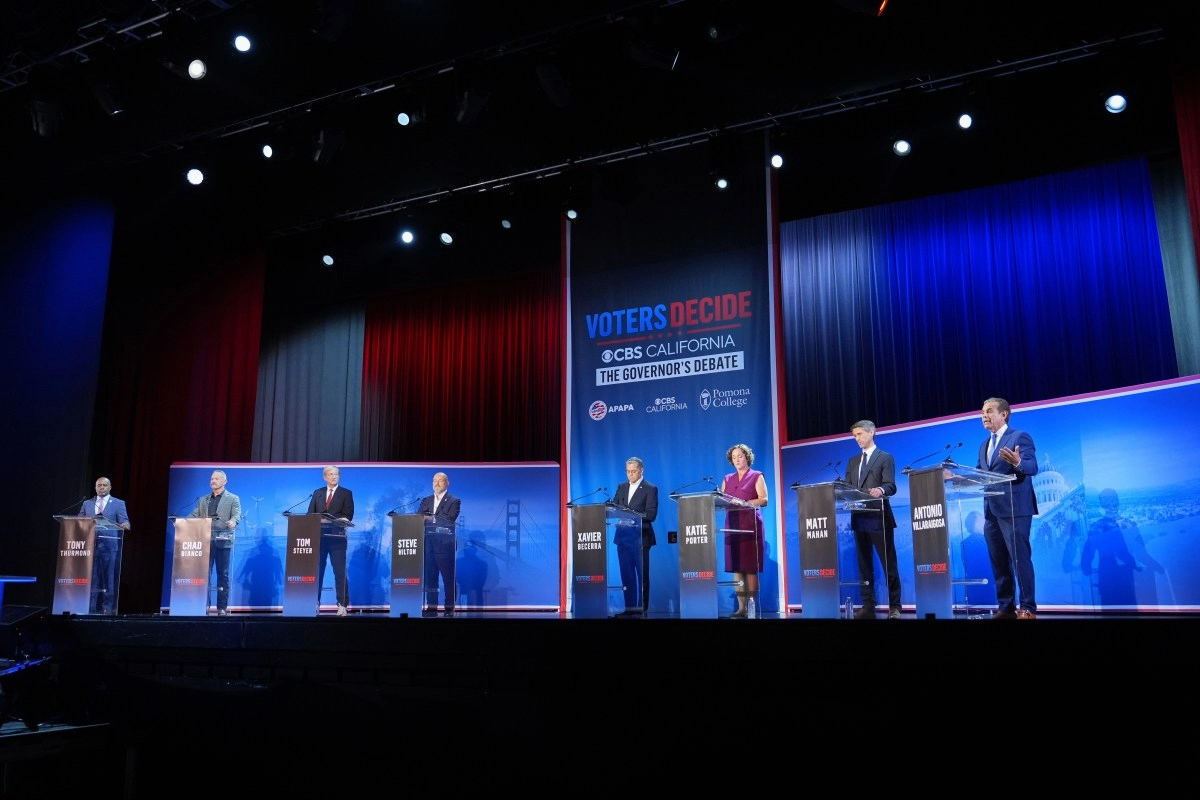

The debate for governor of California became a tense and chaotic confrontation from its first minutes, with personal attacks, constant interruptions, and deep differences on key issues such as the price of gasoline, the housing crisis, insurance, and health care.
During the first half hour, the moderators had difficulty maintaining order among The eight candidates, in a setting that reflected the state's political polarization.
Democrat Katie Porter even lashed out at her political rivals, calling them "worse than their teenage children."
Insurance Crisis
One of the tensest moments occurred when Katie Porter called the FAIR Plan a "huge financial burden," referring to the proposal by Republican Chad Bianco, sheriff of Riverside County.
Porter proposed that the state support insurers to lower reinsurance costs and attract them back to the market: "There are ways to use state funds... to buy more affordable policies."
However, the exchange reflected a larger problem: California is facing an insurance crisis linked to wildfires and climate risks, which has led several companies to leave the state.
Housing, the most ambitious promise
Given that California faces one of the deepest housing deficits in the United States, with millions of homes needed and prices constantly rising, the debate opened the door to proposals to address this crisis.
One who took the lead on this issue was the state superintendent of Public Instruction, Tony Thurmond, who promised to build millions of homes on public land: “We will build 2 million homes… and 2.3 million by 2030.”
He stated that homeownership is “the American dream” and that he would work to provide down payment assistance grants to those who wish to buy a house.
For his part,Porter insisted on expediting permits and reducing costs, while Antonio Villaraigosa proposed a $25 billion support program for first-time buyers.
Economy and Trump in the shadows
Health and National Politics
Education
On the topic of education, a student from Pomona College questioned the candidates about the cost of education.
Thurmond proposed a deferred payment model: “You could use that money to buy a house or start a business.”
“As governor, I will implement this program to help reduce student debt in California,”Antonio Villaraigosa called the tuition fees at the state's top universities, including the University of Southern California and Stanford University, "unacceptable." He stated that his experience working with the Los Angeles Unified School District during his tenure as mayor supports his approach to education. Katie Porter, for her part, proposed two years of free tuition at the state's public higher education systems: the University of California (UC) and California State University. Thus, the debate highlighted not only the profound differences between the candidates but also the complexity of the challenges facing California. With ambitious proposals and opposing positions, the gubernatorial race is shaping up to be one of the most hotly contested in recent years.