

Kevin Warsh sworn in as new chairman of the Federal Reserve: will he lower interest rates?
Kevin Warsh sworn in as Fed chairman at the White House amid pressure from President Trump to cut interest rates
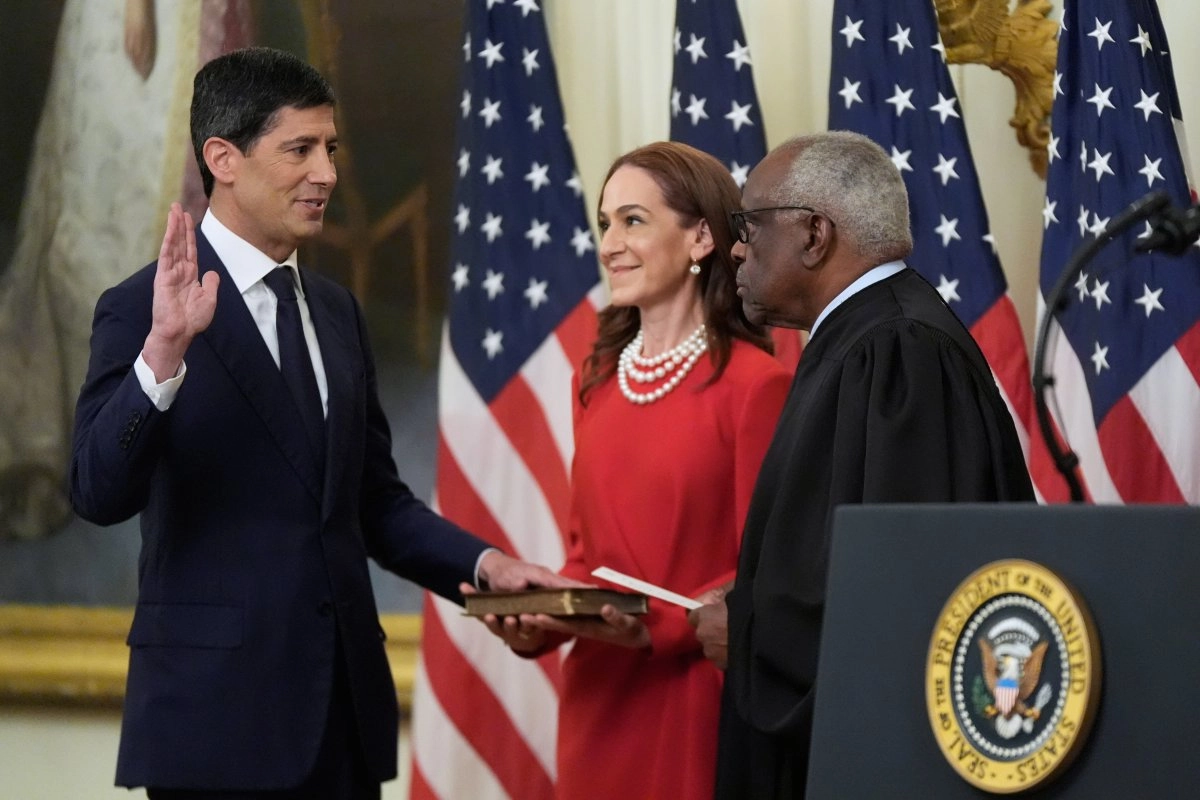

This Friday, a stage at the Federal Reserve (Fed) ends and a new one begins under the command of Kevin Warsh, who was sworn in as the new president of the central bank in a ceremony at the White House. His arrival is framed by the pressure exerted by President Donald Trump, who for months urged Jerome Powell and agency officials to reduce interest rates. Now, the question arises as to whether the new person in charge of monetary policy will give in to these demands.
The swearing-in ceremony took place in the East Room of the White House and was led by President Trump. Justice Clarence Thomas, a member of the Supreme Court, took Warsh's oath before an audience made up of legislators, businessmen and members of the presidential cabinet.
“I want Kevin to be totally independent,” said the American president. “Don't look at me, don't look at anyone.”
However, despite the sobriety of the event and his statements, the president soon after made his position on monetary policy clear again. At an event held in Suffern, New York, Trump assured that interest rates will fall “very quickly,” as if anticipating Warsh's action.
“It all comes down to interest rates,” said the businessman. “If interest rates are lowered, everyone will be very, very happy.”
Despite Trump's expectations, financial markets still consider an immediate rate cut unlikely. Analysts believe that the Federal Reserve could keep them stable for much of 2026 because inflation remains above the 2% target.
Will Kevin Warsh lower interest rates?
Although the new Federal Reserve chair talked about inflation and economic growth, he avoided publicly committing to immediate rate cuts.
“With this oath, I have accepted a great and solemn responsibility,” Warsh declared. “Our mandate at the Federal Reserve is to promote price stability and maximum employment.”
In his inauguration speech, Warsh highlighted the qualities of “independence and determination” to seek lower inflation, without sacrificing economic growth. The economist also announced that he will seek changes within the central bank.
“I will lead a reform-oriented Federal Reserve, learning from the successes and mistakes of the past, moving away from static frameworks and models and maintaining clear standards of integrity and performance,” he explained.
The tension between Trump and Jerome Powell
Warsh's arrival marks the end of Jerome Powell's eight years as chairman of the Federal Reserve. During that period, Powell was a frequent target of criticism from Trump, who accused him of acting too slowly to reduce interest rates.
The president even went so far as to call him “stubborn” and “idiot” while publicly pressing for a more flexible monetary policy.
Despite the change in leadership, Powell will remain as governor of the Federal Reserve, something rare in the recent history of the US central bank.
Warsh's profile and the changes he could promote
Warsh, 56, had already served on the Federal Reserve between 2006 and 2011, during the global financial crisis. After leaving the organization, he criticized that the central bank maintained the emergency measures applied after that crisis for too long.
He has also questioned whether the Federal Reserve is expanding its role towards issues outside its traditional mandate, such as climate change or social inequality.
Now, economists and markets are closely monitoring the possibility that it will promote an internal transformation in the institution. Warsh has previously argued that the Federal Reserve should gradually reduce its huge balance sheet and limit its intervention in markets.
However, any major change will depend on consensus within the Federal Open Market Committee (FOMC), charged with deciding the direction of interest rates.
For now, the new president of the Federal Reserve maintains a speech focused on controlling inflation and modernizing the central bank. The next meetings of the organization will be key to knowing if Trump's pressure will end up influencing US monetary policy.