
The silence with which the church bells received the first rays of the sun on August 1, 1926 announced that that would be a different Sunday in Mexico.
The night before, the Mexican bishops had implemented an unprecedented measure in the history of world Catholicism: the suspension of masses, marriages, baptisms, funerals and any other religious services throughout the country.
The decision was the response to new attempts by the authorities to secularize the country through initiatives such as the reform of the Penal Code known as the “Calles Law,” in reference to then-president Plutarco Elías Calles.
The instrument sought to enforce the anticlerical provisions incorporated into the 1917 Constitution and established fines for religious people who wore cassocks and habits in public, as well as prison sentences for those who openly questioned government policies.
In addition, it limited the number of priests that could be in the country and forced them to register with public bodies in order to exercise their ministry.
The government did not sit idly by and took over the empty temples, which provoked a reaction from the faithful. Three days later, dozens of armed people took over a church in Guadalajara, a city in the west of the country, where they confronted government troops stationed there.
The incident was one of the first in an armed conflict that left some 250,000 dead, according to official figures, and that went down in history under the name of La Cristiada or Cristero wars, due to the motto of those rebelling against the government: “Long live Christ the King!”
A conflict that was brewing
How did a country known for its devotion to the Virgin of Guadalupe end up immersed in a military, religious and political confrontation? Experts consulted by BBC Mundo assured that the answer lies in events that occurred decades before.
“The Cristero war is another episode of the Mexican revolution,” said French-Mexican historian Jean Meyer, author of “La Cristiada,” an extensive three-volume study on the conflict.
Mexican historian Ulises Íñiguez Mendoza also spoke out in similar terms, explaining: “Post-revolutionary governments sought to impose a model of secular society and assigned the Church a much more limited role and, at times, frankly, maintained a hostile attitude toward it.”
The professor from the University of Guadalajara recalled that under the government of General Venustiano Carranza, the 1917 Constitution was issued, which contained five openly anti-clerical articles (3, 5, 24, 27 and 130).
The constitutional norms prohibited the Church from directing schools, they also outlawed monastic orders, limited worship inside temples, stripped churches of legal personality and, therefore, prevented them from owning property, in addition to stipulating that all religious must be of Mexican nationality.
“The model of population control that the post-revolutionary governments wanted to impose brought them into conflict with the control that, without a doubt, the Catholic Church also had,” explained Íñiguez.
“At that time, the Church promoted, for example, a form of unionism and agrarian distribution that was opposed, in many ways, to the nation project of the post-revolutionary Mexican State,” he added.
However, Mexican historian Elizabeth del Carmen Flores told BBC Mundo that the cause must be sought even further back: in the laws that Benito Juárez promulgated in 1855 to achieve the separation between Church and State.
train crash
Experts agreed that tensions between civil and ecclesiastical authorities worsened with the rise to power of President Calles in 1924, who was a fierce critic of the religious institution.
“The Church in Mexico is a political movement and must be eliminated,” Calles wrote to his ambassador in France, according to Meyer in his book.
The president demanded that religious people refrain from getting involved in matters other than spiritual ones, something that went against the provisions of the encyclical Rerum Novarum that Pope Leo XIII published in 1891 and which gave rise to what is known today as the Social Doctrine of the Church.
A year after coming to power, Calles – through the official union Confederación Regional Obrera Mexicana (CROM) – tried to provoke a schism in the Catholic Church with the creation of the Mexican Catholic Apostolic Church (ICAM). Although the initiative failed, the gap with the Catholic hierarchy and part of the parishioner widened.
In June, the then archbishop of Mexico City, José Mora y del Río, stated that the episcopate was opposed to the articles of the Constitution and urged the faithful to request their repeal. Calles, for his part, responded by signing the reform of the Penal Code and the bishops then interrupted worship for the first time in 400 years.
“The suspension of worship is the most drastic measure that the Church could take,” said Flores, who is a professor at the Autonomous University of Zacatecas.
However, the historian clarified that it was not the lack of masses and sacraments that caused the violence, but rather the occupation of the temples by the authorities.
"With the so-called inventories came the closure of temples and many were converted into schools, libraries and, something extremely serious - which also influenced the feeling of grievance of Catholics - is that some were looted and desecrated," he explained.
“For the mentality of a Catholic at the beginning of the last century that was inconceivable,” he concluded.
Íñiguez agreed: “Beyond the pure confrontation between the leaders, it was the grievances against the practice of Catholicism and sacred spaces that made the population's reaction inevitable.”
Bad calculation
At first, the uprising of the “Cristeros” did not worry the authorities.
"'I think we are going to crush them in a matter of two or three months,' Calles told the then governor of Jalisco, one of the most intensely Cristero regions. The governor replied: 'No, Mr. President! You don't know these people; it's not going to be two or three months, but two or three years,'" said Íñiguez.
“In the government, without a doubt, they did not measure the reaction of the population,” added the historian.
The experts consulted assured that there is no evidence that the insurrection was orchestrated by the Catholic hierarchy.
The documents and testimonies point rather towards the so-called National Religious Freedom League, an organization founded in 1925 by lawyers, intellectuals and landowners in order to guarantee Mexicans "the ability to live as Catholics."
The fighting, which was concentrated in the Bajío regions (Jalisco, Guanajuato, Michoacán, Zacatecas and Colima), as well as in Los Altos de Jalisco - the region northeast of Guadalajara - divided the ecclesiastical hierarchy.
“There was a bishop (Antonio Guízar y Valencia of Chihuahua), who prohibited the faithful, as if he were a government official, from violence, while three others were openly pro-Christian,” mentioned Íñiguez.
However, the historian admitted that some religious did fight.
“There were priests in arms, but there were no more than 30 of the 4,500 that statistics tell us that there were then in the country,” he indicated.
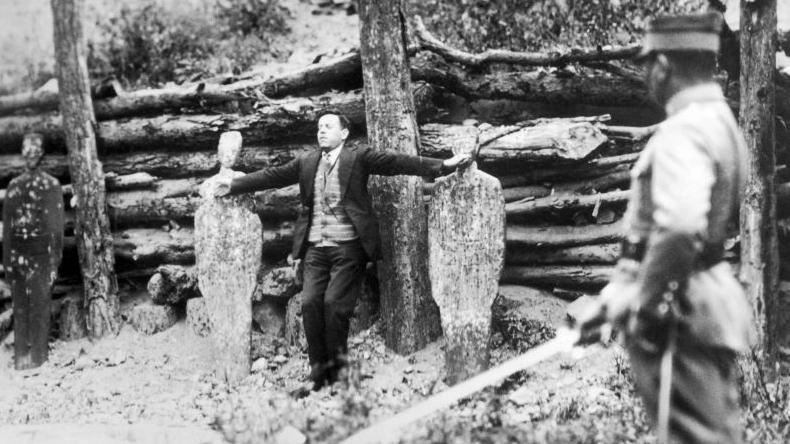
During the war, the authorities intensified their religious persecution, not only against priests—several of whom were shot for the simple act of celebrating mass—but also against ordinary citizens.
"In the archives of the Judiciary I have found files of women who were arrested (imprisoned or harassed) because they were found praying or giving catechism in their homes, despite the fact that public worship was prohibited. In some files, the evidence is images of the Virgin and saints, as well as prayer books," Flores said.
Thousands of people, mostly peasants, were forced by the authorities to move.
The instigators?
Although men were the ones on the front lines, women played a leading role in the conflict.
“Without women there is no Cristiada,” the famous Mexican writer Juan Rulfo once stated, whose family the conflict split in two: one maternal uncle was a priest and another, on the paternal side, was a federal officer who was looking for the first to shoot him, Meyer notes in his work.
"Women were the promoters of the armed uprising. There are countless testimonies, both from the time and later, that maintain that women were the ones who pushed men to take up arms," said historian Flores.
Because? “Because of the fundamental role that women have in Catholicism, in the transmission of the faith,” explained the expert.
“There is evidence that women urged their husbands, fathers and brothers to fight, under penalty of going to the mountains, which constituted an affront to male pride,” he asserted.
In 1927, the Joan of Arc Brigades emerged, which brought together between 20,000 and 25,000 women, according to experts.
But what were the brigade members doing? "Everything, everything except taking up arms; that is, they were in charge of feeding the combatants, organizing hospitals to care for the wounded, passing messages and even weapons, because they were less inspected by the police and soldiers," Íñiguez explained.
“There is a document that says a woman named Glicerina Padilla carried in her body and suitcases 1,232 long cartridges and 700 pistol cartridges of various calibers, 44 pieces of blanket, two blankets, 3 pistols and more than 32 pesos,” Flores illustrated.
And, although women also participated in other conflicts such as the Mexican Revolution, the historian believes that this case was different.
"The Catholics of the time believed that the Adelites were only companions of the revolutionary, that there was no underlying ideological motivation, but the Cristeras did. The truth is that although there were women immersed in revolutionary activities, the Cristeras, in contrast, were defining in the gestation and development of the Cristero movement and that they defended their religious values and the spaces that they had achieved through charitable and lay organizations," he explained.
“There has not been a historical event where the participation of women has been as important as this one,” she stated.
The “settlements” of the conflict
After almost three years of fighting, in June 1929 the Cristero war ended, and the way it ended was as curious as the way it began.
The authorities and the episcopate reached verbal agreements, through which the former returned the temples to the latter, and the latter undertook to celebrate religious services again.
What happened to the articles of the Constitution and the reform of the Penal Code? “They were not touched, but the authorities committed to applying them in a non-sectarian manner,” explained Íñiguez.
This solution went down in history as “the arrangements,” explained Meyer, who pointed out that in practice they should imply a modus vivendi, through which “the Calles Law and the Constitution were not modified, but they were not applied.”
With such an agreement it seems that the Cristeros had been defeated. However, the experts consulted by BBC Mundo denied it.
"The Cristeros were not defeated. In June 1929 they were stronger than ever, but they could not defeat the government," Meyer explained.
"The government, businessmen and foreign investors urged peace. For their part, the Pope and the bishops, who were concerned about the duration of the suspension of worship, also wanted peace," he said.
Íñiguez expressed himself along the same lines, pointing out: “The Cristeros were not taken into account, they were not consulted.”
However, the conflict did not end definitively and in the 1930s there was a second episode, although of lesser intensity.
“After the settlements, hundreds of amnestied Cristero chiefs were murdered in what we could call, and South America knows the term very well, a dirty war by paramilitary groups,” said Íñiguez, who attributed this to the fact that “the settlements” depended on “a very risky good will.”
“Pact of silence”
Another striking aspect of this conflict is that for decades it was an issue that was practically not talked about in Mexico.
The episode was barely studied in schools, but it was not remembered from church pulpits either.
“There was a process of silencing (…) I believe that they were such traumatic events that a process of assimilation and understanding was needed, but also because there was fear of a repetition and of the subsequent persecution and murder of the Cristero leaders,” Flores explained.
Íñiguez agreed: “There was a tacit agreement to try to close that wound, due to a kind of sense of shame and guilt on both sides.”
“The Church, in effect, ordered its bishops to remain silent, because ‘the arrangements’ generated enormous discontent not only among the Cristeros, but also among part of the episcopate and the priests,” he explained.
"From the official side, for its part, the issue was ignored. In the free textbooks of the 1960s and 1970s the conflict was ignored or touched on tangentially," he added.
However, the episode was not lost largely by those who participated in it or witnessed it.
“I remember my great-grandmother talking about when they hid the priests,” Flores said.
However, that began to change in the early 1990s with the reestablishment of diplomatic relations between Mexico and the Vatican, and more recently with the canonizations by Popes John Paul II and Francis of several martyrs from the conflict.
But, a century later, some consequences persist, such as the fact that, in Mexico, the Catholic Church does not own the majority of the temples, but can only use them.