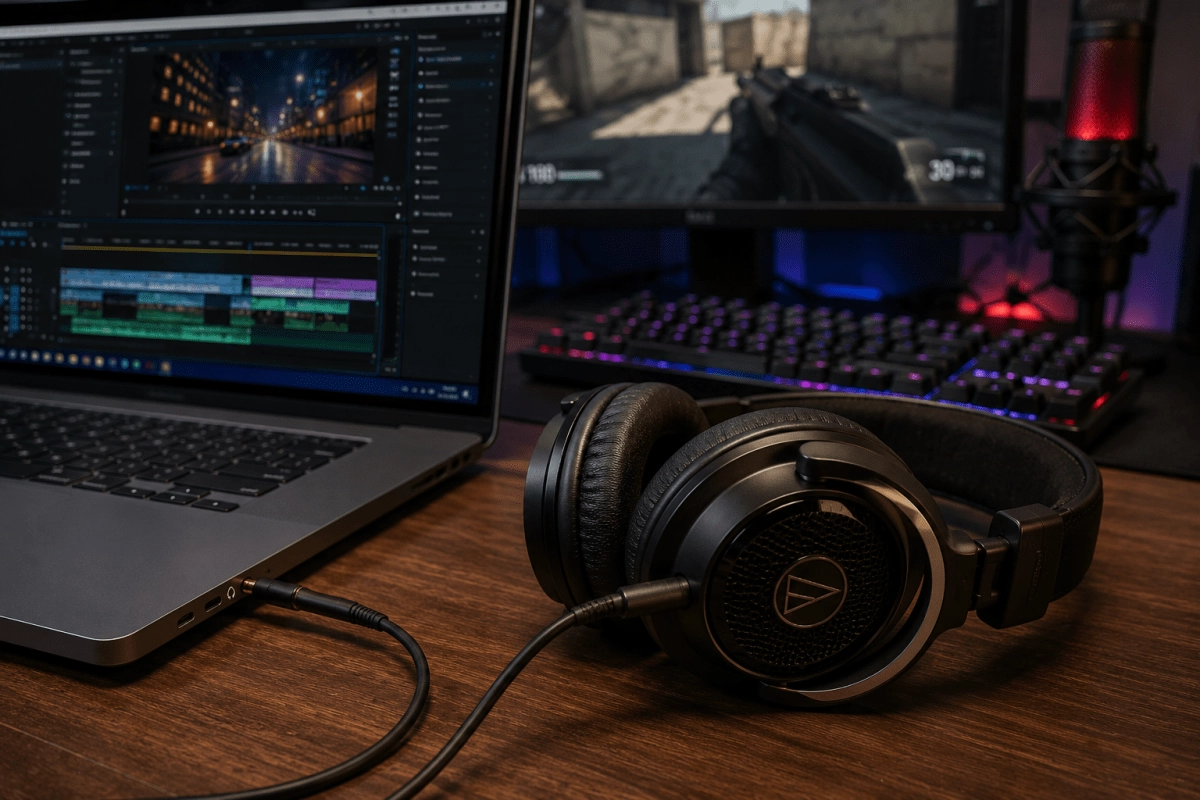

Everyone assumed that the 3.5 mm jack was on its way to the technology museum, along with the CD and USB type A on one side. But it turns out that wired headphones never went away, and in 2026 they are experiencing a kind of silent revenge between gamers, video editors and even journalists. The reason isn't nostalgia, it's pure functionality, something many users rediscover when they get tired of pairing devices or watching their headphones' battery die right before an important call.
This is not a text to convince you to throw your AirPods in the trash. It is rather an invitation to understand that cable and wireless do not compete on the same ground, each one solves different problems depending on what you do with your ears during the day.
Goodbye to the latency problem
If you are one of those who plays online or edits clips for TikTok, this is going to interest you a lot. Latency is that small delay between what happens on the screen and what you hear, and with Bluetooth it can vary between 15 and 30 milliseconds, while a cable has a latency of practically 0 milliseconds. A study by ESL Gaming revealed that 92% of professional players use wired headphones in tournaments precisely for this reason, because in a competitive shooter those milliseconds are the difference between winning or staring at the “you died” screen.
The same applies if you edit video or stream, where synchronizing audio and image perfectly is not a whim, it is a job requirement. The analog streaming offered by cable simply has no real competition at this point, no matter how advanced the Bluetooth codec you use.
No more worrying about the battery of your hearing aids
Here comes one of the most underrated advantages and that is that wired headphones do not depend on batteries that degrade with use. There's no charging, no anxiety about seeing the indicator turn red before leaving the house, and there's no awkward moment when they turn off in the middle of a virtual meeting. You just plug and play, they work just as well today as they will in five years, as long as you take a little care of them.
This also translates into real durability, because by not having complex electronic components or cells that fail over time, a good pair of wired headphones can accompany you for years without planned obsolescence. And speaking of money, when you buy wireless, a good part of the budget goes to chips, batteries and antennas, while with cable all that money translates directly into sound quality.
Who are they really useful for?
Universal compatibility continues to be another plus point, since the 3.5 mm connector works on laptops, consoles, tablets, sound booths and even on the plane without requiring active Bluetooth. This makes them almost mandatory for certain user profiles, although not for everyone equally.
At the end of the day, the question is not which technology is better in absolute terms, but what you need to solve in your daily routine. If your priority is moving freely around the gym, wireless wins hands down. But if your thing is precision, stability and never thinking about charging an accessory again, that cable that many left for dead still has a lot to offer.