
The man who ran the only tavern in Kiowa, Kansas, had managed to take the ax out of the hand of the woman who, seconds before, had entered the premises shouting her intentions to “save men from their drunken fate.” Before running out the back door of the business, the employee even managed to shoot the ceiling.
But not even the sound of the gunshot served to deter a furious Carrie A. Nation, one of the most striking members of the Women's Christian Temperance Union movement, from her goal. In the United States, the woman is known for having accumulated 30 arrests between 1900 and 1910, accused of destroying taverns in several towns in the country.
“One of my companions gave me another axe,” Nation recalled in his autobiography when recounting that first attack in Kiowa, in 1900.
And he narrated: "I went behind the bar to break the mirror and all the bottles that were underneath; I picked up the cash register and threw it on the floor; then I broke the refrigerator hoses and cut all the rubber tubes that transported the beer, so it started to rain all over the place."
Although Nation's story of destruction was unique - often making her the object of ridicule by commentators of the time, who treated her as crazy - the tragic sequence of events that led her to that point was rather common for American women of the time: Nation lost her first husband to alcoholism.
Countless tragic stories of early deaths, domestic violence, and cases of men abandoning their families were linked to excessive alcohol consumption in the United States during the 19th and first half of the 20th centuries.
Average alcohol consumption among men over the age of 15 reached an all-time high in 1830 with 26 liters of 80-proof drink per year. For reference, a whiskey today has between 40% and 60% alcohol by volume.
As award-winning documentary filmmaker Ken Burns described it in his two-part series on prohibition, between the 19th and early 20th centuries, “America was a nation of drunks.”
It was under this complex panorama that a group of women decided to unite and act. For the first time in US history, together they would be able to change the destiny of the entire country.
Temperance
The discussion in the United States about the effects of alcohol on health began in 1784 with a report published by physician Benjamin Rush.
After conducting the first scientific studies on the subject, Rush concluded that alcohol could cause damage to the liver, stomach, digestion, physical appearance and muscle tissue.
Furthermore, in a total departure from what was believed at the time, Rush was the first to declare that alcoholism is a disease that “affects the will,” contradicting the popular wisdom that accused alcoholics of being “lack of character.”
As if this were not enough, Rush was also the first doctor to link cancer to tobacco.
Based on his studies and his strong conviction as a Christian priest, this doctor promoted the “temperance” movement, an ideology based on Christian precepts (self-control, moderation) that advocated abstention from the consumption of alcoholic beverages.
“It was one of the first great reform movements in the United States and was linked to abolitionism: black leaders like Booker T. Washington defended it,” Gioia Diliberto, professor at the University of Illinois and author of the book Firebrands, told BBC Mundo.
“And although there were a lot of men who supported it, the push really came from them, especially in the beginning.”
The movement remained in force during the first part of the 19th century, but saw its efforts diminished due to the outbreak of the American Civil War (1861-1865).
It was only in 1874 that a group of women in Ohio decided to band together to defend temperance values and turn it into a political movement.
Frances Willard and the WCTU
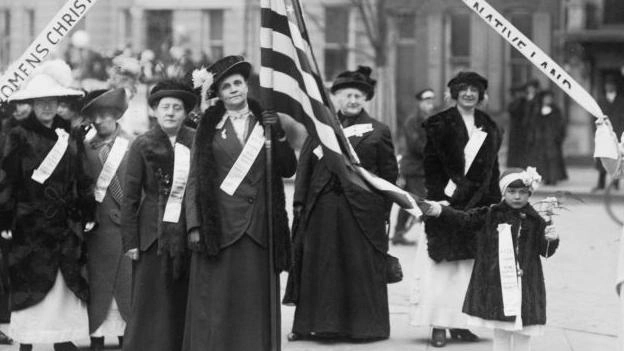
In 1874, a group of women convinced of the precepts of temperance decided to join together to found an organization, the Women's Christian Temperance Union (WCTU), which had the almost exclusive objective of "achieving the complete prohibition of the manufacture and sale of intoxicating beverages."
And during its first years of existence, that was what it dedicated itself to.
But when academic Frances Willard was appointed general secretary of the WCTU, she realized that alcohol prohibition would only come if women gained the right to vote.
“It is key to look at the ban alongside the suffrage movement,” Dr. Sarah Seidman, curator of social activism at the Puffin Foundation at the Museum of the City of New York, told BBC Mundo.
"Both start in the first half of the 19th century and last until the 20th: they are long struggles. Many of the women who promoted suffrage also participated first in temperance and then in anti-prohibitionism. Deep down, they wanted their voices to be heard and they needed more political power to express themselves," she explained.
Willard joined the temperance movement at a young age. She had been a professor and traveled the world in her 20s and, upon returning, ended up serving as dean of women at Northwestern University.
Their arrival coincided with a series of anti-alcohol protests that began to become popular in Ohio between 1871 and 1873, known as the Women's Crusade: demonstrations in which groups of women went from saloon to saloon, praying and asking those who frequented them to repent.
In fact, these crusades were what, a few years later, would inspire Carrie Nation and her famous axe.
Willard was already recognized for her great oratory power, so she was invited to become the spokesperson for the local temperance group and, shortly thereafter, she was promoted to general secretary of the WCTU.
From that position, Willard began to make the organization's leadership uncomfortable, insisting that in order to achieve the ban, women had to be able to vote.
Her position was so popular that she was elected president of the WCTU in 1879 and remained in office until her death in 1898. Willard also dedicated herself to expanding the ideas of temperance, eventually founding the World Christian Temperance Union.
Hannah Whitall Smith, who served as secretary of the WCTU under Willard, described her this way: “As president for almost 10 years of the great organization (…) which unites more than 200,000 women scattered throughout the United States, from Maine to Texas, from Florida to Alaska, Frances E. Willard has earned the love and loyalty that no other woman, I believe, has possessed.”
Social changes
One of Willard's great contributions to the WCTU was that he expanded the organization's previously narrow focus from simply seeking prohibition to trying to improve society at large.
For Willard, “in the beginning, courage was man's greatest virtue: he must tame beasts and go to war, he must calm the wild land while woman, the source in which life is replenished, was kept pure so that the race would not perish in the long lesson and hard battle of its own development.”
“But now that the wild world is tamed, the man raises his strong hand towards the woman, who stands above him in the hard battles of purity, so that she may guide him away from the dominion of drink and the habit of tobacco.”
Her message resonated significantly with many women around the United States who, even without having the vote, took to the streets to express their voice.
"There were many marches and demonstrations," Diliberto explained, "and a lot of lobbying before Congress. It was a real and very strong political movement, with women involved despite not having the vote."
But that was about to change.
The pressure of the WCTU ended up being crucial in giving impetus to what would be an absolute change in US social life: the prohibition of alcohol and women's suffrage.
A new nation
In 1919, the US Congress approved the 18th and 19th amendments to the Constitution: the first prohibited the sale, transportation, manufacture and possession of alcohol throughout the federal territory, while the second prohibited anyone from being discriminated against in voting based on their sex.
“It was good evidence of the growing political power of women, and their greater involvement in society,” said Seidman.
But the ban, a measure that sought to lower crime rates in the country, ended up having the opposite effect: crimes increased by 24%.
It was in the era of prohibition that the first criminal organizations began to be known, dedicated to producing contraband alcohol, as well as importing and selling it, evading - and often corrupting - the authorities.
It was during this difficult time for prohibitionists that Ella Boole assumed the role of national president of the WCTU.
"She Boole was a great speaker. Today she would be running for office and even for the presidency. She was a great spokesperson since college and an excellent debater," said Diliberto.
However, Boole made a political miscalculation: he thought that because she was a woman, she would receive the support of all women and that they were all in favor of prohibition.
"She believed that, since the electorate had doubled with women's suffrage, all women were going to vote for her when she ran for the New York Senate. But that did not happen," Diliberto explained.
Revocation
Very faithful to the ideas of a “pure life” that Willard outlined, Boole guided WTCU in the years that followed the tremendous victory that meant the approval of two constitutional amendments.
“Boole promoted campaigns to ‘clean up’ cinema and ban tobacco,” Diliberto explained, “and although she herself did not lie in her speeches, she tolerated the circulation of pamphlets with misleading statements about the effects of alcohol.”
But the roaring 20s, with their new ideas and attitudes, were changing Americans: many of them had no interest in “the pure life” and, in the speakeasies and bars, women's attitudes also began to mutate.
"The 'new woman', known as the flapper, although it was partly a media invention, marked a real turn: many women flirted with that style, especially on weekends, when they went to the speakeasies," Diliberto said.
“The phrase ‘I am free, white and over 21’ was circulating, which translated into: ‘I can do whatever I want: sleep with whoever I want, work, earn my own money, be glamorous, smoke,'” she added.
"There were even cigarette parades - the 'torches of freedom' - with women walking down Fifth Avenue demanding their right to smoke in public. It was a seismic shift in how women saw themselves and their role in society."
A woman who identified with these values was the New York socialite Pauline Sabin, who upon hearing Ella Boole say that pure living and prohibition were the goals of all women, decided to found her own organization: the Women's Organization for the Reform of Prohibition.
Sabin used many of the strategies that had made the WTCU so powerful, such as training women in electoral issues or public speaking, as well as approving pamphlets with misleading information, but seeking a different objective from that of the organization chaired by Boole.
“The organization that Sabin led, the Women's Organization for Prohibition Reform, became massive,” Seidman said. “By 1933, when the 18th Amendment was repealed, it had approximately one million members.”
The power of the vote
When the Great Depression hit the American economy in 1929, the prohibition experiment really began to be threatened.
High crime rates, coupled with high unemployment rates and a pressing need for the national treasury to receive more taxes were the necessary elements for organizations like Sabin's to convince Congress to do something it had never done in its history: use one constitutional amendment to repeal another.
In 1933, Congress passed the 21st Amendment, which repealed the 18th, which was a victory not only for women like Sabin, but for women's votes in general.
"The campaign to repeal the ban became the first major expression of women's political power after suffrage. From there, they were determined to make themselves heard in American life and politics," Diliberto explained.
Sabin “stayed involved,” Seidman said. "First he was with the Republicans, but then he supported Franklin Delano Roosevelt. He also did some interior decorating and worked with the Civil Rights Union."
“After the repeal, she married her third husband,” Diliberto said, “after the second had died shortly before the repeal of prohibition and she moved to Washington and ended up being recognized as this hostess who threw wonderful parties.”
"And she always limited the drinking time at her parties to 40 minutes. She herself used to have just two drinks all night, but she didn't like to drink because she believed that drinking impeded conservation."
Boole, for his part, never stopped promoting the ideas of temperance and dedicated himself to traveling the world trying to revive the prohibition experiment.
“The only place that also experimented with the ban was Finland, but it also didn't last very long,” Diliberto said. “Boole was the only one in my book who never smoked and the only one who was over 70 years old. And she remained active until the end.”