

The communist Jara and the ultraright-wing Kast will compete for the presidency of Chile in the second round
Since none of the eight candidates obtained more than 50%, the presidency will be decided next month
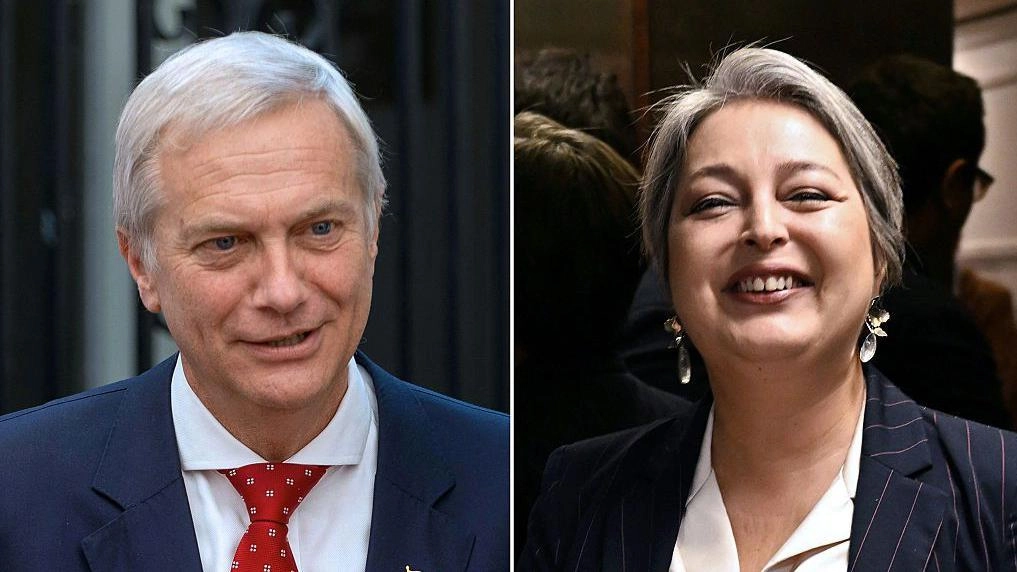

The communist Jeannette Jara and the ultraright-wing Jose Antonio Kast will face opposing models for the presidency of Chile in the second round on December 14.
With 100% of the votes counted in the first round of the presidential elections this Sunday, Jara obtained the 26.8% of the vote and Kast, 23.9%.
Since none of the eight candidates obtained more than 50%, the presidency will be decided next month in a head-to-head between two opposing left-wing and right-wing positions.
While the center-left, currently in power with Gabriel Boric, rallied around Jara, which facilitated his advancement to the runoff, the right wing split among three candidates, and Kast won that "Our country has a future, and it lies in the children," said Jara. "Democracy must be protected and valued; it took us a great deal to recover it, and we cannot allow it to be put at risk today," added the ruling party candidate, who highlighted proposals from Parisi and other candidates not aligned with the right in an attempt to win them over. For his part, Kast called for unity in a speech in which Matthei stood beside him. Kaiser also showed his support.
“For the good of Chile and to overcome the crisis we are in, unity is fundamental. We must unite for a cause that is Chile. We must put everything at the service of a cause, not a candidate or a party. This is the cause of Chile,” said Kast, who is seeking the presidency for the third time and is running as the candidate of change.
December 14th “will be a plebiscite between two models of society,” he said, critical of the current government of Boric, who he linked to Jara.
“Win the votes in the streets,” Parisi, for his part, told Jara and Kast, whom he refused to endorse. Both,He asked those he defined as far-left and far-right, respectively, to put “the people” before “ideology.” The day also saw elections for Congress, which, according to official results, ended up in the hands of the right. Kast's Republican Party and its Social Christian and Libertarian allies won 42 seats, while the center-right coalition Chile Grande y Unidos secured 34 seats, giving them a majority in the Chamber of Deputies. Meanwhile, in the Senate, they won 27 of the 50 seats.
On the other side, Jara's coalition (Unity for Chile) won 61 seats in the Chamber of Deputies and 20 in the Senate.
The electoral process was marked by high voter turnout (85.3%), which is not surprising given that voting is mandatory in the South American country.
Crime and illegal immigration have dominated the campaign amid a rise. in violence and organized crime, which some candidates attribute to criminal organizations like the Venezuelan Tren de Aragua.
In Search of Change
Analysis by Daniel Pardo, BBC Mundo's special correspondent in Chile
The first round proved that the Chilean electorate wants new solutions, is tired of the culture war, and is deeply critical of established strategies.
This is demonstrated by the result for Franco Parisi, a pragmatic economist because concerned of people's everyday problems rather than the ideological and political battle. Parisi, although he won't be in the second round, will be a key player in the coming years, especially if he manages to win a good number of seats in Congress. Now the clear favorite is Jose Antonio Kast, who will have to win over the votes of the rest of the right wing. Its main objective is to prevent the left from turning the second round into a plebiscite on its supposedly radical tendencies. Meanwhile, the ruling left-wing coalition doesn't even seem to have reached 30% of the vote, which leaves it in a bad position heading into the second round. This is a hard blow for Gabriel Boric's government, which failed to meet the high expectations of four years ago. Jeannette Jara is no longer the favorite and will therefore have to shift from defense to offense and present herself as the safeguard of democracy against an opponent, Kast, who many may see as anti-liberal. Jara will have to shed the communist label, to the point that many are saying she may suspend her membership in the Communist Party and distance herself even further from Boric's government. In any case, it has become clear that Chileans want change.
Who is Jeannette Jara?
Heading into the second round, Jara faces the challenge of winning votes from outside her base, among an electorate concerned about security and immigration—key issues for the right—and critical of the outgoing government of Gabriel Boric, in which she served as a minister.
Jara, 51, was born in Conchali, a low-income district in northern Santiago, to a mechanic and union leader. She is the eldest of five siblings, whom she helped raise. She is the only one of them to have gone to university. She often says, “I didn't know anyone who had gone to university until I did.”
She studied public administration at the University of Santiago, Chile, and later, law at the Central University. She paid for both with informal and temporary jobs.
At 19, she married Gonzalo Garrido, a student leader and electrical engineer who committed suicide two years later in the midst of severe depression.
In the early 1990s, the regime of Augusto Pinochet had just ended. The negotiated democratic transition generated skepticism among left-wing youth, who expected a clearer, less gradual change of model. The Communist Party, due to its staunch criticism of neoliberalism, was the only left-wing movement that remained outside the ruling coalition known as the Concertacion. After graduating with her first degree at the beginning of the century, Jara joined the Internal Revenue Service and became involved in the labor movement, where she gradually gained power as she won internal elections and specialized in tax and labor law. A decade later, already married for the second time and a mother, she entered politics, first as an advisor to the Minister of Social Development and then in the Undersecretariat of Social Security during the second term of Michelle Bachelet (2014-2018), now her friend and, for many, a kind of political precursor. It was the first time that the Communist Party, gradually settling within the political system, while a powerful but marginal force, held real power.
In 2022, the ruling party found itself cornered by the defeat in the constitutional plebiscite. President Boric had to reshuffle his cabinet and called on Jara to head the Ministry of Labor.
There, the current candidate promoted ambitious reforms that serve as her campaign platform: she intervened in the pension system, reduced the workweek to 40 hours, and increased the minimum wage.
Many considered these the clearest achievements of the outgoing government. And she managed them through dialogue and connection with the grassroots.
Who is Jose Antonio Kast?
Kast is attempting to become president for the third time. He initially ran for president in 2017, finishing fourth with just 8% of the vote. He tried again in 2021 and won the first round, but lost the runoff with 44% of the vote to current President Boric, who obtained 56%. Now Kast says that “the third time's the charm,” as he asserted on Sunday night. But one thing seems certain: this Catholic and conservative lawyer has already contributed to transforming the traditional Chilean right,with a platform that draws comparisons to leaders in other countries such as Donald Trump, Javier Milei, and Nayib Bukele. Married to lawyer Maria Pia Adriasola, with nine children, and close to the international conservative Catholic movement Schoenstatt, Kast has also rejected the “far-right” label often applied to him. This Sunday, his first message of gratitude was to God. However, he has defended the military regime of Augusto Pinochet (1973-1990) and even said that if he were alive, he would have voted for him.
His older brother, Miguel Kast, was a minister and president of the Central Bank in the military government, a regime under which there were serious human rights violations such as torture, murder, and the disappearance of thousands of people.
Kast has denied endorsing such abuses, although he also stirred controversy from his first presidential candidacy by saying, for example, that “many things were done for the human rights of other people during the military government.”
Although he lost to Boric in 2021, following the social unrest in the country, and suffered another electoral defeat with the rejection of the constitutional reform proposal he promoted in 2023, his advancement to the runoff election on December 14 demonstrates the enduring relevance of his political movement.
In the first round on Sunday, Kast surpassed two other candidates who were competing against him within his own political camp. ideology.
Now his electoral challenge is to secure the votes of those who opted for those candidates in order to achieve the majority that eluded him in the past.
“Kast has tried to represent a 'new' right wing, what I call the populist nationalist right,” Robert Funk, a political scientist at the University of Chile, tells BBC Mundo.
He proposes closing the borders to illegal immigration and a hardline policy against violence and criminal gangs.