

Cape Verde: a selection of 26 players and almost 26 migrant stories
Cape Verde was eliminated, but it leaves a unique message: why it is a symbol of a soccer diaspora that excited the tournament. A story that resonates

Cape Verde left the World Cup, but it leaves more than just an elimination. It leaves a football story that does not fully enter into the result, nor in the statistics of the match, nor even in the standings. The African team that took Argentina to the limit in the round of 16 was not just the team of a small island country. It was, above all, the portrait of a nation spread throughout the world.
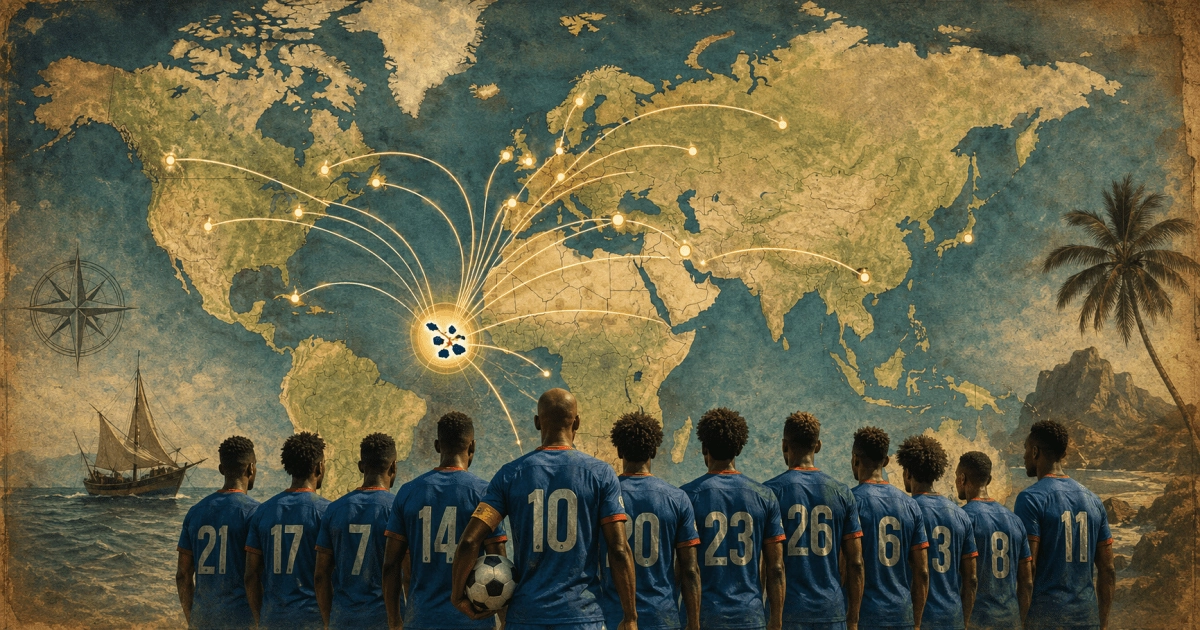
The most powerful image is not only in the 3-2 final score, nor in the resistance against the defending champion, nor in the emotion of a fan who experienced the tournament as a collective conquest. It is in the composition of the squad: 26 footballers, 25 clubs and 14 countries represented. A team assembled like a map of the Cape Verdean diaspora.
Cape Verde has just over half a million inhabitants and a history marked by the sea, migration and extended family ties between Africa, Europe and America. Therefore, their selection is not only explained by the players born on the islands, but also by the children and grandchildren of Cape Verdeans who grew up in other countries and chose to wear the shirt of the Tubarões Azuis, the Blue Sharks.
The fact sums it all up: in the World Cup squad there were more players born in Rotterdam than in Praia, the capital of Cape Verde. According to The Guardian, six members of the team were born in the Dutch city, while four were born in Praia; In total, 11 players on the squad were born in Cape Verdean territory.
That proportion is not a statistical rarity. It is a synthesis of identity. Cape Verde is a country, but also a network. An archipelago in the Atlantic and, at the same time, a community that lives in Lisbon, Rotterdam, Paris, Boston, Luxembourg, Marseille, the United States and other points on the map. Its selection, more than many others, functions as a family reunion on a global scale.
In modern football, almost all teams have players distributed across different leagues. But in Cape Verde this dispersion has another meaning. It is not a power that exports talent to large markets, but rather a small country that builds competitiveness based on its migratory ties. Each call is also a search: find players with Cape Verdean roots, convince them, integrate them and build a common belonging.
You can see: Mexico or England: who wins on Sunday, according to the AI
For this reason, the squad appears distributed in clubs with very different profiles. There are footballers who went through important leagues, like Logan Costa, linked to Villarreal, or Steven Moreira, in Columbus Crew. There are players in Portugal, Cyprus, Russia, Hungary, Finland, United Arab Emirates, Türkiye, Israel, Romania, Ireland and other destinations. It is not a selection of superstars, but of crossed trajectories: careers worked far from the spotlight, between medium-sized clubs, peripheral leagues and hard-earned opportunities.
There are also names that summarize that mix of journey, job and belonging. Ryan Mendes, captain and historical reference, is one of the symbols of the team. He went through France, England, the United Arab Emirates and Türkiye, and arrived at the World Cup as a figure that goes beyond sports. For Cape Verde, Mendes is not just a veteran striker: he is a moving memory, a kind of bridge between generations.
The archer Vozinha, another emblem, became one of the characters of the tournament. At 40 years old, his presence connected with one of those stories that the World Cups still allow: footballers who do not arrive from the top of the business, but who find unexpected visibility in a few nights. MarketWatch presented him as one of Cape Verde's great media appearances during the World Cup, after his performances and the growth of his public profile.
The elimination against Argentina reinforced that reading. Cape Verde was not a troupe or an exotic curiosity. He competed. Reuters highlighted that the match against Argentina was part of the country's first World Cup participation, a fact that helps to dimension what was at stake: for a debuting team, taking a world champion to a dramatic match was already a declaration of existence.
The Guardian described the duel as one of the most intense matches of the tournament: Argentina won 3-2, but Cape Verde tied twice, resisted and left a strange feeling for a defeat. It was not enough to advance, but it was enough for millions of people to look for where Cape Verde is, who its players are and how such a small country could be so close to a global surprise.
The value of this selection appears there. Cape Verde is not big in terms of population, infrastructure or World Cup history. It is great for something else: for the ability to bring together scattered fragments of an identity and turn them into a team.
A player born in Rotterdam, another trained in Portugal, another who plays in the United States, another who competes in Russia, another in Cyprus, another in the Middle East. All with different clubs, different accents and different routes. All within the same t-shirt.
The strength of the diaspora
Cape Verde does not end with its islands: it also lives in its migrant communities spread across Europe, America and other regions. This global network is what is known as a diaspora.
In times when football is usually told through money, Cape Verde offered another narrative: that of the country that did not need a powerful league to build a recognizable team.
Its strength came from the diaspora, from family ties, from surnames, from stories of back and forth. Of that belonging that does not always depend on the place where one is born, but also on the place to which one symbolically returns.