

'Football belongs to the people' celebrates community, play and resistance
Exhibition in Boyle Heights connects the arrival of the World Cup with immigration raids and more social background
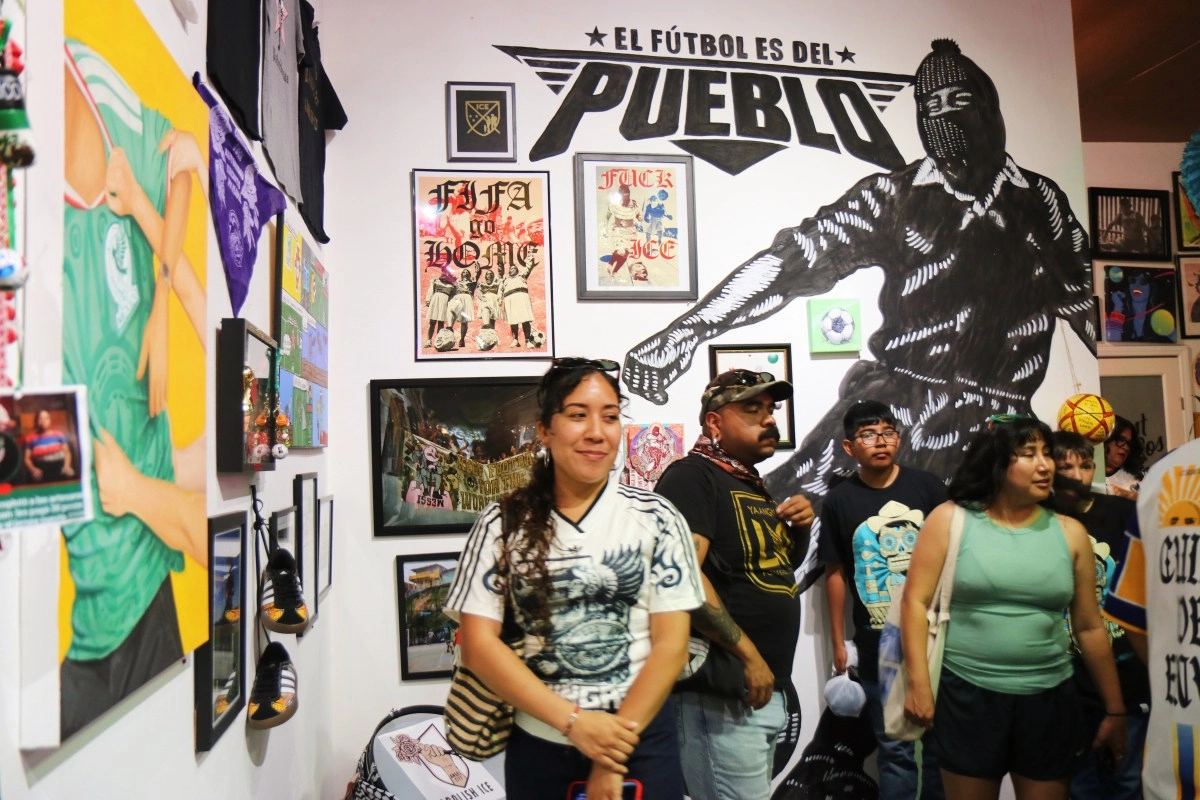

As Los Angeles experiences a soccer celebration with the 2026 FIFA World Cup, a year after immigration raids took over the city, the Boyle Heights community came together a few days ago to celebrate their connection to the game and their unwavering resistance over the last year, with an art exhibition and a neighborhood soccer helmet.
“The message I want people to take away is that we take care of ourselves, not only in the game or on the field, but also off it, as we have done in the last year,” said Nico Aviña, co-owner of Espacio 1839 in Boyle Heights.
The event titled “El Futbol es del Pueblo” began with a new art exhibition held at Espacio 1839, where more than 30 local artists of different ages presented works of art, photographs and installations with the theme focused on soccer, its roots and the struggle.
The statement “football belongs to the people” reflects the historical origin of the sport as an expression of the working classes, the neighborhoods and the communities that make the sport what it is. However, this year, there is an intense debate about whether that popular essence has been lost in the face of increasing commercialization, high costs and commercial interests, even the possible presence of immigration agents at games.
“We wanted to remind people of the importance of the community, that soccer belongs to us and is the property of the people,” said Aviña. “It does not belong to corporations or FIFA, which only takes money out of our pockets so that they become richer while we continue doing the same thing.”
Aside from Espacio 1839, Aviña is also part of a soccer collective and a nonprofit organization called People's Football Club, which organizes community games to raise funds in support of various causes, including Middle Eastern Children's Alliance, TransLatina Coalition, and organizations that assist people affected by ICE raids.
Especially in Boyle Heights, which was one of the Los Angeles districts considered among the most vulnerable to immigration control measures, according to a Los Angeles County report.
“Boyle Heights is our home, so for us it's a way to unify the community through football, especially after what we went through last summer with the raids,” Miriam Rodríguez said. “Our communities should also feel happiness and keep in mind that this is a struggle, but the struggle can also be seen as today's community event, being in community and enjoying.”
Art and social causes
Within the exhibition, people also had the opportunity to purchase sports t-shirts designed by Avina, t-shirts that had messages such as “Chinga La Migra” and “From Palestine to Mexico.”
One of the artists who also participated in the exhibition was Vianney Harelly, who presented an installation that shows some of the darkest aspects of the World Cup matches. Their installation paid tribute to the indigenous women responsible for Mexico's new jersey, which has been the subject of controversy due to accusations that they were not adequately compensated for their contribution.
Among the group of artists were also Marc Rivera, 12 years old, and Miguel Yáñez López, 13 years old, who painted a work that, they say, tries to connect with your ancestors. The painting depicts the World Cup final between Mexico and Portugal and Tenochtitlán, the ancient Aztec capital, which was the center of a sport called ōllamalīztli (or tlachtli), which is said to be the origin of the sport we know today.
For two weeks, the two little artists painted their picture every day after leaving school.
“It is important that we remember our ancestors and the origins of this sport, because we are here thanks to them,” said López.
Another work included was a pair of hand-painted soccer cleats by artist Erica Friend. Her sneakers were decorated with monarch butterflies, which often symbolize migration in the Latino community. For the artist, soccer has always been part of her life, whether when she was a girl and played with her cousins and friends, or now, as an adult.
“For me, it's about giving back to the community, because most of the time when the games start, everyone is really excited to go to the stadium, but actually not everyone can go,” Friend said. “And most of the time, the lower class community is left out, so today is just a day where we can be together as a community and share art, history and fun.”
Finally, artist Oscar Daniel painted a green cloth with the phrase “Football, Freedom” and the image of a Zapatista woman holding a ball. While his other drawing included two girls playing a small game wearing Palestine t-shirts. The theme of both works, according to Daniel, is about how people use games to rectify everything that is outside their control.
“I think it's very important because it sends the message that, no matter what they do to us, we are always going to be here, we are always going to continue having fun, sharing our lives and experiences, and laughing, expressing and sharing with the world how special we are,” Daniel said.