

Who is being arrested by ICE in the US under the Trump government?
Despite the campaign promise to deport criminals, data reveals a different reality
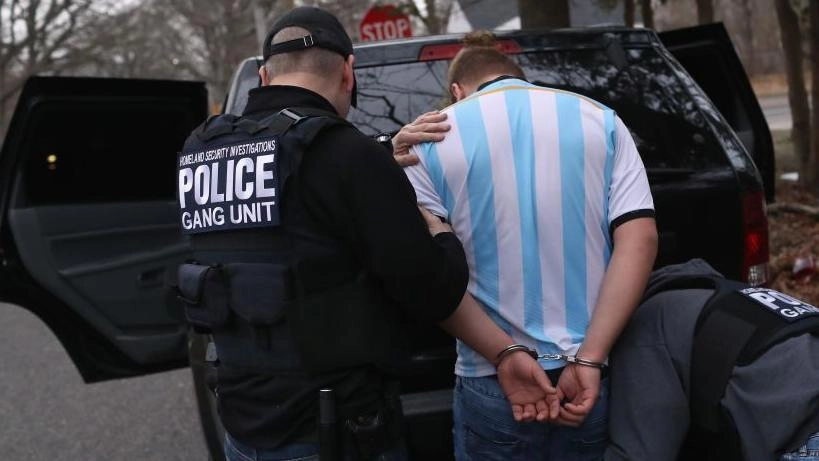

During the election campaign, Donald Trump was very clear: “I will launch the largest criminal deportation program in US history.”
That promise, opinion polls suggested, proved very popular among the American population, including many legal immigrants who felt that too many people were entering the country the “wrong way.”
Since the president took office, he has expanded the scope of his mission, targeting not only criminals, but also migrant workers, certain student activists, and even tourists with visa problems.
For nearly five months, the arrests and deportations met with little resistance. But now, protests have broken out in parts of Los Angeles after immigration officials stepped up their workplace raids.
But who are the immigrants detained by Immigration and Customs Enforcement (ICE)? And who else do they have in their sights?
Criminals and “Collateral” Arrests
Since taking office, President Trump has highlighted the plummeting border crossing numbers and the record-breaking arrests that have occurred under his administration.
Approximately 51,000 undocumented immigrants remained in ICE detention as of early June, the highest number recorded since September 2019.
While there are no accurate, up-to-date figures publicly available on the total number of arrests made by immigration enforcement since January 20, some White House officials have said they hope ICE will be able to increase its daily arrest rate from the approximately 660 recorded during the first 100 days of Trump’s presidency to as high as 3,000 arrests per day.
Initially, U.S. officials They insisted that the operations were “targeted” at criminals and potential threats to public safety.
But a significant number of undocumented immigrants detained by the Trump administration have no criminal record, according to a data tracker.
The Transactional Records Access Clearinghouse, a Syracuse University project that compiles immigration figures, estimates that of the 51,302 people in ICE detention facilities as of June 1, about 44 percent had no criminal record beyond having entered the U.S. illegally.
The unrest in Los Angeles was sparked by a series of immigrant arrests that left a total of 118 people in custody, including five gang members, according to the Department of Homeland Security.
ICE says those arrested in Los Angeles are “the worst of the worst.” The agency identified a handful of people with criminal records, including drug trafficking, assault, child cruelty, domestic violence, theft, and migrant smuggling.
However, it is unclear how many of the total arrests have prior criminal records.
The parents of a 23-year-old undocumented immigrant, a member of Mexico's indigenous Zapotec community, told The Washington Post that their son, who they said had no prior criminal record, was detained outside a clothing store.
The BBC cannot independently confirm the details of this case.
Border czar Tom Homan called the arrests “collateral damage,” arguing that agents cannot legally justify encountering undocumented immigrants and not detaining them.
Visitors and residents
There have been several cases of tourists arrested and held in detention centers.
In April, for example, a A 28-year-old Welsh tourist was held for 19 days at an ICE processing center in Washington state after being denied entry to Canada due to what later turned out to be a “visa mix-up.” In a more recent incident in June, 25-year-old Italian national Khaby Lame (the world’s most popular TikTok star with 162 million followers) was detained at the Las Vegas airport for “immigration violations.” ICE alleged that Lame overstayed his visa after entering the country on April 30. Officials later said he was granted “voluntary departure” and left the country. Also in March, Canadian actress Jasmine Mooney was detained for two weeks after being arrested at the San Ysidro border crossing, where she was attempting to enter the United States.
She later described the conditions of her detention as “inhumane” and said she was kept in a cement cell with no blankets and limited toilet facilities. She was later released without being charged with a crime.
Her case caught the attention of British Columbia Premier David Eby, who said the incident further increased Canadians’ anxiety about traveling to the U.S.
“Our relationship is so strained right now that this case makes us wonder: What about our family members working in the United States?” said in a statement to the CBC.
Others, like Fabian Schmidt, a 34-year-old German citizen, were detained at airports.
Schmidt, who has lived in the United States since 2007, was stopped while traveling to the United States from Luxembourg.
In an interview with WGBH, a New Hampshire news outlet, Schmidt said he was questioned about a minor drug charge that was later dismissed and a subsequent charge levied against people who drive under the influence of alcohol or drugs that resulted in a fine.
The Department of Homeland Security (DHS) has largely avoided commenting on specific cases but has repeatedly insisted it is operating legally.
'Foreign Enemies'
Some of the most striking images of the Trump administration's immigration policy come from El Salvador.
More than 250 people the US government accuses of being members of the Tren de Aragua gang have been transferred to a Salvadoran mega-prison, Cecot.
However, relatives of some of the men have questioned any links to the gangs, with some arguing they were arrested as a result of innocent tattoos.
“It’s really disheartening,” Adelys Ferro, executive director of the Venezuelan-American Caucus, told the BBC. “All of these decisions are inhumane, cruel, and also illegal.”
The most prominent case is that of Kilmar Ábrego García, a 29-year-old Salvadoran man living in Maryland who was deported to El Salvador in March.
Several judges, including those on the Supreme Court, have ruled that Ábrego García was wrongly deported and that the government must “facilitate” his return to the country and his family.
On June 6, he was returned to the United States to face federal criminal charges after being indicted on charges of illegally transporting undocumented immigrants while they were still in the U.S.
Students
Foreigners who participate in political protests are also in the Trump administration’s crosshairs,Despite some having valid permanent residency or student visas.
Anthony Enriquez, a lawyer at the Robert F. Kennedy Human Rights organization, told the BBC that there were “increasing numbers” of foreigners with permanent residency permits who have been detained since Trump returned to the presidency.
“Immigration authorities feel empowered to make arrests they are not legally allowed to,” he said.
More than 1,600 international students have had their visas revoked for various reasons, according to Nafsa, an organization that focuses on international education.
Many of the arrests come as part of a White House crackdown on perceived “anti-Semitism” on US campuses, including the arrest of Mahmoud Khalil, a prominent figure during anti-Gaza war protests at Columbia University last year.
Khalil, 30, has a residency permit and has been fighting to stop her deportation in court.
Tufts University student Rumeysa Ozturk also spent six weeks in custody before being released.
The university later said it was told that Ozturk, who had participated in pro-Palestinian protests, had had her student visa revoked. She continues to fight her deportation in court.
Although these cases have been heavily criticized, ICE has justified some of the arrests by saying the students participated in activities “aligned” with the Palestinian group Hamas.
“A visa is a privilege, not a right,” said US Homeland Security spokeswoman Tricia McLaughlin in a post on X.
Click here to read more stories from BBC News Mundo.
Subscribe here to our new newsletter to receive a selection of our best content of the week every Friday.
You can also follow us on YouTube, Instagram, TikTok, X, Facebook and on our new WhatsApp channel.
And remember that you can receive notifications in our app. Download the latest version and activate them.