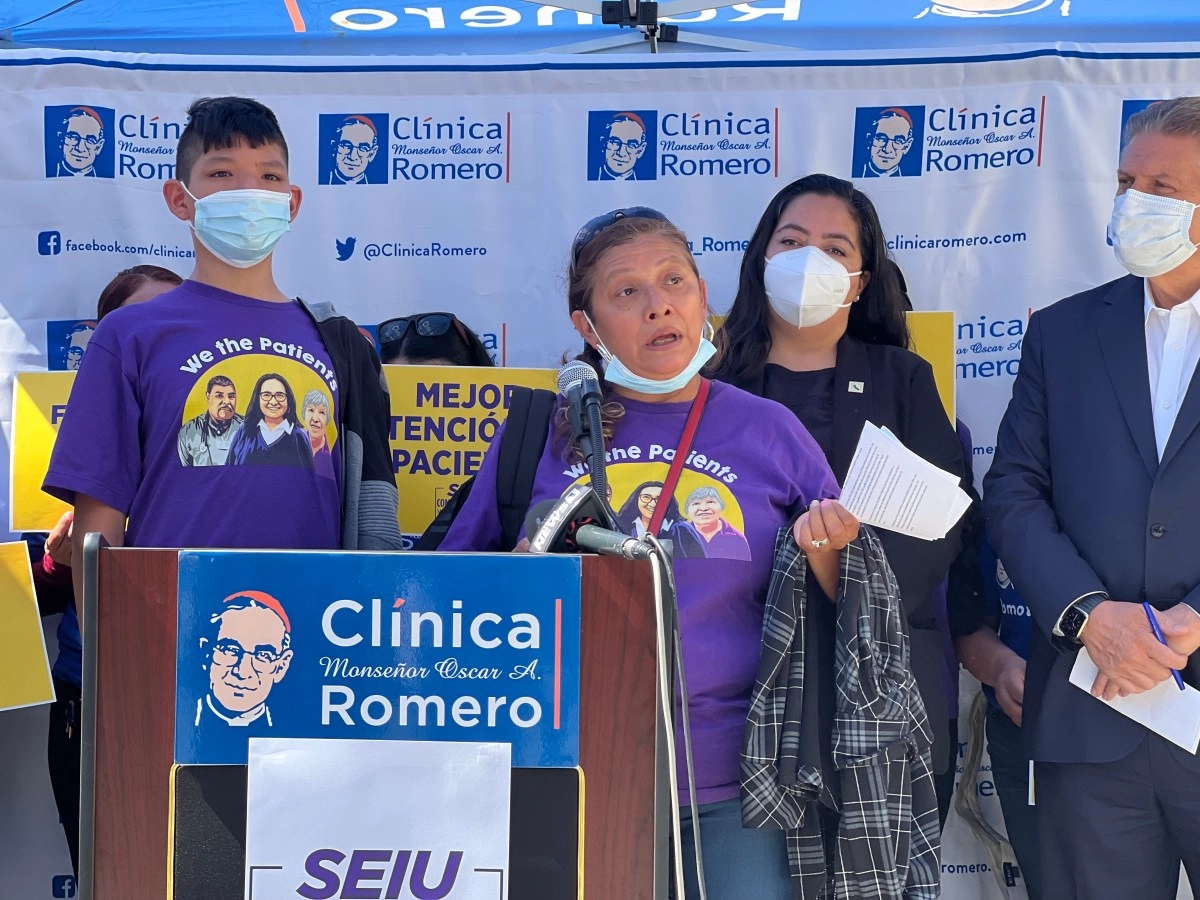

SEIU-UHW, a powerful union that includes health care workers in the West, proposed a ballot measure aimed at changing the state statute. This is a democratic practice that California shares with 20 other states.
He submitted twice the signatures required to pass his motion, which is the equivalent of 5% of the votes cast in the most recent gubernatorial election.
With this, he managed to advance that bill, which voters will decide on November 3.
It is likely that by a simple majority, voters will approve it.
Se trata de la Clinic Funding Accountability and Transparency Act.
The fact that a union is the promoter of the measure gives it an aura of prestige; It would seem that just because the bill was initiated by him, it is evidence that his purpose is to look after the people, the community, the town.
Regardless of the union's purpose in proposing the law, its effect is the opposite. It has the potential to harm the people, the community, the town. Especially to the Latino migrant community in California.
Because? What is it about? What does this motion say?
Next up: A “yes” vote supports this initiative to require nonprofit federally qualified health centers (FQHCs) and their likes to spend at least 90% of their total annual revenue on goals that advance the health center's mission.
And of course, a “no” vote rejects it.
This law wants the thousands of nonprofit health centers to be subject to a spending structure, which, it details, will be defined by the state Attorney General.
What if not? A community clinic that spends more income than allowed on expenses not accepted by the Attorney General will be fined. The fine will be deposited in a separate account, and used for “the training, hiring and retention of clinical workers,” at the discretion of the Legislature.
The problem with this proposal is not that it comes from a union. SEIU-UHW deserves my respect. But in the rush to benefit its members, it harms Latino community clinics, these health centers' specific duty to the community, and their millions of patients, including families of their own members.
For many, community clinics are the only health care option.
Especially considering the enormous damage that the federal H.R. law is causing to the community. 1 – Donald Trump's famous One Big Beautiful Bil. The effects of this regulation devastated health centers and community clinics with a lethal combination of loss of federal coverage, reduced operating revenues, and administrative requirements that limit public assistance. Because of her, hundreds of thousands of Angelenos lost their Medi-Cal coverage, undermining the financial foundations of community clinics previously compensated by the federal government.
For its part, the Clinic Funding Accountability and Transparency Act aims for the state to control the expenses, investments, efforts and ultimately decisions of California community clinics.
It's not the time. And not in this way.
According to the 2024 California Health Care Almanac report, the number of patients receiving care at Federally Qualified Health Centers, or FQHCs, increased from 4.1 million in 2015 to 5.3 million in 2022, a 31% increase. Most of them are Latino and low income.
And the same text of the measure, as presented to Attorney General Rob Bonta
recognizes its importance, saying that “Federally Qualified Health Centers (FQHCs) are a form of community clinic critical to California's health care safety net, as their mission is to provide primary and preventive care to low-income and underserved populations.”
They do it without profit motive, with often voluntary and always hard-working work. Especially now, when people have fewer options, these clinics are insufficient to meet the needs of the community.
They need more, not less, support.
But unfortunately, the proponents paint a strange, contradictory and irresponsible picture of the reality experienced by community clinics.
According to the introduction to the measure, “workers report chronic staff shortages, high workloads and staff turnover, as well as long waits for patients,” which is unfortunately true.
But at the same time he states that “many clinics are highly profitable, sometimes running annual surpluses of up to 20% of total revenue, rather than spending funds in a manner consistent with their charitable mission.”
Not only that! The text adds: “many clinics pay excessive shares of their revenue toward executive compensation, resulting in insufficient investment in basic patient services.”
All of this without telling us how many clinics reserve profits, which ones distribute exaggerated compensation, and what percentage of them are “very profitable.” The motion, after recognizing the importance and role of community clinics, paints them as insensitive to the health of communities, concerned with their own profit.
Anyone who has known our community clinics knows that this is not true. From what we know, this is not the case. If there is any that comes close to that negative description, then they should report it, investigate it, change its steering committee, fine it, change it.
Instead, they propose tying all community clinics hand and foot, neglecting their realities and ultimately harming them.
Contrary to what they are making us think. Although that is not its purpose.
Because the problem is that the bill does not specifically include as “acceptable” expenses the special services that our community clinics offer to the community. It does not define them as part of that 90%.
What are they? For example, translation services, patient navigation, transportation, and community outreach workers such as promoters. All of them are necessary for hundreds of thousands of low-income patients who need to have what is said by doctors, pharmacists, nurses, and administrative staff who do not speak their language translated. That they need the medical care process explained to them. That they need to be taken to health centers because they don't have a car and public transportation can take hours. And they benefit enormously from health promoters.
All of these expenditures achieve the mission of improving equity and access to health care. They must be considered as such.
This legislation is primarily opposed by the California Primary Care Association (CPCA), which sued it in federal court in April to prevent it from appearing on the November ballot. The lawsuit, “California Primary Care Association vs. Weber,” continues.
CPCA and numerous healthcare organizations, clinics, trade associations, and community organizations have formed the Protect Patients coalition. All participating organizations are presented on this page: https://protectpatientsca.com/our-coalition/
The consequence of this omission is an ambiguity regarding the inclusion or exclusion of these services. The statute that will be submitted to the popular will in November does not mention them, does not protect them, but instead delegates the authority to define what constitutes a qualified expense to the Attorney General of California.
This in turn will be based on the rulings of a federal form to determine the income of each institution, since although California's main tax-exempt tracking form is FTB 199 (Annual Information Return for Exempt Organizations), the proposal instructs nonprofit organizations to detail their income based on "the data reported in the total income figure on line 12 of Part I of Form 990 for each clinic."
To do justice, the proposal should be amended and clearly define that these community expenditures directly facilitate the provision of primary care. Therefore, they are part of the allowed expense. They are investments in the well-being of people.
In short, an analysis focused not only on the benefit of health workers but on the survival of the clinics, the maintenance of the services they offer to the Latino community and on the millions who do not have access to another form of medical care, shows that the text tends to ignore them.
The bill is not what it purports to be. It is not convenient for our people.