

Artist responds to the censorship of his work by the White House: Freedom of expression under threat
Felipe Feggo Galindo, a Latino artist based in New York, denounces the White House censorship of his work
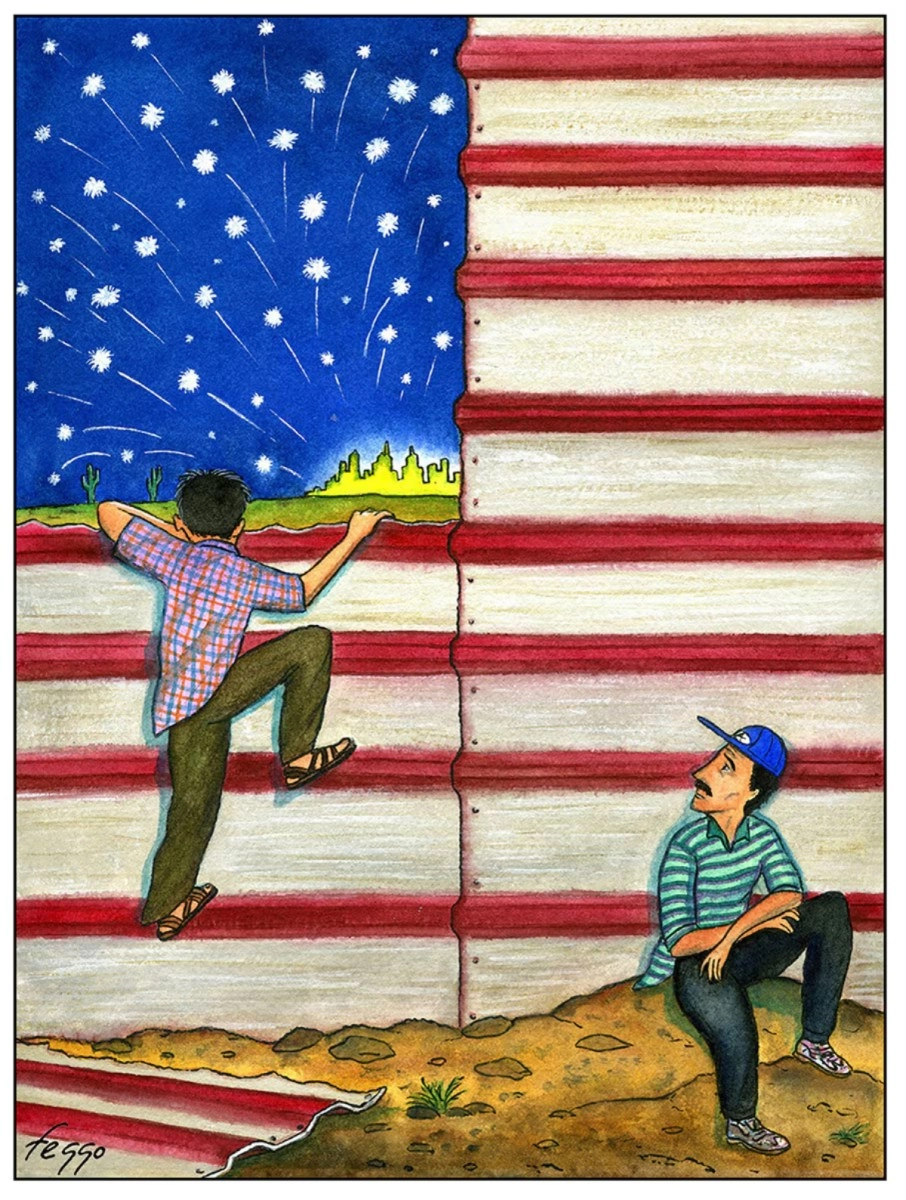

The White House published the article “President Trump Is Right About the Smithsonian” on August 21 with a list of Smithsonian exhibitions, programming and works of art that it considered objectionable, one week after announcing that eight of the institution’s museums were required to submit their current wall texts and future exhibition plans for a thorough review.
When Manhattan-based artist Felipe “Feggo” Galindo learned from a friend that his 1999 work, “4th of July from the Southern Border,” was included on the White House list, he felt a mixture of shock, fear, and confusion.
The work was on display in “Present! A Latino History of the United States,” an exhibition anticipating the upcoming opening of the Smithsonian American History Museum and was shut down, Galindo said in an Instagram post thanking prominent U.S. media outlets that supported him.
In an emailed statement to La Opinion, Galindo explains his reaction to learning that the Trump administration deemed his work “unacceptable” and included it on “a list of censorable works, taken from ‘The Federalist,’ a conservative publication, where my image was described as ‘promoting the open borders by showing migrants watching fireworks through an opening in the US-Mexico border wall.”
The work, a detail of which can be seen in the main image at the top, shows a boy admiring Fourth of July fireworks through an American flag-shaped fence at the US-Mexico border, wishing he could be in the United States.
“I created this image in 1999, and it has since been widely exhibited and published in the US and abroad. It is part of my series “Manhattan: Intertwined Mexican and American Cultures,” a project of drawings, animations, and a book that have received numerous awards, been widely exhibited, and are held in public and private collections,including the United States Library of Congress,” Galindo said in his statement.
“I am proud of this work and of being a Mexican and American citizen. However, today I also feel vulnerable. I can’t help but wonder: Was this how artists in Hitler’s Germany felt when their works were labeled ‘degenerate art’?
“My answer is simple: Art is powerful. Artists should not be harassed, censored, or silenced. Freedom of expression is a fundamental pillar of democracy, and any attempt to suppress it must be firmly resisted,” Galindo said.