

Why France is on the verge of becoming the “sick” of Europe
The European country is in the middle of several crises at once. Is it fair to blame President Macron?
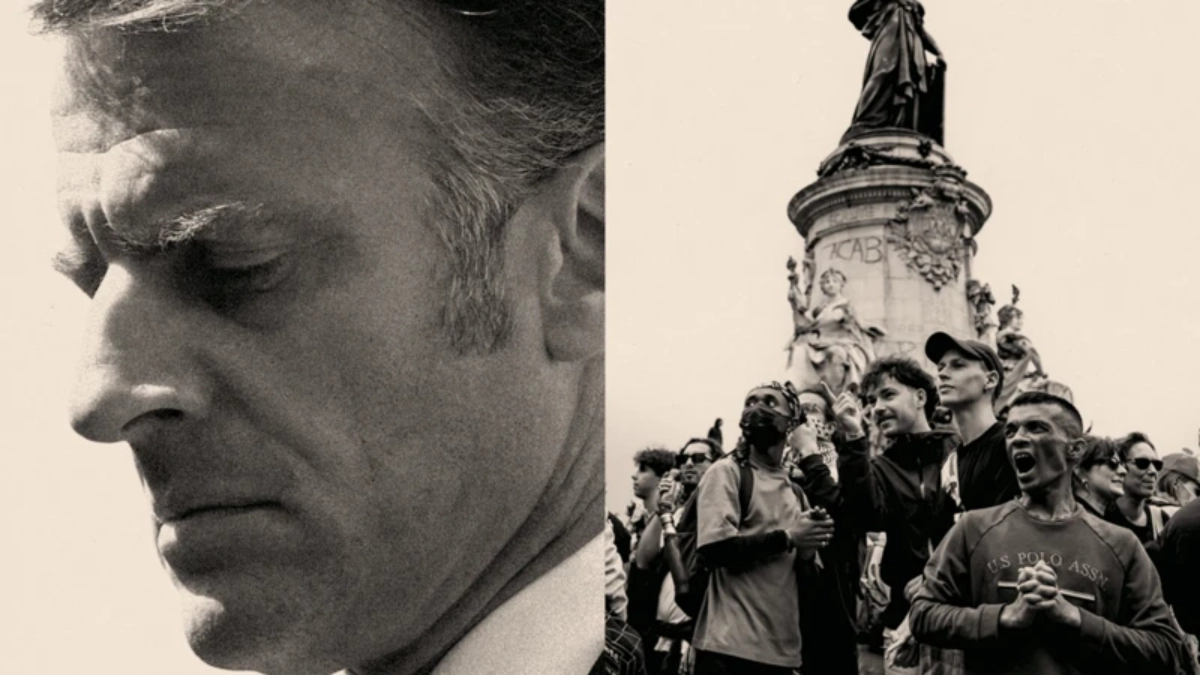

Some in France were annoyed this week to learn that the political chaos their country is experiencing has become a laughingstock… for Italians.
In less than two years, France has had five prime ministers, a political feat unsurpassed even in the turbulent times of post-war Rome.
And now the French Parliament, reconfigured after the president's decision to call early elections in July 2024, is struggling to form a majority capable of passing a budget.
This is compounded by a general strike called Thursday by unions opposed to earlier budget proposals.
Newspapers in Rome and Turin displayed clear gioia maligna (malicious joy) in recent events.
There was the humiliation of the recently ousted Prime Minister Francois Bayrou, warnings of spiraling debt, and the possibility that the French economy needs to be bailed out by the International Monetary Fund.
But above all, there was the fading glory of President Emmanuel Macron.
“So where is the 'grandeur' now?” asked the daily Il Messaggero.
The cost of servicing the national debt this year is estimated at 67 billion euros (about $78.683 billion), a figure that now consumes more money than every government department except Education and Defense. Forecasts suggest that by the end of the decade it will reach 100 billion euros (about $117,439 billion dollars) per year.
On Friday, September 12, the Fitch agency lowered France's debt rating, which could make borrowing more expensive for the French government and reflects growing doubts about the country's stability and its ability to service that debt.
The possibility of having to resort, hat in hand, to the International Monetary Fund for a loan or requiring an intervention by the European Central Bank is no longer far-fetched.
And all of this, against a backdrop of international turbulence: the war in Europe, the disengagement of Americans, and the inexorable rise of populism.
Last Wednesday, a national day of protest was organized by a group called Bloquons Tout (Block Everything).It was eventually exploited by the far left, having little impact beyond some violent street clashes.
However, a far bigger test came on Thursday, with mass demonstrations against the government's plans called by unions and left-wing parties.
In the words of veteran political commentator Nicolas Baverez: “At this critical moment, when the sovereignty and freedom of France and Europe are at stake, France finds itself paralyzed by chaos, impotence, and debt.”
President Macron insists he can guide the country through this difficult time, but he only has 18 months left of his second term.
One possibility is that the country's inherent strengths—its wealth, its infrastructure, and the resilience of its institutions—will allow it to weather what many see as a historic turning point.
But there is another scenario: that it emerges permanently weakened, prey to extremists on both the left and the right, as the new “sick man of Europe.”
Tensions with the prime ministers
This whole situation dates back to the disastrous dissolution of the National Assembly that Macron decreed in early summer 2024. Far from creating a more solid basis for governing, the new Parliament was divided into three blocs: the center, the left, and the far right.
No single group could form a functioning government, as the other two would always unite against it.
Michel Barnier and then Francois Bayrou floundered for a few months as prime ministers, but both fell over the central question facing all governments: how the state should raise and spend its money.
Bayrou, a 74-year-old centrist, made the issue of French debt a central issue. It now stands at more than €3 trillion, or about 114% of gross domestic product (GDP).
He wanted to stabilize the payments by cutting €44 billion from the 2026 budget.
Bayrou was brought down last week when left-wing and far-right MPs united in a confidence vote, but polls showed many voters were also hostile to the prime minister's proposals, such as abolishing two national holidays to fund higher defense spending.
Emmanuel Macron's immediate election has been to entrust a member of his inner circle with pioneering a new approach.
Sebastien Lecornu, 39, appointed prime minister last week, is a soft-spoken Norman who became a presidential confidant during nightly whiskey-and-chat sessions at the Elysee Palace.
After the appointment, Macron said he was convinced that “an agreement between political forces is possible while respecting each other's convictions.”
Macron is said to value Lecornu's loyalty and the sense that his prime minister is not obsessed with his own political future.
After tensions with his two predecessors—the veterans Michel Barnier and Francois Bayrou—the president and prime minister are now completely on the same page.
“With Lecornu, Macron is basically the prime minister,” argues Philippe Aghion, an economist who has advised the president and knows him well. “Macron and Lecornu are essentially one and the same.”
Lecornu's Herculean Task
Macron wants Lecornu to bring about change. After leaning mostly to the political right, he is now seeking an agreement with the left, specifically with the Socialist Party (PS).
According to the law, Lecornu must present a budget by mid-October at the latest. This must be approved before the end of the year.
Mathematically, the only way he can achieve this is if his centrist bloc is joined by the “moderates” on their right and left, ie, the conservative Republicans (LR) and the Socialists (PS).
There's a catch: every concession to one side makes it more likely that the other will walk away from the negotiations.
For example, the Socialists, who feel the wind in their sails, are demanding a much lower target for debt reduction. They want a tax on ultra-rich entrepreneurs and a repeal of Macron's 2023 pension reform (which raised the retirement age to 64).
But these ideas are anathema to the pro-business Republicans, who have threatened to vote against any budget that includes them.
The main employers' union, MEDEF (the Enterprise Movement of France), has even said it will organize its own “mass demonstrations” if Lecornu's response to the budget impasse is to raise taxes.
Further compounding the situation is the time factor: Macron's imminent departure makes it even more unlikely that either side will make concessions. There are important municipal elections in March, and then the presidential elections in May 2027.
At both ends of the political spectrum are powerful parties—the National Rally (RN) on the right, and France Insoumise (LFI) on the left—that will cry “betrayal” at the slightest sign of compromise with the center.
And for any politician of consequence, there may well be an instinct to limit any contact with the rapidly deteriorating asset that is Emmanuel Macron to an absolute minimum.
Lecornu's task is therefore Herculean. At best, he could achieve a deal and avoid an immediate defeat in the Assembly. But such a budget would necessarily be incomplete.
The signal to the markets would be that there has been a new "French fix." The cost of servicing the debt would rise further.
The alternative is failure and the resignation of another prime minister.
That path is Macron's doomsday scenario:another dissolution leading to more elections, which this time could be won by Marine Le Pen's National Rally.
Or even—as some are already demanding—the resignation of Macron himself for his role in presiding over this impasse.
Several crises at once
For those who study France, it is always possible to adopt a less “catastrophic” tone. After all, the country has been through crises before and always managed to recover. Indeed, some see reason to admire Macron's France.
For former Republicans (LR) president Jean-Francois Cope, “the fundamentals of the French economy, including its import-export balance, remain solid.”
“Our unemployment rate is traditionally higher than the UK's, but it's far from disastrous. We have a high level of business creation and better growth than Germany,” adds Cope.
Aghion, Macron's former advisor, is also relatively optimistic. “We are not about to collapse, like Greece,” he says. “And what Bayrou said about debt was an effective wake-up call.”
However, for others, the unstable global situation makes such comments seem overly optimistic, if not complacent.
According to economist Philippe Dessertine, director of the Paris Institute of High Finance, “We cannot rule out the hypothesis of an IMF intervention, as politicians do.”
“It's as if we were on a dike. It seems quite solid. Everyone is standing. on it and telling us it's solid. But underneath, the sea is eating away at it, until one day, suddenly, everything collapses.”
“Unfortunately, that's what will happen if we continue to do nothing.”
According to Francoise Fressoz of Le Monde newspaper, “we have all become totally addicted to public spending. discontent and buy social peace.”
“Everyone can now feel that this system has come to an end. We are at the end of the old welfare state. But no one wants to pay the price or face the reforms that need to be made. death, but many don't believe it or don't see why they should be the ones paying.
Presiding over all this is a man who came to power in 2017 invested with hope, promising to bridge the gap between left and right, business and labor, growth and social justice, eurosceptics and Euroenthusiasts.
After Bayrou's fall, French commentator Nicolas Baverez drew a devastating conclusion in Le Figaro: "Emmanuel Macron is the true target of the people's defiance, and he bears full responsibility for this shipwreck."
"Like all demagogues, he has transformed our country into a field of ruins," he concludes.