

CSU workers ask that salary increase promises be fulfilled
They accuse that the salaries of Cal State University leaders are through the roof, while they barely have enough to survive
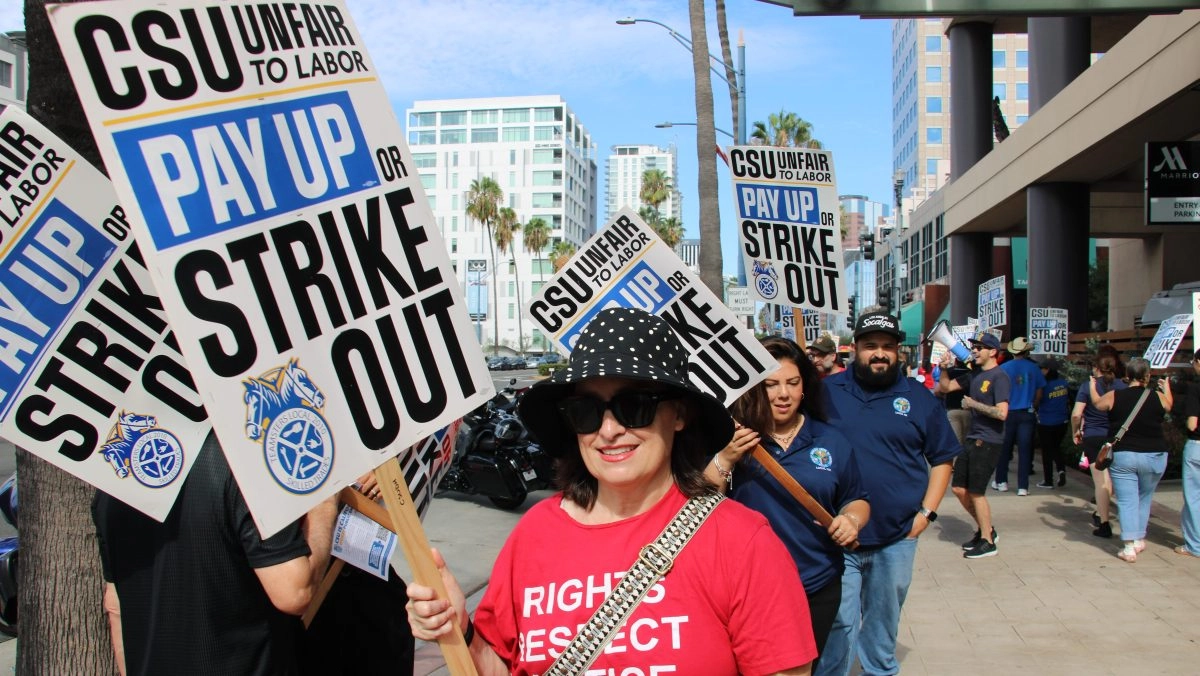

Despite the increase in state funding, approximately 1,200 skilled trades workers in the California State University (CSU) system are still waiting for regents to keep their promises, avoid excuses and pay the wage increase owed since 2025.
Union members of Unit 6 of Teamsters Local 2010 marched this Monday during a noisy protest in front of the Long Beach Marriott hotel, where the official meeting of the 16 members of the CSU board of directors took place, who in November 2025 approved salary increases and performance bonuses for campus presidents and vice chancellors, leaving workers aside.
The board of regents' decision raised base salaries for chancellors to an average of nearly half a million dollars, all while the university system faces significant budget shortfalls, tuition increases and conflicts with faculty unions.
For example, Loren J. Blanchard, chancellor of CSU Long Beach, earns $543,742 annually, is offered housing and has deferred compensation of $61,244, while Berenecea Johnson Eanes earns a salary of $521,024, plus $80,000 for housing and a 5% annual “performance bonus.”
However, the highest salaries go to Erika D. Beck, president of the CSU Northridge campus, with $563,012, and Jeffrey D. Armstrong, of San Luis Obispo University, with $611,203. In total, the salaries of the 22 CSU campus presidents alone total approximately $11 million.
And the workers?
Depending on their trade, skilled union workers earn an average of $70,000 to $100,000 annually.
“They are all specialized in what they do and we take pride in ensuring that our workers perform the tasks assigned to them to the best of their ability,” Ali Tweini, policy director for Teamsters Local 2010, told La Opinión. “But, the benefits the CSU system gets from them far exceeds what it pays them.”
Teamsters Local 2010 represents 1,200 workers who they say have not been paid fair wages, as well as 28,000 workers across California's education sector.
“We have been negotiating since July 2025 and the CSU has offered zero salary increases, while administrators have received double-digit increases,” stated Ali Tweini. The last negotiating session, a week ago, ended in nothing.
“They came empty-handed,” he said. “They did not present any proposal and, that is why we believe that they are not negotiating in good faith,” added the union leader.
"Everywhere we go, people want to know who we are. So we tell them: We are the Teamsters! The mighty, mighty Teamsters! Fighting for justice and wages!" demonstrators who gathered on the sidewalk of Ocean Boulevard in Long Beach chanted loudly in English.
Fight for a decent wage
Teamsters Local 2010 member Dennis Sotomayor spoke about the fight for justice being waged by California State University (CSU) workers.
“Even though CSU receives full funding from the state and additional funds from the governor, they refuse to negotiate in good faith and do not pay us workers a living wage,” he said. He has been a maintenance mechanic for 26 years, earning $65,500 annually — not counting overtime — to support his family in Pasadena.
His financial situation has worsened because, although his wife works, she has been on disability leave for four months.
“He has a standing problem; my wife spends a lot of time standing at work,” Sotomayor shared. His two children and his 90-year-old grandmother live with him.
Sotomayor reported that CSU has not met the salary increases stipulated in the contract, while administrators have received increases.
"First and foremost, we demand justice and respect. We have been fighting this battle for years. The CSU continues to negotiate in bad faith. They do not want to come to the table. We have marched on the Capitol [in Sacramento] and, in fact, we lobbied the legislature to get funding. We have helped them overcome their funding obstacles and yet they still refuse to pay a living wage."
Sotomayor, who works in the public safety division at California State University, Los Angeles, emphasized: "We're just trying to get ahead at work. They're constantly firing people and not rehiring anyone."
He added: "We work with skeleton staff. We always face the threat of layoffs if they have to pay us more, but we have reached a point where the struggle is real, given the current economic situation. We simply need help. Workers need to be able to survive."
The noisy protest was joined by workers and representatives of the unions Unite HERE, California Faculty Association (CFA), CSU Employees Union, California Academic Professionals (APC) and the California Labor Federation (CLF).
“If necessary, we are willing to go on strike to achieve better wages and working conditions,” stressed Gregory Christopher Brown, of the CFA Association. "We know that thanks to the union strength, CSU works. If we don't work, the university doesn't work. If necessary—even if we don't want to do it—we will go on strike if necessary."
Brown assured that they have the support of faculty, staff and students, as well as the CFA, librarians, counselors and coaches.
“Our taxes”
Similarly, Cliff Smith, union representative of local section 36 of the Roofers and Waterproofers Union, criticized that administrators of the CSU university education system increase the salaries of administrators and consultants, while workers do not receive any salary increase.
“Money for education, not for deportation” and “Only the people save the people” read on a protesters' sign, to which Smith referred: “Certainly the administration—even though it is a public university—does not look out for the best interests of either its own employees or the California community in general.”
"The CSU system is financed by our taxes. Our children must be able to afford their studies in these institutions, but the administration only seeks its own benefit. Only the people can save us," he indicated.
CSU's response
Amy Bentley-Smith, director of communications, said California State University (CSU) was notified on June 29 of this year of the state budget allocation for fiscal year 2026-27 and has since submitted its initial salary proposals for that period to its union partners.
"These proposals mark the beginning of pay negotiations, not their conclusion. In all sectors, collective bargaining is not resolved by a single proposal; it is a process that involves ongoing negotiations and the exchange of counterproposals. The CSU remains committed to this process and to conducting good faith negotiations with each of its employee unions," it said in a statement.
He added that for both the CSUEU (California State University Employees Union) and the Teamsters, the CSU's initial proposal included the full implementation of pay scales, a measure identified by both unions as a top priority.
"It is important to note that this was the CSU's initial offer. Additional negotiation sessions have already been scheduled, which will provide the parties with new opportunities to continue negotiating," he stressed.
However, he stated that, “unfortunately, upon receiving CSU's initial salary proposal for the 2026-27 fiscal year, the California Faculty Association (CFA) immediately declared an impasse in negotiations.”