

How the tentacles of drug trafficking are infiltrating Belgium, a country in the heart of the European Union
Cocaine seizures destined for Belgium from South America are multiplying. Meanwhile, Belgian society suffers the consequences of drug trafficking

At the end of October, a Belgian investigating magistrate caused a stir by publishing an open letter asking her government for "urgent" help.
The official asserted that drug trafficking was turning Belgium is a narco-state, and experts warned that the rule of law is threatened in this country located in the heart of Europe, whose capital is also the capital of the European Union (EU).
“Are we becoming a narco-state? Exaggerated? According to our anti-drug commissioner, this evolution has already begun,” accused the judge from Antwerp, a city whose port has become one of the main entry points for cocaine into Europe.
The investigating magistrate described drug trafficking as an “organized threat that undermines institutions.”
“Large mafia structures have been consolidated, becoming a parallel force that challenges not only the police but also the judiciary,” she added.
Although experts consider the claim that Belgium is already a narco-state an exaggeration, they warn that drug trafficking has become a major problem in the European country.
Due to a growing With the demand for drugs throughout Europe, drug traffickers are taking advantage of Belgium's strategic location and the port of Antwerp as a distribution point for illicit goods. But perhaps the most important factor that has made Antwerp a cocaine hub in Europe is the fact that its port is one of the largest on the continent: the constant flow of containers offers opportunities to conceal illicit products within shipments. “The accusation is exaggerated.” "Antwerp has the second largest port in Europe and traditionally receives goods from Latin America. Therefore, it has become a natural entry point, along with the port of Rotterdam, for cocaine," Letizia Paoli, a criminologist and professor at the Faculty of Law of the University of Louvain, tells BBC Mundo.in Belgium.
“And the Dutch authorities began to step up controls in Rotterdam before the Belgians,” he continues.
“I think the accusation of a 'narco-state' is exaggerated, but there are worrying trends, without a doubt,” he adds.
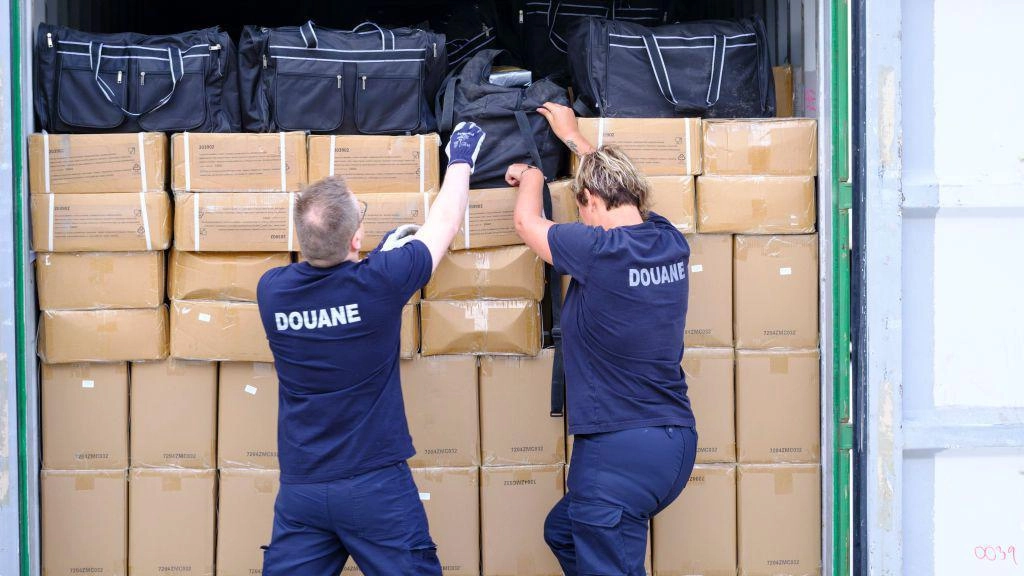
Last year, Belgian customs officials intercepted 44 tons of cocaine at the port of Antwerp, a significant drop from the 121 tons seized in 2023.
But Belgian authorities say these figures are not necessarily a sign of progress.
During the first half of this year, 51 tons of cocaine destined for Belgium were intercepted in South America, a 155% increase compared to the 20 tons in the same period last year.
But the problem is not limited to South America; it extends beyond it.
In December of 2024, authorities in the Dominican Republic reported the seizure of more than nine tons of cocaine, the largest in the country's history. The drugs were found in two banana containers from Guatemala destined for the port of Antwerp. 1,977 drug trafficking cases: This relatively new Belgian problem is not limited to Antwerp. In Brussels, the capital of the country and the EU, drug trafficking is also leaving its mark. According to Brussels police figures, 1,977 drug trafficking cases were recorded in 2023, a 26% increase compared to 2022 and a 76% increase since 2015. Also in 2023, 6,595 drug possession incidents were recorded in the Belgian capital. And the violence, which some link to the use and Drug trafficking appears to be spiraling out of control for the authorities.
In 2024, 89 shootings were recorded in the Belgian capital, and reports indicate that this year the figure will be even higher.
Similarly, since last year, Brussels has identified 16 areas considered especially dangerous, called hotspots, primarily linked to criminal gangs and drug trafficking.
Drug-related deaths
Several drug-related deaths have also been recorded, something extremely rare just a decade ago.
“While in 2013 we found no murders related to the cocaine trade in Belgium, between 2014 and 2025 we found that in Antwerp, the center of cocaine trafficking, there were six drug-related murders,” explains criminologist Letizia Paoli.
“But if we consider that in a single year around 160 homicides in Belgium, drug-related murders are not many. "They don't even represent 10% of the murders associated with high-level cocaine trafficking in Antwerp; there were only six in ten years," she clarifies. The open letter points out that criminal organizations have infiltrated ports, customs, the police, and even the prison and judicial systems. It also states that judges, including the author, have been threatened and calls for government action. Criminologist Letizia Paoli says she supports the call for authorities to allocate more resources and offer greater protection to magistrates: “These are truly reasonable and necessary requests."But she insists there is no reason to speak of Belgium as a narco-state. In her opinion, a narco-state has three characteristics: a very high level of violence that affects community life, drug-related corruption so widespread that it reaches the highest levels of government, and a drug economy that contributes significantly to the GDP.
“None of these three criteria apply to Belgium,” he points out.