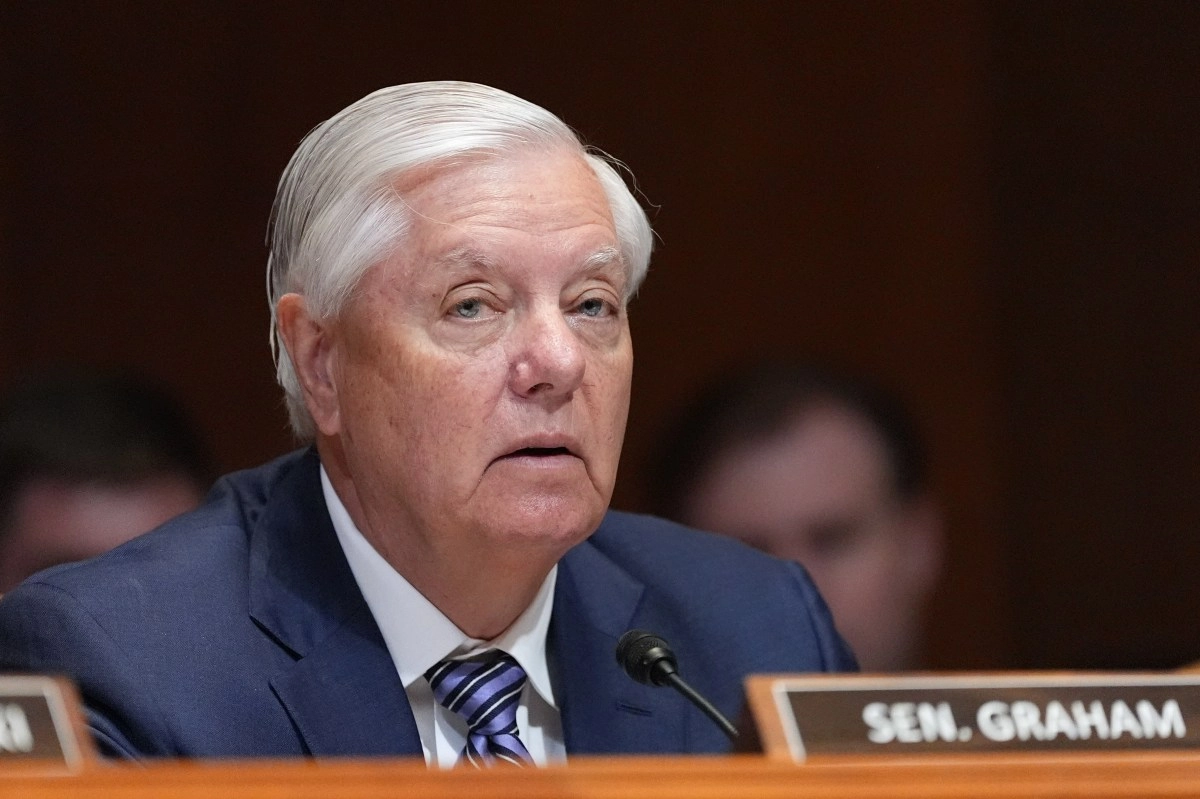

During an interview on CBS' "Face the Nation," the South Carolina legislator defended the decision to attempt a negotiated solution to the Iranian nuclear crisis, despite growing criticism from several conservative Republicans who believe that the understanding grants too many advantages to Tehran.
"Let's try a diplomatic solution. I think it's going to fail," Graham said. “If there is no diplomatic route through the memorandum of understanding, then other forms of pressure will have to be resorted to.”
The statements reflect the complex political moment that the Trump administration is going through, which faces questions from both Democrats and members of his own party over the recently signed agreement with Iran and several decisions related to national security.
Graham distances himself from Trump in dispute over National Intelligence
In addition to addressing foreign policy, Graham distanced himself from the president on another sensitive issue: the direction of the US intelligence community. The senator publicly called on Trump to revive Jay Clayton's nomination to head the Office of the Director of National Intelligence, after the White House unexpectedly halted his Senate confirmation process.
"I think what we had originally planned should stay. Clayton should be the new director of National Intelligence," Graham declared. The senator's position represents an unusual difference from the Republican president, who decided to support acting director Bill Pulte, a controversial figure who lacks prior intelligence experience and whose appointment has generated resistance in both parties.
Graham argued that Clayton has bipartisan support and warned that holding up the reauthorization of the Foreign Intelligence Surveillance Act (FISA) represents a risk to national security. “The country faces too many threats to allow Section 702 of FISA to disappear,” said the legislator. “We are playing with fire.”
The controversy occurs while the Senate debates the renewal of surveillance tools used to track foreign threats, a discussion that has gained greater relevance due to the international context and the major events currently taking place in the United States.
Iran deal divides Republicans
Graham also responded to criticism from several Republican senators, including Ted Cruz, Tom Cotton, John Cornyn and Bill Cassidy, who have questioned the possibility that Iran could benefit economically from the deal. One of the most controversial points contemplates the development of an international plan to promote Iranian economic reconstruction through investments that could reach $300 billion.
Weeks ago, Graham had compared the initiative to a “Marshall Plan for Germany with the Nazis still in power.” However, he explained that he partially modified his position upon learning that the resources would not come directly from the United States. According to the senator, an eventual financial participation from countries such as Saudi Arabia, Qatar and the United Arab Emirates would be a sign that the Iranian regime has begun to change its behavior in the region.
Even so, he made it clear that he maintains deep doubts about the viability of the project and about Tehran's real willingness to modify its policies.
Graham went further to predict that if negotiations fail, the Trump administration could take far-reaching measures in the Middle East, including an intervention to ensure the security of the Strait of Hormuz, one of the most important shipping routes for the global oil trade.
The senator assured that the strategic objective of the White House continues to be to expand the Abraham Accords and incorporate Saudi Arabia into a normalization process with Israel.
As talks between Washington and Tehran move forward in Switzerland under a 60-day deadline to reach a final deal on Iran's nuclear program, Graham's cautious endorsement reflects the difficult balance Trump faces: keeping the door to diplomacy open without losing the support of a Republican base increasingly skeptical of any understanding with Iran.