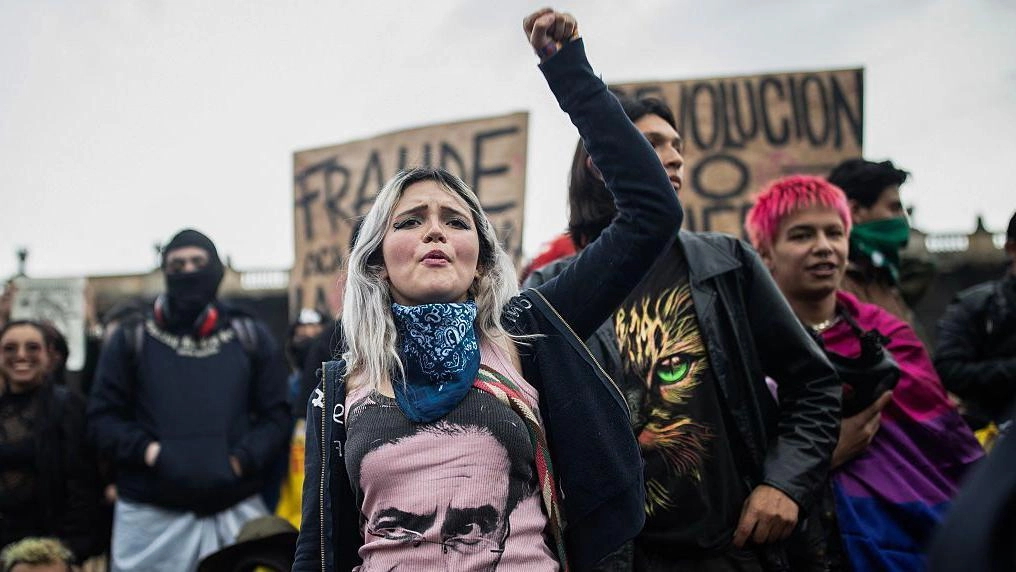

There are defeats in which one can win.
The case could apply to the Colombian left, which has never been stronger despite narrowly losing the presidential election to right-wing candidate Abelardo de la Espriella in late June.
The left-wing candidate, Iván Cepeda, was just 250,000 ballots behind his opponent. He got 12.7 million votes compared to his rival's 12.9 million. Both were historical records.
Cepeda easily surpassed the 11.1 million voters who voted yes to the current president, Gustavo Petro, in the 2022 second round.
Then Petro reached the largest vote ever seen in Colombia.
Four years later, progressivism fell short of continuing its project, but it far surpassed its political push.
Petro and Cepeda's party, Historical Pact, is the largest force in Congress with which De la Espriella will govern.
Cepeda's 12.7 million voters are a powerful weapon to oppose the policies of the right-wing president, who must strive to achieve consensus with a fragmented legislature and a people divided between two antagonistic visions.
Consolidation of the left
Alejandro Chala, a political scientist at the National University of Colombia, points out that, despite the electoral defeat, “a progressive commitment was consolidated.”
It is notable, given that it was not until 2022, with Petro's victory, that the left came to power in Colombia for the first time.
Several reasons delayed the prominence of the left in this country: a historical conservatism, a systematic “extermination” of its leaders for decades that included the murder of Cepeda's father, Manuel Cepeda Vargas, and stigmas arising from the conflict between the State and leftist guerrillas.
Even today it is common to hear voices from the right saying that “Cepeda was the FARC candidate”, without providing evidence, or that with the left there is a risk that “Colombia will become Venezuela”, in reference to the acute economic and political crisis that this country suffered under Chavismo.
“The left was always there, but now it came out of the closet,” León Valencia, Colombian analyst and political scientist, reflected for BBC Mundo.
Perhaps a key moment for this exit was the social outbreak that occurred between 2019 and 2021. During this, protesters demanded a new economic model and more social justice.
Several analysts attributed Petro's victory to his ability to include several of these demands in his project.
Now, four years later and despite the fact that several of Petro's promises of change remained expectations, the left is reinforced even though it no longer occupies the Casa de Nariño.
"A unity project was consolidated. This experiment (that of the left united in the Historical Pact) is coherent and has clear premises about the country's model in the future," says Chala.
These premises support a stronger State, more reforms and social investments, fleeing extractivist economies and being more inclusive of Colombian racial and territorial diversity, among other ideas.
They are visions antagonistic to those of De la Espriella, who proposes less State, fewer taxes and taking advantage of Colombia's mining-energy potential without ruling out controversial practices such as fracking.
Frustration and confrontation
That is a positive vision. Another reading, according to analyst Carlos Cortés, is that of “frustration, because they were very close to winning.”
For months, Cepeda, with a long career in politics, appeared as a favorite in the polls.
That in the final stretch he has lost his advantage against an outsider like De la Espriella leaves lessons for the left about what was missing to win.
Cepeda was interviewed by BBC Mundo a few days after the elections.
In the conversation he assumed responsibility for the result, but said he had filed complaints after being asked about his accusations against De la Espriella of alleged vote buying.
On several occasions, Petro has floated the theory of “electoral fraud” and repeated that Cepeda was the true winner of the elections.
Neither of them has made public any evidence that reinforces their arguments.
During these four years the left was characterized by Petro's personalist, often polarizing, style.
Cortés believes that these positions could complicate the future of the left, especially if, now that he is leaving the presidency, Petro continues with this line from his channels, where he accumulates more than 11 million followers between X and Instagram, for example.
One of the criticisms that the left accumulated during the campaign was its reluctance to add and serve more moderate, center profiles, which could strengthen its position.
“We have to see if they will mend those bridges to get closer to those sectors that, although several reluctantly supported Cepeda's candidacy, is an issue that I do not see resolved,” says Cortés.
For now it seems an unlikely scenario. Petro will assume the leadership of the Historical Pact and will lead the opposition together with Cepeda.
So far no names have emerged that strongly challenge that leadership.
Firewall to De la Espriella
Passing reforms in Congress was the main thorn in the side of Petro's mandate. The same could happen to De la Espriella.
The composition of the Legislature barely changed between the 2022 and 2026 elections. It remains fragmented, without clear majorities. Weaving alliances will be essential.
De la Espriella stood out in the campaign with a polarizing and threatening speech against his political rivals.
Just hours before the election, his campaign issued a statement saying that “Colombia needs a Congress that understands the gravity of the national moment.”
He then added that, if Congress betrayed “the citizen mandate, they will find themselves with a government of popular origin, with popular strength and with a direct connection with millions of Colombians who are no longer willing to continue being ignored.”
The letter was interpreted by opponents as a test of strength in the face of possible obstacles in parliament.
Yann Basset, a political scientist at the Universidad del Rosario, thinks that the strength of the left will mean “an effective opposition in Congress.”
“If De la Espriella tries to forcibly decree legislation that reverses the social reforms of the Petro government, he will also face the possibility of a strong mobilization in the streets and institutions,” adds the expert.
De la Espriella lacks automatic majorities in Congress. Its allied movement, National Salvation, only has four seats in a Senate of 103 seats.
Although he could seek and find the support of several right-wing parties in the Legislature for various initiatives, compromises will be essential.
"It is not clear that he can govern by decree, as perhaps he intended before the elections. He won by a very narrow margin," says Basset.
The left, although wounded, is far from weak.
Cepeda knows this and has warned of “civil disobedience” if De la Espriella tries to compromise or annul the so-called social achievements of the Petro government in matters such as land distribution and labor and pension reforms.