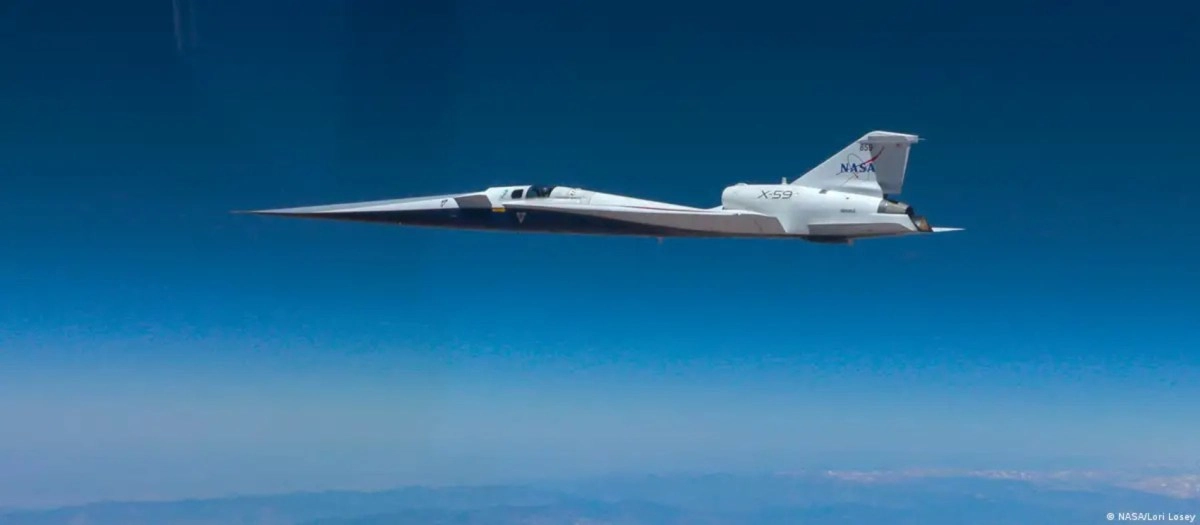

The experimental X-59 aircraft has exceeded the speed of sound for the first time without generating the characteristic sonic boom of predecessor models, a milestone that NASA considers decisive for the future of supersonic commercial aviation.
In a test carried out on June 5, the aircraft took off and landed at Edwards Air Force Base, in California, after an 81-minute flight in which it reached a speed of Mach 1.1 – equivalent to 1,147 km/h – at an altitude of 13,228 meters.
"You know you're supersonic when the indicators say you're supersonic. I didn't feel anything. Everything went smoothly and we easily reached Mach 1.1," says pilot Jim 'Clue' Less, in a NASA statement.
Why reducing sound is the greatest achievement
Unlike NASA's F-15 jets that accompanied the recent test, the X-59 does not generate the characteristic loud boom as it breaks the sound barrier, but rather a soft thud. That sound difference is the core of the project.
The sonic boom was precisely one of the obstacles that ended the Concorde, the commercial plane that operated between 1976 and 2003 and connected London or Paris with New York in three and a half hours at more than 2,000 km/h.
The noise generated by exceeding the speed of sound led dozens of countries to ban supersonic flights over land, condemning Concorde to operate only over the ocean. Economic problems and a fatal accident in 2000 ended up ending commercial supersonic flights between Europe and New York.
The design that eliminates the noise
The most visible feature of the X-59 is its extremely elongated nose, which takes up one-third of the aircraft's total 30.5 meters.
The motor is located on top, with a surface under the nozzle that disperses sound waves before they are compressed.
It is precisely this compression of waves that generates the sonic boom in conventional aircraft, but the design of the X-59 is designed to prevent it.
The second test managed to exceed Mach 1.4
On June 12, in a second test reported by the US agency, the X-59 reached Mach 1.4 - 1,487 km/h - at 16,700 meters altitude, the conditions required for future commercial flights.
“In the coming days, we hope to take the next step and reach Mach 1.4,” NASA administrator Jared Isaacman had anticipated in the first report.
But there is still a long way to go; The X-59 still has months of performance testing left. Once completed, the Quesst mission will fly the aircraft over several U.S. communities to collect data on how the public perceives the sonic boom it generates at supersonic speeds.
“The plane wants to go faster, and we're looking forward to that moment,” says Less.
The future of commercial supersonic aircraft
The goal of these tests is not for the X-59 supersonic jet to become a passenger-carrying aircraft. The idea is to collect as much data as possible so that regulatory authorities rethink current restrictions on supersonic flights.
If the plan works, it is likely that other companies will seek to manufacture commercial models to be able to fly faster to another part of the planet without disturbing people and animals on land with the loud noise.