

What does it mean that Russia has deployed its strategic nuclear forces in its largest military exercises to date?
Russia conducted strategic nuclear exercises "to prepare and employ nuclear forces in the face of an aggressive threat," the Russian Defense Ministry said
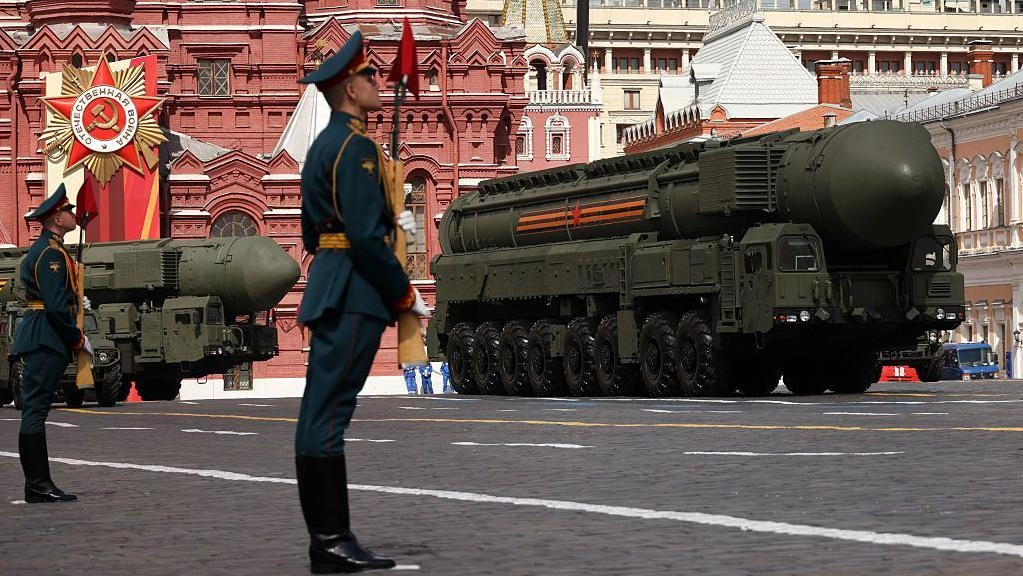

On May 19, Russia began large-scale strategic nuclear exercises “to prepare for and employ nuclear forces in the face of an aggressive threat,” the Russian Defense Ministry announced. The day before, maneuvers had been carried out with Russian tactical nuclear weapons deployed in Belarus.
Russia usually holds these large-scale nuclear exercises in October. They are generally called “Thunder”, but in February 2022, before the full-scale invasion of Ukraine, there was an exception to this rule.
The exercises involve the entire nuclear triad: intercontinental ballistic missiles, nuclear submarines and strategic bombers.
“The exercise will involve more than 64,000 troops, more than 7,800 pieces of weapons, military equipment and special equipment, including more than 200 missile launchers, more than 140 aircraft, 73 surface ships and 13 submarines, including eight strategic missile submarines,” the Ministry of Defense stated in a statement.
This represents a significant part of all strategic nuclear forces. According to the Bulletin of Atomic Scientists, in 2026, Russia has, according to rough estimates, more than 320 launchers, including silos and mobile platforms. Therefore, most of them participate in the exercises.
Of the 13 strategic nuclear submarines, eight participate in the exercises. Considering that some submarines are often undergoing repair or maintenance at a naval base, these eight ships could constitute almost the entire fleet of combat-ready strategic submarines.
After the biggest attack
The exercises are being carried out against the backdrop of massive and increasingly frequent attacks by Ukraine's long-range drones against targets in Russia.
Two days before the military exercises, the Russian capital suffered its largest drone attack, in which three residents of the Moscow region were killed and 17 people were injured.
Ukrainian President Volodymyr Zelensky called the overnight strike a “just response” to recent Russian attacks in Ukraine, including Kyiv, where a missile hit a nine-story building on May 14, killing 24 people.
Official sources do not mention any connection between the attack in Moscow and the exercises.
Technically, however, strategic nuclear forces are on constant alert, and their deployment probably does not require as much time as other forces.
Belarusian exercises
On the eve of major Russian strategic nuclear exercises, Belarus began maneuvers with tactical nuclear weapons. Russia deployed tactical nuclear warheads to the country in 2023.
The Belarusian Defense Ministry announced that these exercises would test the ability of nuclear weapons units to launch missiles from unprepared areas throughout the territory.
This is not the first time Belarus has conducted nuclear exercises with tactical weapons. In 2024, for example, a combat readiness test was carried out with nuclear aircraft carriers: a battalion of Iskander tactical missiles and a squadron of Su-25s.
NATO conducts annual exercises with air units armed with American nuclear bombs deployed in Europe. These pumps are located in Italy, the Netherlands, Belgium, Germany and Türkiye.
But exercises on Belarusian territory often generate apprehension in the West; The invasion of Ukraine in 2022 began, among other places, from Belarusian territory.
Even before this invasion, NATO analyzed possible scenarios for the outbreak of war with Russia, in which the attack would begin with large-scale maneuvers in Belarus. These concerns were expressed as early as 2017.
Sarmat launch
On May 12, Russia tested a new intercontinental ballistic missile, the Sarmat.
This heavy missile is designed to replace the R-36M Voevoda missiles (NATO codename: SS-18 Satan) in the Russian nuclear forces, manufactured by the Ukrainian company Yuzhmash, whose maintenance is no longer carried out by its specialists.
Russian President Vladimir Putin, after receiving the report on the launch of Sarmat, declared that its range exceeds 35,000 kilometers, more than double that of Voevoda.
A range of 35,000 kilometers allows the missile to be directed towards its target along any trajectory, rather than the shortest. This greatly complicates its interception.
Other features Putin mentioned — suborbital flight trajectory and launch weight — also surpass those of other intercontinental ballistic missiles (ICBMs).
The sum of all these parameters has never been demonstrated in practical tests. In only two successful launches, the rocket did not travel more than 6,000 kilometers.
Putin often talks about strategic weapons, mainly nuclear, in his speeches.
Commenting on the Sarmat launch, he also mentioned other nuclear projects. He spoke about the Oreshnik medium-range missile, which, according to the Russian president, will be in service from 2025.
He also mentioned nuclear propulsion systems: the Poseidon underwater vehicle and the Burevestnik cruise missile. Successful testing of these two vehicles was reported in 2025.
However, in those cases, no evidence was received from independent sources that such tests had been performed.