

What the Nobel Peace Prize for Maria Corina Machado means for the Venezuelan opposition and for Maduro
The Norwegian Nobel Committee's recognition brings a breath of fresh air to the Venezuelan opposition
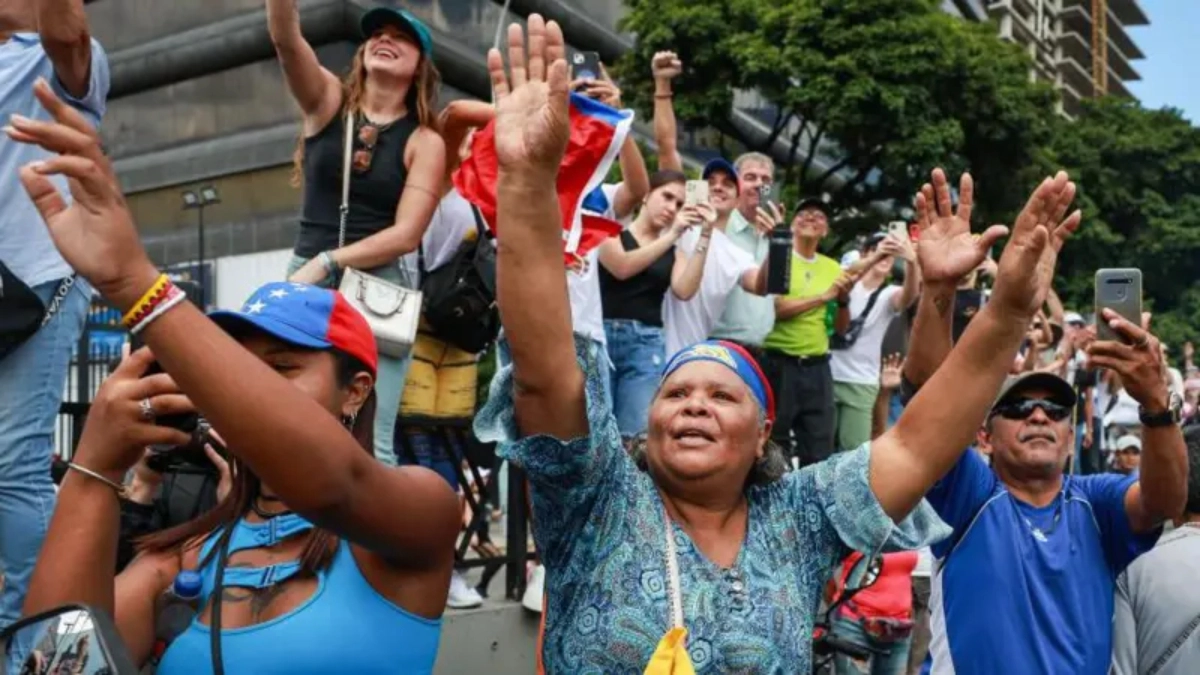

With these words, Edmundo Gonzalez Urrutia reacted to the announcement that Venezuelan opposition leader Maria Corina Machado had won the 2025 Nobel Peace Prize.
Gonzalez, who was the opposition presidential candidate in Venezuela in the elections of July 28, 2024 (28J) and is considered by several countries to be the legitimate elected president of Venezuela, expressed his reaction in a clip published on opposition. This was severely limited in its capacity for action after the shake-up of Nicolas Maduro's government following the June 28 elections, when the National Electoral Council (CNE) proclaimed him the winner but never showed the minutes that would have allowed verification of that result.
In a matter of weeks, more than 2,000 Venezuelans were imprisoned, Gonzalez Urrutia had to seek asylum in Spain, and Machado had to go into hiding.
Since then, the political climate in Venezuela has not been the same.
The Norwegian award also comes at a particularly difficult time for Maduro's government, as it became more internationally isolated after June 28 and has been under pressure from the government of US President Donald Trump for the past two months.
In August, the US announced the deployment of a military flotilla in the Caribbean, close to the coast of Venezuela, with the stated aim of combating drug trafficking in the region.
The detail is that Washington accuses Maduro of being the head of a narco-terrorist organization, so in his speech he seems to be portraying him as a legitimate target.
In this context,What impact could the awarding of the Nobel Peace Prize to Maria Corina Machado have?
“A breath of fresh air for the opposition”
Elsa Cardozo, retired honorary professor of International Relations at the Central University of Venezuela, points out that this award highlights for Venezuelans and the world “what the fight for democracy has meant” in that South American country.
“That momentum is something that is sometimes not appreciated enough and that has returned time and again, and with Maria Corina Machado it returned with particular force until she won an election on the terms that she did,” Cardozo tells BBC Mundo, referring to the obstacles that the opposition had to overcome to reach the June 28th elections, since the government did not allow Machado to run and security forces were used on numerous occasions to prevent the opposition from campaigning.
Carmen Beatriz Fernandez, analyst at the consulting firm DatastrategIA and a doctor in public communication from the University of Navarra, in Spain considers the award to be an endorsement that legitimizes the opposition's struggle and Machado's leadership.
“For the opposition, this is a global endorsement on par with the 93% support that Maria Corina Machado obtained in the opposition primary elections in 2023. This minimizes the other options within the opposition and consolidates her leadership,” he points out.
Analysts also hope that the recognition will serve as an incentive for Venezuelans who want change in their country.
“For the opposition, it is a breath of fresh air, an extremely important source of legitimacy, recognition of their years of struggle, as the justification for the award states,” Carlos Malamud, a researcher specializing in Latin America at the Elcano Royal Institute, told BBC Mundo.
Thus, the recognition could be a sort of stimulant for an opposition that mobilized massively for change in the June 28 elections, but instead of seeing it materialize, it has instead faced, according to They denounce, more threats and restrictions on exercising their political rights.
“This revives people's enthusiasm, their willingness to persevere, to not give up, to have courage, which is one of the messages of the prize. This has a positive effect on encouraging people and stimulating the democratic impulse among Venezuelans,” says Cardozo.
“I can't imagine any mobilization of people in the streets now that would have occurred in other times to celebrate it. I don't there will be, but the spirit within is there and this strengthens hope, the expectation of good things,” he adds.
In more practical terms, the Nobel Prize is a platform that legitimizes and amplifies Machado's figure and message on the international stage, but also protects it.
“This is huge.”It reflects her tireless efforts, at great personal cost, to restore democracy in Venezuela. It increases her international visibility, making it more difficult for the regime to attack her," Eric Farnsworth, a research associate at the Center for Strategic and International Studies (CSIS), told BBC Mundo. Cardozo agrees: "This makes things more difficult for the government. It makes it more costly to discredit her and eventually harm her." In a way, this protects her, as far as possible, in the midst of barbarism." embarrasses and slaps Maduro in the face,” says Farnsworth.
Carlos Malamud, for his part, indicates that the Venezuelan government receives this hard blow “at a time when the naval and air deployment of the United States has it quite cornered.”
The good thing that the prize has for Machado and the opposition also has, according to Elsa Cardozo, an inverse effect when it is reflected on the government. “Everything that the prize values ????is, in some way, the opposite version of what the regime represents,” she specifies.
In that Director, Carmen Beatriz Fernandez points out that a key element lies in the mention made when awarding the prize that democracy is an essential condition for lasting peace.
“That is the key, because the Maduro government closed the doors to peace when it stole the elections on July 28. When they snatch the result, they are basically telling society that it is not possible to make a change through peaceful means,” she points out.
The expert adds that the Nobel Prize weakens the Maduro government's narrative of presenting Machado as a radical and violent figure, while also delegitimizing the president.
“Maduro's popularity and ability to have any international influence are at a minimum, and this further reduces his standing on the international stage,” she says.
Another negative factor for the Maduro government, according to Malamud, is that the prize is awarded by Norway.
“The awarding of the Nobel Prize underscores Maria Corina's contribution to the struggle for the transition from dictatorship to democracy in Venezuela. This is important coming from the Norwegian Committee, especially considering that Norway worked for a long time to mediate in the Venezuelan conflict, but repeatedly encountered neglect or evasion from the Venezuelan government, which promised one thing and then ended up doing another."
"Until now,They had never used the term dictatorship to refer to Venezuela; However, now they have clearly used it,” says the expert.
In announcing the recognition to Machado, the Norwegian Committee highlighted that he was being awarded for “her tireless work in promoting the democratic rights of the Venezuelan people and for her struggle to achieve a just and peaceful transition from dictatorship to democracy.”
Will this change anything in the short term? Malamud believes it is too soon to know, but points out that a key moment will occur when Machado has to travel to Norway to collect the award in December.
“Will they allow Maria Corina Machado to travel to Europe to collect the award?” he asks.