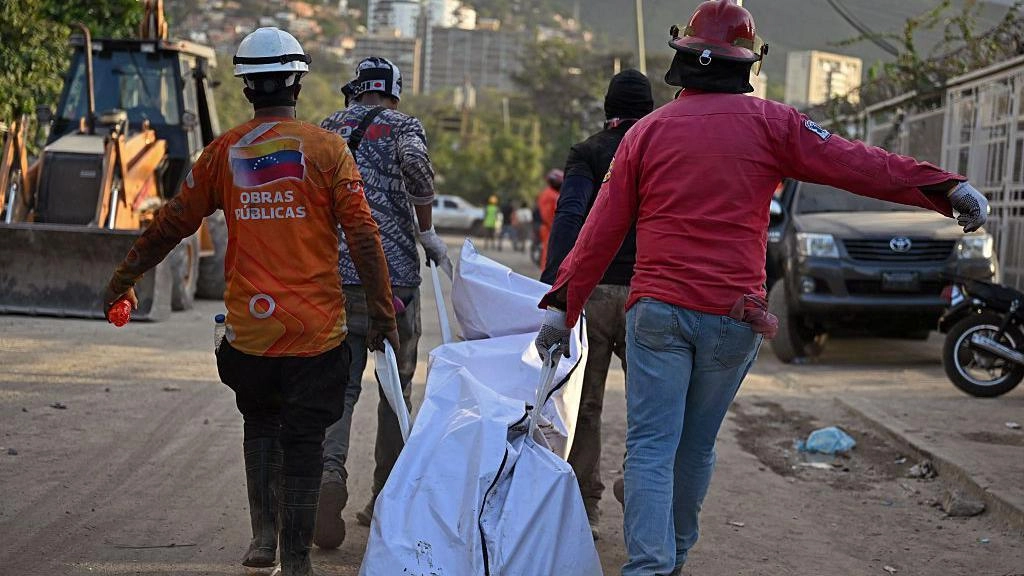

Restoring toys, distributing lunches in hospitals, recycling clothes or making body bags are some of the tasks that dozens of volunteers undertook to alleviate the effects of the devastation in Venezuela.
Lilian Gluck created an emotional support kit: stuffed animals restored and wrapped in blankets, tied with colorful bows and cards inviting them to take care of them. Its new owners are children affected by the earthquakes in Venezuela.
“When we go to La Guaira, we tell the children: 'This stuffed animal went through the earthquake and is afraid, but it is looking for a friend to take care of it,'” explains Gluck in a call from Caracas.
“The children get excited, they hug them and they commit to taking care of them.”
The 67-year-old teacher and educational psychologist founded the Stuffed Animals Hospital almost a decade ago, an organization that educates about the value of reuse through recycling toys.
But after the earthquakes that shook northern Venezuela on June 24, distributing stuffed animals became an accompaniment task in disaster zones.
"The stuffed animal covered with a blanket tells the child who has been through the earthquake that they can take care of each other. If there is fear at night, they can hug and play together."
During the last month, the Stuffed Animals Hospital has received all kinds of donations: from dolls so damaged that they are irreparable, to stuffed animals with letters from their former owners telling the new owners how much love they felt for those toys.
"It's sad to see the panorama. There are kilometers and kilometers of tents with children inside, with people who are waiting for something to give them to get out of there," says Gluck when remembering his visits to La Guaira, the state most affected by the earthquakes.
"But every time we sit with our children and they play and dance, it gives you a break, a joy. Seeing them hug their stuffed animals gives you contentment in your heart."
During the first month after the earthquakes, Gluck says that the volunteers distributed more than 1,000 stuffed animals.
Mini burgers and cupcakes
Chef John Fuentes, 51, had coordinated the preparation of breads, arepas stuffed with ham and cheese, pasta with tuna and Chinese rice, to distribute them in hospitals and shelters in Caracas and La Guaira.
But it was a doctor's request for children from the Pediatric Surgery service that changed her perspective on the contribution of volunteerism to alleviate the effects of the tragedy.
“We made 50 combos with mini chicken burgers, vanilla cupcakes and natural yogurt with strawberry jam and juice,” says Fuentes from the Alta Cocina Venezuela culinary school, which lends its facilities to prepare the supplies donated by the Gastronomic Chamber of Caracas and Miranda.
When Fuentes arrived at the hospital to hand out the lunches, he discovered that many of the children were amputees.
"I steeled myself not to cry. I made as little eye contact as possible. I felt like if I stared, I was going to fall apart," she recalls with a lump in her throat.
“I spoke to them like I did to my son when he was little: ‘Here, daddy, here's a hamburger, enjoy it.’ And they made such tender gestures of gratitude.”
Fuentes and his team have distributed more than 2,000 food rations in the last five weeks in hospitals and shelters in Caracas and La Guaira.
Cushions for shelters
When donations of clothes in poor condition saturated the collection centers, Gabriel Santana began to receive calls from volunteers asking for help to turn those pieces into useful products in the midst of the emergency.
With the purpose of creating valuable goods from waste, Santana founded Taller Neo 3 years ago, a recycling venture that made its first pots and glasses with crushed bottle caps.
Although he had never worked with textile waste, upon discovering that people were sleeping on the floor in shelters, Santana had the idea of creating a product that would help them rest.
“We decided to transform the mountains of clothes into filling for cushions that are distributed among the victims of the shelters,” explains the 30-year-old from his workshop in Caracas, surrounded by older women who make the cushions.
"The most impressive thing is the volunteering. They are elderly seamstresses who created a community. They make 200 cushions a day and what they are most grateful for is having a space where they can contribute."
The volunteers sort the clothes and completely discard anything that is dirty or has a bad smell. They then cut up the stained flannels, torn or buttonless clothing to use as stuffing, with the help of a company that processes cotton.
With rolls of resistant fabric donated by companies and spontaneous ones, they cut and sew the wrapping of the cushions. As the days went by, they realized that they could also make “little beds” for the dogs and cats that were left homeless.
“The first week we were still not efficient, but in one month we manufactured 2,200 cushions for people who are sleeping on the floor,” Santana says proudly.
“We have already reached the first ton of recycled textile waste.”
To make production sustainable in the medium term, for a few days they have been manufacturing cushion keychains with the word “Faith” printed in one corner.
Each keychain costs US$5 and is equivalent to a donation of two cushions for the shelters.
Patterns for body bags
Camila Isabel Díaz, 38, studied pattern making and tailoring to create her own clothing design brand for women. He never imagined that his workshop could make mortuary bags.
Once the double earthquake occurred, Díaz thought he could donate drinking water or food. Until he found out, through social networks, that a body bag cost US$16 in Caracas or La Guaira.
"At that moment, I didn't understand anything. I hadn't understood how I could help," she says, still amazed.
Without those bags, survivors could not remove the bodies of their relatives from the morgues.
Díaz contacted another shop that was making the bags and offered to help. They shared the materials to start: zippers, threads and 50 meters of a fabric that was not suitable for preserving bodies. He also received donations of money to buy new supplies.
“At what point did I go from making handmade clothing to making body bags?” she asked herself as she embarked on the task of making body bags.
Initially, Díaz had his usual team: three dressmakers and a pattern maker. But after posting a message on Instagram asking for help, volunteer seamstresses offered to go to her workshop to make the bags with whatever they had, including blue fabric instead of black.
As the days went by, the designer and her team refined the production process: they made the bags with waterproof and anti-fluid fabric, with standard measurements that until then she was unaware of.
"They started writing to me from the morgues and I started sending bags. We made between 25 to 30 a day," he says. “I never thought my own workshop would be so helpful.”
Designer Camilia Isabel's team made more than 400 body bags in less than a month.