

Requiring immigrants to apply for a Green Card from their country could “penalize” people, lawyers warn
Members of the AILA warn about the consequences of the memorandum that requires immigrants to apply for Legal Residency from a US consulate.
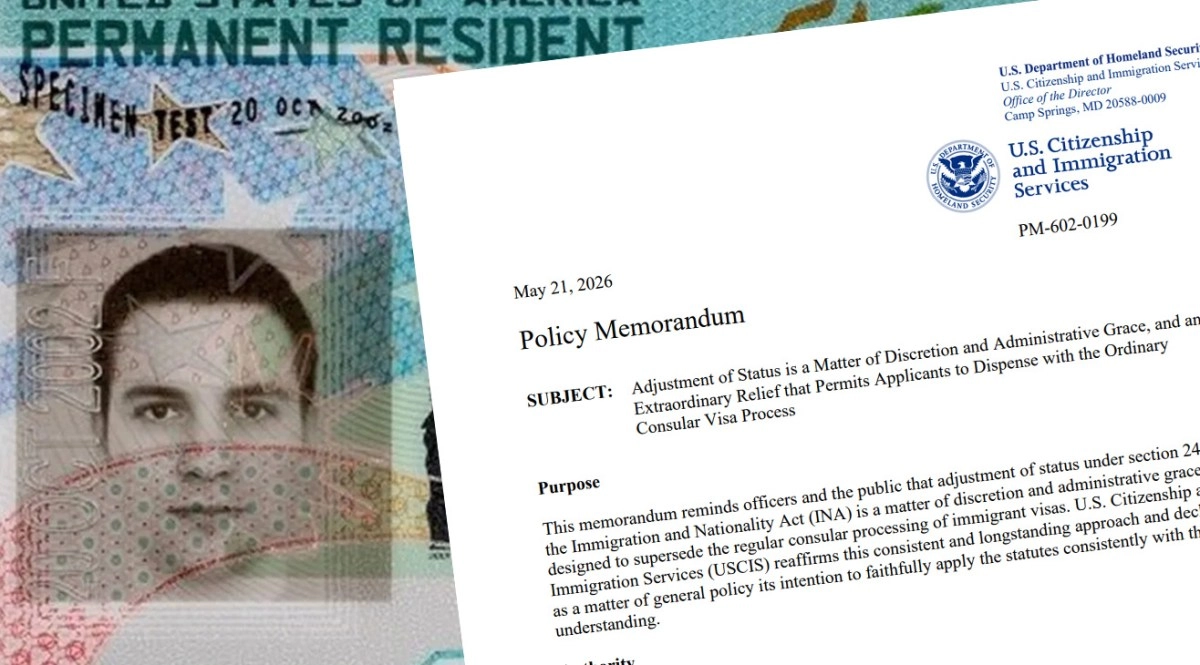

The decision by President Donald Trump's government to require immigrants living in the United States to apply for a Green Card from their country could "penalize" people, in addition to generating chaos in the immigration system, warn members of the American Immigration Lawyers Association (AILA).
The office of Citizenship and Immigration Services (USCIS) released a memorandum – without the signature of a senior official – instructing that immigrants who apply for Legal Permanent Residence or Green Card must do so from their country of origin, although it is indicated that there will be “exceptional” cases.
“This memo raises serious legal and practical questions that USCIS has not yet answered,” said Shev Dalal-Dheini, Senior Director of Government Relations. “Rather than improving the immigration system and increasing our security, this policy risks penalizing those who try to follow the law.”
Dalal-Dheini expressed this position during a virtual press conference with AILA members, where he insisted on the lack of clarity of the rule.
Ben Johnson, executive director of AILA, explained that the USCIS change is not simply a “technical” issue.
"For those who are not familiar with the subject, this might seem like a simple technical change in the procedure. It is not. This is a profound change with serious consequences for people, families and companies throughout the country," he said.
Johnson added that the policy change aligns with other modifications of the Trump administration, focused on legal processes.
“It consists of another attempt to hinder the legal immigration system, making it slower, stricter and more unpredictable,” he lamented.
He added that for more than 70 years, “adjustment of status” – as the petition for a Green Card is known – was created by Congress and applied by administrations of both parties, generating confidence in the system.
"People trusted that system. They made life-changing decisions based on it. They took jobs, started businesses, got married, had children, bought houses, built their futures, all while following the law as Congress wrote it and as the government has applied it for decades," he said. “This policy demonstrates complete disregard for those people, for those decisions, and for the impact it will have.”
Johnson recalled that the Trump administration has imposed visa bans on 75 countries and warned that the US consular service is overwhelmed.
Who is initially affected?
There is no exact list of which immigrants the new USCIS policy may primarily affect, but Johnson listed people on “parole,” that is, people on temporary stay permits and entire families.
“Once adjustment of status is reframed as something extraordinary rather than a fundamental legal process, the consequences will affect family reunification immigrants, work-related immigrants, long-term residents, and people with strong ties to the United States,” he lamented.
In the US there are two ways to apply for a Green Card: living in the country and from a consulate, but with the new policy it could primarily be the second way.
Four questions for immigrants applying for the Green Card
Jeff Joseph, president of AILA, highlighted that since last Thursday, one day before the memo was published, immigration officials who review Legal Permanent Residency petitions began to ask new questions to applicants.
"We began to hear that adjudication officers asked people four questions during interviews, and these four questions were variations of the following: First, why did you apply for adjustment of status instead of consular processing? Second, are there any factors that prevent you from consular processing? Third, do you still have family living in your home country? And fourth, why did you decide not to return to your country when your authorized period of stay expired?" Joseph said.
The expert described the memorandum to complicate Green Card requests as “erroneous, reprehensible and illegal.”