

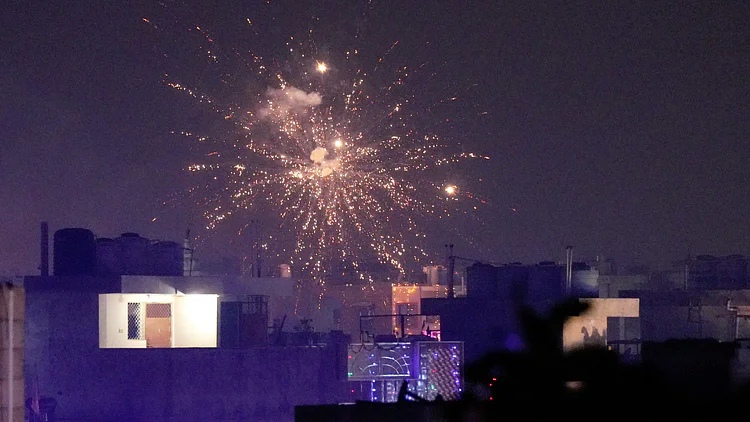
Delhi Pollution: Despite the ban, there was a lot of fireworks, burning in the eyes due to the smoke of the firecrackers
The festival of Diwali was celebrated across the country on Monday.

Time to Read 4 Min
Delhi Pollution: In violation of the ban on bursting of crackers in the national capital, Delhiites not only burst firecrackers on the night of Diwali, but also burst crackers with loud noises. Delhi Environment Minister Gopal Rai said last week that bursting crackers on Diwali in Delhi could attract a jail term of up to six months and a fine of Rs 200. As night progressed, the sound of firecrackers became louder and violated the permissible decibel limit. Despite rules being framed to prevent people from bursting firecrackers, people started pyrotechnics in different areas of the city including South to North East and North West Delhi as soon as evening.
old tradition of bursting firecrackers
The festival of Diwali was celebrated across the country on Monday. It is an old tradition to burst crackers on this day, but city officials said the decision to ban fireworks was taken due to environmental and health concerns. Delhi's air quality on Monday slipped into the 'very poor' category amid rising incidents of stubble burning and favorable weather conditions that have contributed to air pollution. However, the 24-hour average air quality index (AQI) stood at 312, which is the second-best AQI in seven years on Diwali. Earlier in 2018, the AQI was recorded at 281 on Diwali.
what the journey said
Experts had feared that the air quality could worsen if more crackers were burst again this year. The Air Quality System and Weather Forecasting and Research (SAFAR) had earlier predicted that if crackers are burst this time as in the previous year, the air quality may reach 'severe' level on Diwali night and another The day may remain in the 'red' zone. However, despite the ban, people started fireworks in different areas of the city from 6 pm onwards. The sound of firecrackers was heard in South Delhi's East of Kailash, Nehru Place, Moolchand and other areas since evening.
This time the sound of firecrackers is less than last year
A person living in Burari said that they are educated people still doing this. What will the children learn from this? The situation remained the same in many areas including Laxmi Nagar, Mayur Vihar, Shahdara, Yamuna Vihar in East and North East Delhi. Some residents said that this time the sound of firecrackers was less than last year, but the sound of crackers increased after 9 pm. Loud firecrackers have been allegedly burst in Munirka, South West Delhi. Bipasha Ghosh (19) had come from Kolkata a few days ago to the Kailash Hills area of ​​South Delhi. He said that in my area, it started after 11 pm. I wonder if there is a ban on bursting of crackers in Delhi. Also, those who do so are irresponsible and insensitive towards the environment. Also insensitive to those who have respiratory problems and other health problems.
impact on air quality
Ritu Nandan, a student living in South Delhi, said that I will not go out on Tuesday. I know what the air quality will be. At the same time, 408 teams were formed to implement the ban on bursting of crackers in Delhi. Delhi Police had constituted 210 teams under the leadership of Assistant Commissioners of Police. At the same time, the Revenue Department formed 165 teams and the Delhi Pollution Control Board formed 33 teams. People also burst firecrackers in neighboring Haryana's Gurugram and Faridabad cities adjoining Delhi. In Uttar Pradesh's Ghaziabad, the AQI was 301, Noida 303, Greater Noida 270, Gurugram 325 and Faridabad 256. AQI between zero and 50 is 'good', 51 to 100 'satisfactory', 101 to 200 'moderate', 200 to 300 'poor', 301 to 400 'very poor' and 401 to 500 'severe' ' is considered.