

'I froze': Undocumented person faces a fine of $1.8 million from DHS
Thousands of immigrants have received letters with monetary penalties to pressure them to self-deport
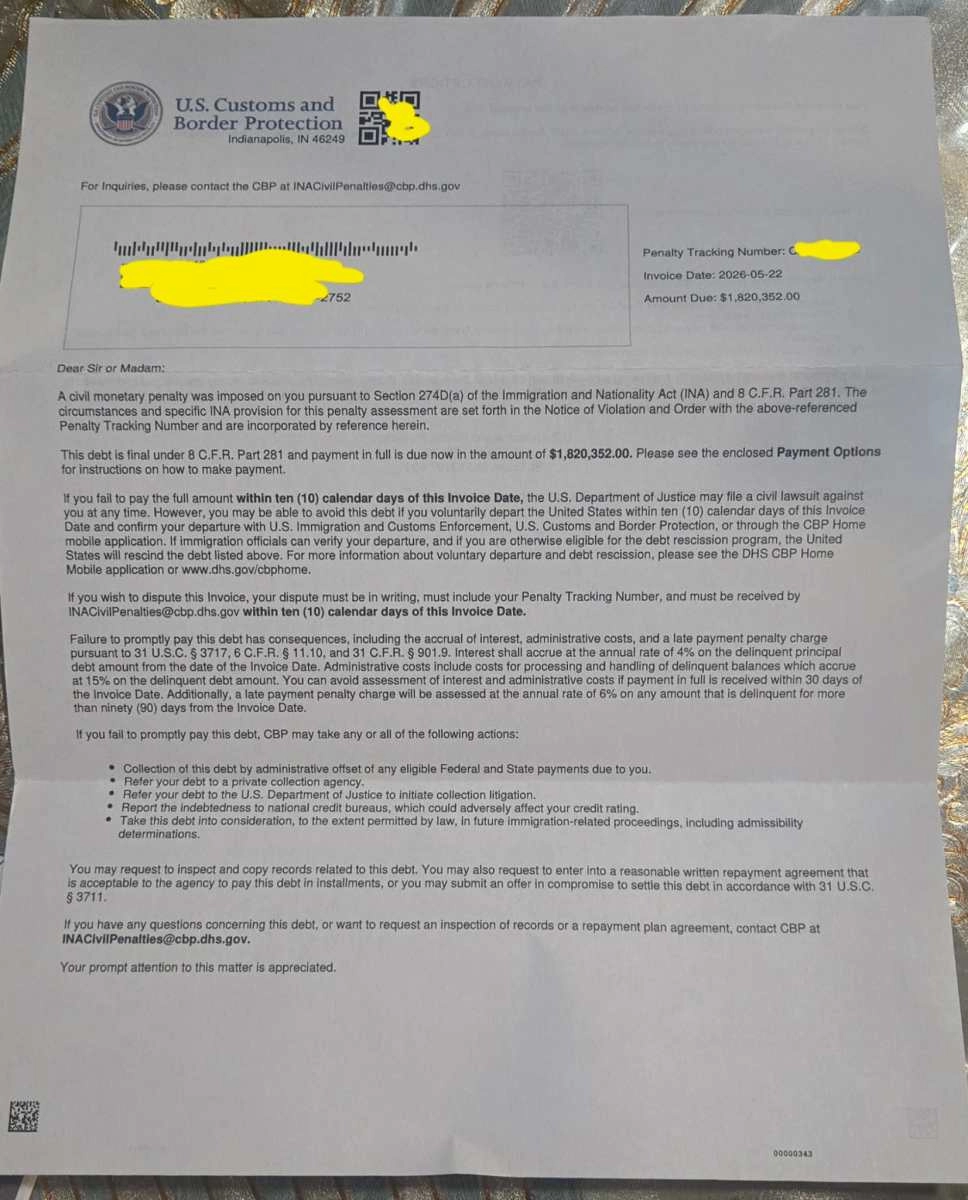

At the end of May, Angel, who has lived in Los Angeles for more than two decades, received a letter in the mail from the Department of Homeland Security informing him of a $1.8 million fine for failing to file a deportation order.
Angel (his real name was omitted due to his lack of immigration status) said the days and weeks since he received the letter have been filled with anguish.
“I froze on receiving the letter,” he said. “I couldn't eat. I lost my appetite. I felt cornered.” He added, “I started asking myself over and over again what was going to become of me. I don't have money to pay that amount. What will happen to my family if I am deported?”
A recent report by the Marshall Project reveals that the federal government has sent more than 65,000 similar letters to immigrants across the country who, like Angel, have pending deportation orders. In Angel's case, the $1.8 million is based on a fine of $998 per day with a legal minimum of five years.
By administering the fines, which total about $36 billion, the Trump administration has revived a little-used 1996 law that allows financial penalties for immigrants who failed to comply with deportation orders.
Beware of notaries
Angel is 47 years old and has been working in construction since he arrived in Los Angeles from Mexico. With a lump in his throat, this husband and father of three, aged 21, 18 and 12, all US citizens pause for a long time during the interview. Between sobs, he says his problems began when he visited a notary in 2001, shortly after arriving in the country.
“He promised me a work permit, a social security number, and residency,” Angel said. "At that time, he had only been in the country for a year, and out of ignorance, I naively believed him."
In Mexico and other parts of Latin America, notaries are lawyers appointed by the state, with broad legal authority, which does not occur in the United States. This confusion has led to legal and financial problems, as well as numerous scams targeting immigrants.
In Angel's case, three years later, in 2004, when an immigration judge denied his request for asylum, and issued a deportation order, he understood his mistake.
“I wasn't the only one, there were hundreds,” explained Ángel, who paid the notary $4,000 for his services. As he said, the notary never explained that he would file an asylum application on his behalf.
Historically, the approval rate of asylum applications for Mexican citizens has been less than 10%.
The judge told Angel that he could opt for his self-deportation or for agents to go to his home. "I replied that I would go on my own," he said.
Angel did not leave. He stayed in the country, motivated by the need to financially support his parents in Mexico. A year later, in 2005, she married and started her own family.
“I have a very good job. I pay my taxes. My wife has always volunteered at our children's schools,” Angel said. “I've never had a problem with the police; I have an impeccable credit history. Many consider me an exemplary citizen."
Shattered dreams
Two weeks after receiving the first letter from DHS, Angel received a second one notifying him that his debt would be sent to a collection agency.
“Since then, I have consulted with many lawyers trying to find a solution, but there is nothing that can be done. An attorney wanted to charge me $5,000 for filing an appeal; another $8,000 for filing for bankruptcy, but that option is not available. It doesn't work when you owe money to the government.”
She finally decided to cancel her bank accounts and put her savings and vehicles in her children's names to prevent them from being repossessed.
"They have also told me that they can garnish up to 25% of my salary, which would affect me a lot because I am the only breadwinner in my family."
Angel said he expects the Trump Administration to send him another letter with a subpoena, and that ultimately a judge will decide his fate.
“If my children had already finished their studies, I would feel calmer to return to Mexico,” he said. "My daughter wants to study to be a teacher and my oldest son dreams of becoming a drone engineer. Deporting me would mean shattering their dreams."
"The goal is to break them"
Juan José Gutiérrez, director of the Coalition for the Full Rights of Immigrants, said that these fines have two purposes: first, to continue terrorizing the immigrant community.
"The only thing left for them is to take away the few savings they have," he said.
The second, he added, is to get people to voluntarily deport themselves, thus fulfilling Trump's campaign promise to massively deport. "The goal is to emotionally break undocumented immigrants, so that, in panic, they can self-deport."
For his part, Angel, devastated and without a way to regularize his immigration status, said that his greatest desire is to contact other immigrants who have received the millionaire fines from DHS.
“So far, I haven't been able to contact anyone. Talking to someone who is living the same nightmare as me would help me a lot."
This story was produced as part of “Aquí Somos,” a collaborative journalistic project of American Community Media and community media outlets across the state.
Protect your assets
Alex Galvez, an immigration attorney in Los Angeles, advises immigrants who receive these letters to beware of lawyer scams that offer to appeal DHS fines of more than $1 million.
“There is nothing to appeal; and we are seeing lawyers charging up to $4,500 for filing an appeal that will not stop the fine or cancel the deportation,” he explained. “What they should do is protect their assets, especially queens who own a home, and create a trust to prevent their properties from being seized or confiscated.”
He added that he has seen cases of immigrants who received these letters, and soon after, Immigration and Customs Enforcement (ICE) agents came for them, because they already have the information of where they live.
"What happened is that ice detained them when they left their homes," he said. “I've seen it.”