

Congressional leaders react to Trump's order to attack Iran
Some Republicans questioned Trump authority to attack Iran, and Democrats criticized that decision without approval from Congress.
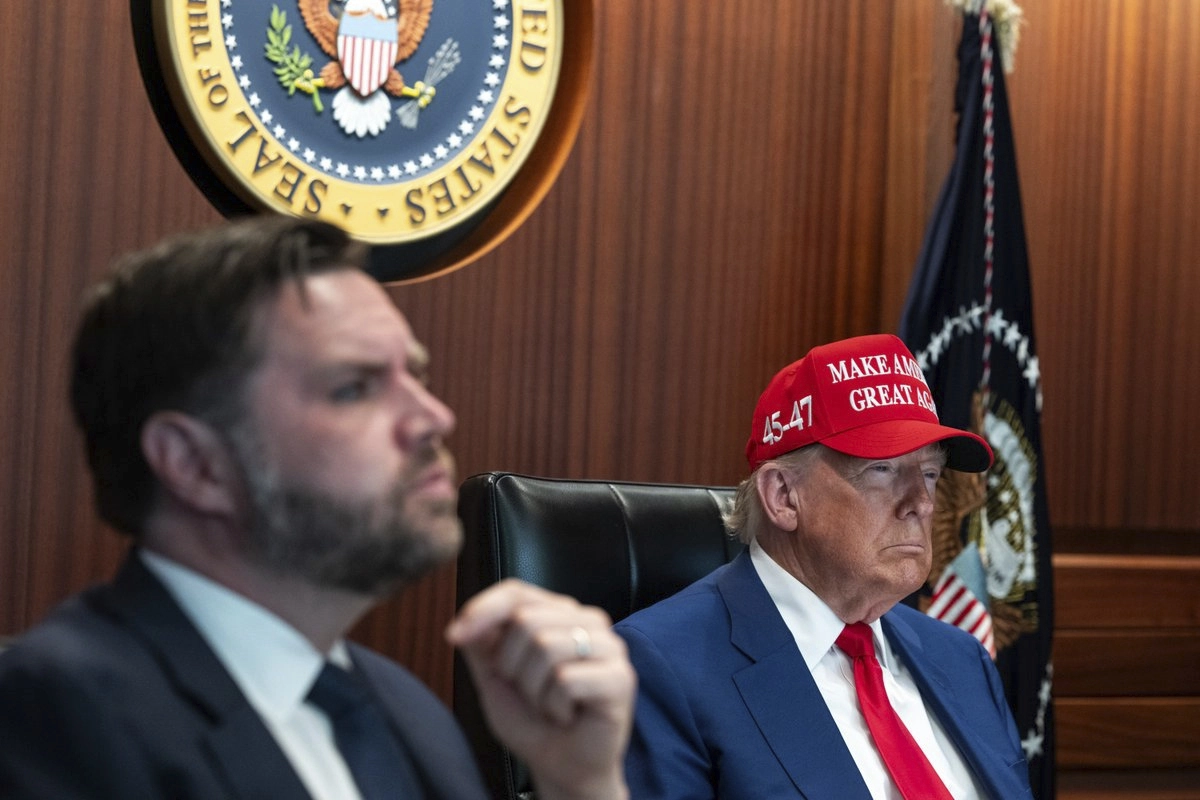

Congressional leaders expressed surprise Saturday night at President Donald Trump's announcement that he had ordered a U.S. strike on three Iranian nuclear sites, with some Republicans praising the move, others criticizing it, and some Democrats questioning the president's authority to declare war on Iran.
South Carolina Republican Senator Lindsey Graham, a hawkish supporter of Israel, said in a post on X moments after Trump announced the attack was “the right decision.”
Other Republican and Democratic lawmakers condemned President Trump’s decision, saying it was unconstitutional and should have gone through Congress.
“This is not constitutional,” wrote Republican Congressman Thomas Massie on social media, quoting Trump’s message announcing the attack.
The top Democrat in the House of Representatives, Minority Leader Hakeem Jeffries, said Trump had “misled the country.”
“Donald Trump promised to bring peace to the Middle East. He has broken that promise. The risk of war has dramatically increased, and I pray for the safety of our troops in the region who are in harm’s way,” he said.
“President Trump misled the country about his intentions, did not seek congressional authorization for the use of military force, and risks drawing the United States into a potentially violent war.” disastrous Middle East situation,” Jeffries continued.
“First, the Trump administration has a heavy burden to explain to the American people why this military action was taken. Second, Congress must be fully and immediately informed in a classified manner. Third, Donald Trump assumes full responsibility for any adverse consequences that result from his unilateral military action,” the Democratic leader added.
Senate Democratic Minority Leader Chuck Schumer said in a statement:“President Trump must provide the American people and Congress with clear answers about the actions taken tonight and their implications for American security. No president should be able to unilaterally lead this nation into something as momentous as war with erratic threats and no defined strategy. Confronting Iran’s ruthless campaign of terrorism, nuclear ambitions, and regional aggression demands strength, resolve, and strategic clarity. The danger of a broader, longer, and more devastating war has increased dramatically.” Schumer noted: “We must enforce the War Powers Act, and I urge Senator Thune to introduce it to the Senate immediately. I will vote for it and implore every senator in both parties to pass it.” Democrat Jim Himes recalled that members of Congress like him must have a voice in these types of matters “before the bombs fall,” something his fellow Senator Alexandria Ocasio-Cortez also asserted, asserting that “the President’s disastrous decision to bomb Iran without authorization is a grave violation of the Constitution and the war powers of Congress.”
Sean Casten, also a Democrat, said that regardless of “the merits of Iran’s nuclear program,” neither Trump nor any other U.S. president has the authority “to bomb another country that does not pose an imminent threat to the United States.”
“This constitutes an unequivocal impeachable offense,” Casten warned.
House Speaker Mike Johnson was briefed in advance of the U.S. strikes on Iran’s nuclear facilities, a source familiar with the matter reported by multiple outlets.
Johnson was scheduled to be in Israel on Sunday to address the Knesset, but the trip was canceled because of the ongoing conflict.
Johnson also issued a statement backing the strikes, calling them “decisive” action to prevent terrorism.
Who has the power to declare war on the United States United States
Under US law, Congress has the power to declare war on a country, and lawmakers who have criticized it equate the attack on Iranian facilities as an act of war against Iran, which was directly attacked by Israel and attacks between the two countries have since erupted.
According to the US Senate: “The Constitution grants Congress the exclusive power to declare war. Congress has declared war 11 times, including its first declaration of war against Great Britain in 1812.”
“Congress made its last formal declaration of war during World War II. Since then, it has passed resolutions authorizing the use of military force and continues to shape U.S. military policy through appropriations and oversight.”
Bipartisan Divisions in Congress
Since Trump opened the door to entering the conflict between Israel and Iran, Republicans have been divided over whether the United States should intervene and risk being drawn into another conflict in the Middle East, something the president had previously ruled out.
While Massie opposed the bombing, Republican Senator John Cornyn of Texas said the attack was “the right decision.”
The president announced the bombing on the Truth Social networking site around 8 p.m. ET.
Trump said the bombing “successfully” hit three Iranian nuclear facilities, including Fordow, which is considered one of the centers Iran confirms attacks
Iran's nuclear agency confirmed on Sunday the attacks on its atomic facilities in Fordo, Isfahan and Natanz, but insists its work will not stop.
The Atomic Energy Organization of Iran issued the statement after Trump announced the US attack on the facilities.
Iran said on Sunday morning that there was no sign of contamination at its nuclear plants in Isfahan, Fordo and Natanz following the US airstrikes on the facilities.
Iranian state media quoted the National Center for Nuclear Security System as issuing a statement saying its radiation detectors had not registered any radioactive releases following the attacks.
“There is no danger for residents living in the vicinity of the mentioned facilities,” the statement added.
Previous Israeli airstrikes on nuclear plants have also not resulted in any release of radioactive material to the surrounding environment, according to the International Atomic Energy Agency.