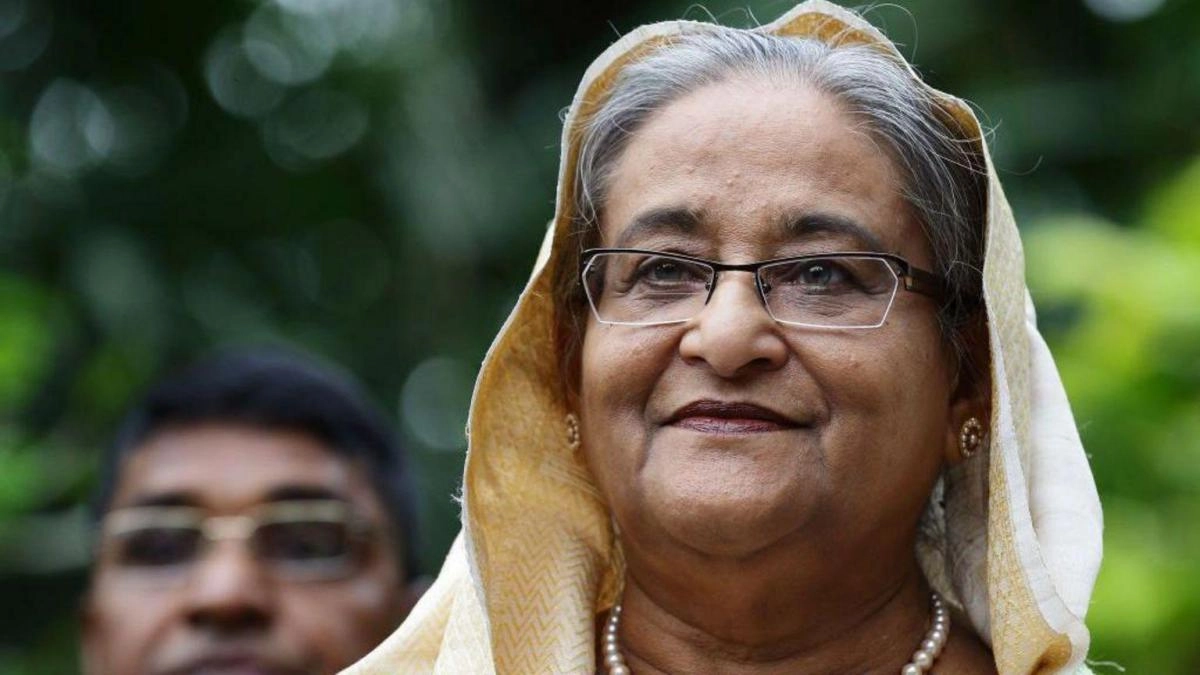

Former Bangladeshi Prime Minister Sheikh Hasina was sentenced to death for crimes against humanity for the repression of student protests in mid-2014.
Hasina, who began her political career as an icon of the pro-democracy movement, was declared Guilty in absentia for ordering the use of lethal force against protesters during the demonstrations that ended in her removal from office and in which 1,400 people died, mostly from security forces shootings, according to UN human rights investigators. In their reports, the experts indicate that Hasina attempted to cling to power through systematic and deadly violence against protesters. She and her party, the Awami League, are credited with the country's economic improvements. However, in recent years she was accused of becoming autocratic and repressing the opposition. Exiled in India since leaving power in July 2024, Hasina was tried in absentia by the International Crimes Tribunal in Bangladesh. Prosecutors accused her of ordering a brutal crackdown on protesters, which is already considered the worst bloodshed in the country since independence in 1971. Relatives of the victims demanded harsh sentences for the former prime minister. Hasina, for her part, denied all charges against her, claiming that her trial was politically motivated. The verdict represents a diplomatic test for both India and Bangladesh. The Dhaka government has formally requested her extradition, but so far Indian authorities have shown no willingness to grant it.
Who is Sheikh Hasina?
Born into a Muslim family in East Bengal in 1947, Hasina has politics in her blood.
Her father, the nationalist leader Sheikh Mujibur Rahman, nicknamed the “Father of the Nation” of Bangladesh, led the 1971 independence movement and became its first president.
At that time, Hasina had already gained a reputation as a student leader at Dhaka University.
Her father was killed along with most of her family members in a military coup in 1975. Only Hasina and her younger sister survived because she was traveling abroad at the time.
After living in exile in India,Hasina returned to Bangladesh in 1981 and became the leader of the Awami League, her father's party.
She joined other political movements to hold pro-democracy demonstrations during the military rule of General Hussain Muhammad Ershad.
Propelled by the popular uprising, Hasina quickly became a national icon.
Elected as prime minister for the first time in 1996, Hasina gained popularity after signing a water-sharing agreement with India and a peace treaty with tribal insurgents in the southeast of the country.
However, her government has been criticized for a series of trade deals suspected of corruption and for adopting an overly political subservient position to India.
In 2001, she lost the election to her former ally Begum Khaleda Zia of the Bangladesh Nationalist Party.
As heirs to a dynasty, both women have dominated Bangladeshi politics for more than three decades.
Analysts say the rivalry between these two political leaders led to a series of bus bombings, while disappearances and extrajudicial killings became commonplace.
In 2009, Hasina finally returned to power, making her a true political survivor, having endured numerous arrests while in the opposition, as well as several assassination attempts.
She has also survived numerous attempts to force her into exile and judicial investigations in which she has been accused of corruption.
Achievements and Controversies
Having been one of the poorest countries in the world, Bangladesh improved economically since 2009 onwards under her leadership.
Per capita income tripled in the last decade, and the World Bank estimates that more than 25 million people have been lifted out of poverty in the last 20 years.
Much of this growth has been driven by the garment. industry, which accounts for the vast majority of Bangladesh's total exports and has expanded rapidly in recent decades.
Using the country's own funds, loans, and development assistance, Hasina's government also undertook massive infrastructure projects, including the Padma Bridge over the Ganges, which cost US$2.9 billion.
However, Hasina has long been accused of enacting authoritarian and repressive measures against her political opponents, critics, and the media.
This point is central to describing her leadership, especially for a woman who once fought for multi-party democracy.
Since Hasina returned to power in 2009, human rights groups estimate that at least 700 people have been victims of enforced disappearances, while others have been killed. Hasina denies responsibility for these acts.
Bangladeshi security forces have also been accused of serious abuses.
In 2021,the United States sanctioned the Rapid Action Battalion, a notorious police unit accused of carrying out numerous extrajudicial killings. Human rights activists and journalists also faced increasing attacks, including arrests, surveillance, and harassment. Her government, in turn, was accused of “judicially harassing” dissidents, including Nobel Peace Prize winner Muhammad Yunus, who became head of the interim government after Hasina left the country. Yunus had been detained by early 2024 and faced more than 100 charges, which his supporters say were politically motivated. Hasina's government denied the allegations of abuse of power while restricting entry to the country for foreign journalists seeking to investigate the allegations. Protests against civil service quotas, which sparked last year's uprising, occurred as Bangladesh It was grappling with the soaring cost of living following the pandemic. Since 2016, inflation has skyrocketed, foreign exchange reserves have plummeted, and external debt has doubled. Critics blame this situation on Hasina's government mismanagement and claim that Bangladesh's economic progress only benefited the former prime minister's inner circle.
Lethal Force
In January 2024, Hasina won an unprecedented fourth term as prime minister in widely disputed elections, considered a sham by critics and boycotted by the opposition.
Protests began that same year, demanding the abolition of quotas in civil service jobs.
By summer, they had grown into a broader anti-government movement after Hasina used the police to brutally suppress the protesters.
Amid growing calls for her resignation, Hasina remained defiant and labeled the protesters "terrorists." She also sent hundreds of people to jail and filed criminal charges against hundreds more. An audio recording leaked to the press suggested she had ordered security forces to “use lethal weapons” against protesters, although the former prime minister denies issuing an order to shoot unarmed civilians. Some of the bloodiest events occurred on August 5 of last year, the day Hasina fled by helicopter before crowds stormed her residence in Dhaka. On that day, police killed at least 52 people in a busy neighborhood, making it one of the worst cases of police violence in the country's history. Hasina, who was tried in absentia, called the court a “sham.” “It is a rigged court, controlled by my political opponents, designed to deliver a predetermined guilty verdict and divert the world's attention from the chaos,” “The violence and mismanagement of the [new] government,” Hasina told the BBC a few days ago.
The former prime minister called for the ban on her party to be lifted before the elections scheduled for February.
In a separate case,Hasina is also accused of crimes against humanity related to enforced disappearances during the Awami League government. Hasina and the Awami League deny all charges.
Hasina and other prominent members of her former government also face a corruption trial in another court, charges they deny.