

What has Trump done to keep his grand promise to lower prices in the US (and has he achieved it?)
The president promised to lower prices for Americans

The promise to combat inflation was one of Donald Trump's main arguments to win the 2024 election.
Trump blamed then-President Joe Biden for the sharp rise in the cost of living, which was then the main concern of voters.
He also formulated Ambitious promises to lower prices for Americans “from day one.”
A year after his victory, BBC Verify analyzes some of the president's claims.
Food
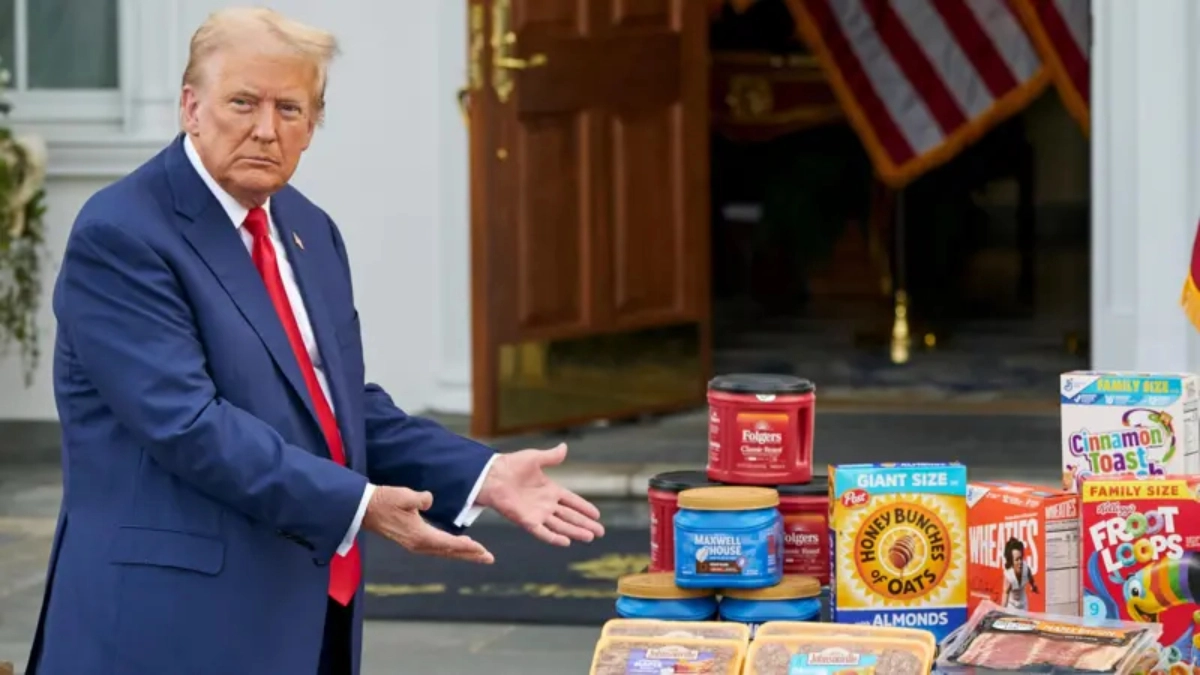
“When I win, I will bring prices down immediately, from day one,” Trump declared, surrounded by packaged food, milk, meat, and eggs, at a press conference in August 2024.
Official data—which includes a four-month period of Biden's presidency—shows that food prices rose by 2.7% in the 12 months to September 2025, with significantly larger increases for some products:
Since Trump took office in January, the data also shows that, with the exception of a dip in April, food prices have risen every month.
“The US president has very little control over food prices, especially in the short term,” Professor David told BBC Verify. Ortega, an expert in food economics.
Trump's tariffs are raising the prices of certain foods, he explained; a third of the coffee consumed in the United States comes from Brazil and is therefore subject to a 50% tariff.
Trump's crackdown on irregular immigration may also have had an impact, Ortega added, especially in agriculture, where it is estimated that up to 40% of workers—around one million people—are undocumented.
Farmers and companies are being forced to raise wages to attract more labor, although at this time there is no data to quantify these impacts in terms of price increases.
Diane Swonk, chief economist at KPMG, believes that changes in tariff and immigration policies have contributed to the increase in costs.
“There is no doubt that these changes are beginning to manifest themselves as inflationary pressures,” she stated.
She added that other factors, such as weather events, have also contributed.
“In the case of coffee, there were weather problems that resulted in a very poor growing season, a situation that was exacerbated by the tariffs imposed on Brazil and Colombia,” she explained.
A White House official told BBC Verify that President Trump does not control weather patterns in South America and that the rise in coffee prices is a global phenomenon.
Coffee data shows that prices rose globally, peaking in February, but are now falling.
The same official indicated that the president is addressing the rise in beef prices by increasing temporarily imports.
And, while food prices have generally risen, not all food items have become more expensive.
When Trump succeeded Biden in January, the price of a dozen large eggs was $4.93, reaching an all-time high of $6.23 in March following outbreaks of avian flu.
Since then, prices have fallen to $3.49 a dozen.
“President Trump’s supply-side policies are keeping Joe Biden’s inflationary crisis in check,” White House spokesman Kush Desai said.
Other items that have decreased in price over the past 12 months include butter and margarine (-2%), ice cream (-0.7%), and frozen vegetables (-0.7%).
Electricity
During his campaign, Trump promised to drastically reduce electricity bills.
“Under my administration, we will cut energy and electricity prices in half within 12 months, 18 at the most,” he declared at a rally in August 2024. However, since he took office, prices have risen. The latest figures show that the average residential electricity rate reached 17.62 cents per kWh (kilowatt-hour) in August 2025, up from 15.94 cents in January 2025, according to the U.S. Energy Information Administration. “It was technically impossible (to cut prices in half) when he made the promise,” said Professor James Sweeney of Stanford’s Precourt Energy Institute. Electricity prices reflect not only the cost of generation but also the cost of distribution through “the wires, transformers, and so on,” he explained.
Professor Sweeney attributes the increase to both supply and demand issues.
“We have a sudden surge in demand, driven primarily by data centers. Those creating images using artificial intelligence consume significant amounts of electricity,” he argued.
He added that cuts to renewable energy subsidies and tariffs on imported steel—which make building new power plants more expensive—have also contributed to the price increase.
Swonk agreed that the rise of AI is driving up prices, especially for people with lower incomes.
He pointed out that “this exacerbates inequality, as consumers with greater access to solar panels and renewable energy tend to be from wealthier households.”
In response, a White House official stated that Trump is promoting power generation from coal, natural gas, and nuclear energy, which, he said, “is the only viable way to meet the growing energy demand and “Reduce energy prices.”
Cars
At a campaign rally in September 2024, Trump extended his promise to lower food prices to cars, telling his supporters, “We’re going to lower the prices… of food, cars, everything.”
However, the average price of a new car surpassed $50,000 for the first time in September, up from $48,283 in January, according to Kelley Blue Book, a U.S. vehicle valuation company.
Vehicle prices typically rise between 2% and 3% annually, explained Erin Keating of Cox Automotive.
“Tariffs, which have been the biggest factor in the auto industry over the past 12 months, have only fueled inflation,” she said.
She explained that new car prices are rising by about 4% annual, and that tariffs contribute at least one percentage point.
“We believe that in 2026 prices will rise even further, as most manufacturers are refraining from raising them directly because of the tariffs, but sooner or later they will have to.”
Keating mentioned the tax breaks for the population included in Trump's spending bill, which, in his opinion, could incentivize the purchase of new cars.
When asked about the rise in car prices, a White House official told BBC Verify that the government has taken historic regulatory steps to “reverse the radical left's energy fraud and save billions annually.”
Gasoline
Trump specifically promised during his campaign to “reduce the price of gasoline to less than $2 a gallon.”
On the day he took office, the average price of a gallon of regular gasoline was $3.125, according to the American Automobile Association (AAA).
Although he is far from fulfilling his promise to lower prices to less than $2, the price of a gallon of gasoline has fallen to a national average of $3.079.
In response, a White House official referred us to a gasoline price comparison website, which shows a national average of $2.97 per gallon, slightly lower than the AAA data.
The official added that President Trump has been rapidly boosting the U.S. economy with the goal of making gasoline affordable again for families across the country.