

Cristiano Ronaldo and Portugal beat the European champions and are crowned in the Nations League
A goal from the Portuguese star, who came off injured late on, sent the game into extra time and Portugal won the match on penalties.
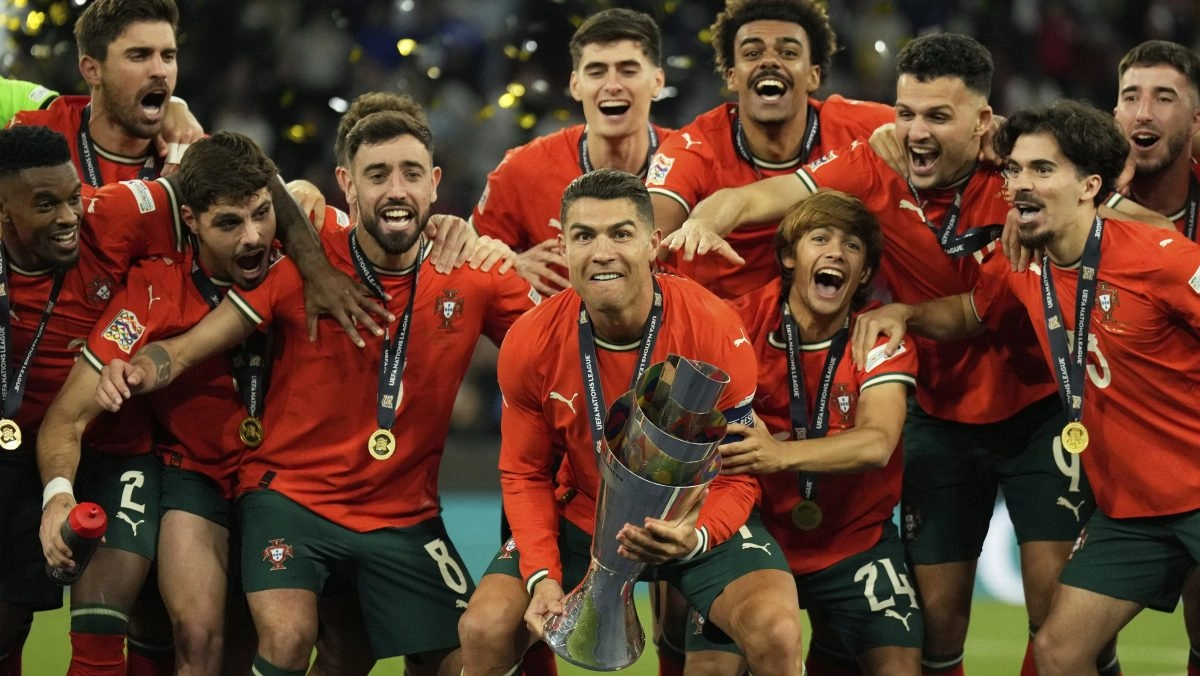

Portugal achieved the unthinkable in the UEFA Nations League final: They twice overcame their own score, sent the game into extra time and were crowned with authority in the penalty shootout. As if that weren't enough, they went down in history as the first team to win the tournament twice.
Spain, the reigning Euro Cup champion, lost the lead twice in the match played at the Allianz Arena in Munich, Germany. La Furia Roja, who this time wore yellow, took the lead early in the match, just 21 minutes in, when Martín Zubimendi scored a rebound to make it 0-1. The Portuguese claimed an offside by Mikel Oyarzabal that the referee did not grant.
Just five minutes later, Portugal responded, equalizing through the boots of Nuno Mendes in another controversial play. Spain claimed an offside by "El Comandante" in the play that the defender finished with a left-footed cross.
Spain's second goal came in the final stretch of the first half through Mikel Oyarzabal and was not without controversy, as the Portuguese thought they saw a foul against Bernardo Silva. Once again, the refereeing team did not rectify their decision.
In the second half, Cristiano, the usual goalscorer, appeared to equalize with a shot inside the six-yard box after a rebound generated from a cross by Nuno Mendes, which the Spanish defense could not control. The Portuguese fans celebrated and then started chanting their idol's name. And every now and then they started chanting it again. It was the 61st minute and there would be no more goals, only those from the penalty shootout. The chants grew louder in the 87th minute when Cristiano Ronaldo sat down in the center circle and had to be replaced by Gonçalo Ramos due to injury. Extra time arrived and the players were trying everything, and the decision could come from any single play. Pedro Porro, for example,I tried to score from midfield when I saw Diogo Costa out of position. On the Portuguese side, Rafael Leao tried one break after another.
A lost ball or something similar could have spelled doom. Both coaches, Luis de la Fuente and Roberto Martínez, had said before the final—and also before the semifinals—that in duels between rivals of a certain caliber, the difference would ultimately come down to the details.
The game had to be decided from the penalty spot. Some might say that in games like this, it's better if there's no winner. But that's something undoubtedly only the so-called neutral spectators say, those of whom Mikel Ozarzábal had said the day before that they were going to really enjoy the game.
A key detail was that the penalties had to be taken on the goal behind which the Portuguese defense was located. Each Spanish penalty taker was greeted with whistles. Each of the takers scored their own, until the fourth for the Spanish team arrived; Morata missed and automatically became the Spanish villain. That penalty saved by Diogo Costa was the final straw that decided an intense final, as Rubén Neves converted the next shot and the Portuguese on the pitch and in the stands erupted with excitement.